Only Harvard Grads need apply

It’s hard to take articles in Slate too seriously, but I have to admit I was quite perplexed about the following article (with the concomitant research publication here).

The main thrust of the article seems to be as follows. A disproportionate number faculty at research universities in the US received PhDs from a small number of prestigious institutions, and hence (?) such hiring practices reflect profound social inequality. Is it just me, or does this appear to be utter bollocks? There is an obvious pair of hypotheses that would completely explain the data, namely:

  1. There is a hierarchical system of admission to graduate programs,
  2. Universities hire the strongest candidates they can, and admit the strongest graduate students they can.

Let’s examine these possibilities in the context of graduate school in mathematics. I have, on several occasions, been responsible for graduate admissions at my institution. I would say, on the whole, that prospective graduate students are among the most class conscious of anyone in academia. I would guess that, at least 75% of the time, a student will accept either the program that is the most highly ranked amongst those where they were admitted or a school within at most one or two places of their highest ranked option.

What about the second hypothesis? The worry here is that universities might view “undergraduate/graduate institution” as a proxy for “quality of candidate.” In my experience (being on hiring committees), this is utterly preposterous. I am not claiming that mathematical judgements are not a slippery thing — there are many variations which relate to matters of taste and inclination — but there are some reasonable objective criteria (GRE scores for graduate applications, publication record for job candidates) which would serve as a check against any implicit bias in this regard.

We here at Persiflage, however, are open to the idea that we may have missed something. So here are some other possibilities:

  1. You are talking about Mathematics, a field for which it is easier to make reliable judgements about the quality of research, and a field for which there is a more pronounced spike in talent at the top of the scale. Is this true? I honestly don’t know. Perhaps whatever field it is that produces papers like the one under consideration is not something for which talent of any kind is an asset, and so there is no real difference between graduates from Harvard or from Podunk U. Less sarcastically, suppose (say) I compare the English department faculty at the top ranked place (taking from this list) Berkeley and compare it to a place also ranked in the top 25 schools but closer to the bottom of that list, say UIUC. Then, if I knew something, could I confidently say that one department is much better than the other?
  2. You are talking about the experience of hiring/admitting students at a Group I university. Perhaps it is the case that, for lower ranked universities, there is insufficient expertise to hire on the basis of talent/output, and so PhD institution serves as a lazy way to evaluate the candidate. This seems to be a somewhat condescending argument, but it’s true that I don’t have any idea how hiring works at non-Group I universities. But surely the letters of recommendation would carry the most weight, and they would reflect the quality of research? At the very least, if you are going to claim this is what happens, you need to come up with a way to substantiate that claim.

Ultimately, I certainly don’t feel that I can rule out bias when it comes to hiring, but the fact that the paper under review uses “prestige” as a dirty word and doesn’t seem to acknowledge in any way that there is some correlation between prestige and quality of graduates is highly disturbing. Perhaps, as with this paper, the main goal is to substantiate the political beliefs of the authors rather than to undertake a serious academic inquiry. Still, even if the methodology is flawed, I would like people’s opinion on the conclusion.

Posted in Politics, Rant | Tagged , | Leave a comment

Review of Buzzard-Gee

This is a review of the paper “Slopes of Modular Forms” submitted for publication in a Simons symposium proceedings volume.

tl;dr: This paper is a nice survey article on questions concerning the slopes of modular forms. Buzzard has given a (very explicit) conjecture which predicts the slopes of classical modular (\(p\)-stabilized) eigenforms of level prime to \(p,\) at least under a certain regularity hypothesis. One consequence is that, under favourable circumstances, all the slopes are integers. The current paper describes the link between this and related problems to the \(p\)-adic Langlands program, as well as raising several further intriguing questions concerning the distributions of these slopes. The paper is well written, and is a welcome addition to the literature. I strongly recommend that this paper be accepted.

Review: Buzzard’s slope conjectures live somewhere in the world between 19th and 21st century mathematics. Suppose that one considers the space of over-convergent cusp forms of level \(N = 1\) for \(p = 2.\) Then, using nothing more than classical identities between modular functions, one may prove that the smallest eigenvalue of the compact operator \(U_2\) is at most \(\|2^3\|_2 = 1/8.\) On the other hand, it is now a “folklore” conjecture (Conjecture 4.1.1 of the paper under review) that, if \(p\) is odd and \(f\) is a classical modular form of level \(\Gamma_0(N)\) prime to \(p\), then the residual representation:

\(\overline{\rho}: G_{\mathbf{Q}} \rightarrow \mathrm{GL}_2(k)\)

is irreducible locally on the decomposition group at \(p\) whenever the valuation of \(a_p\) is not an integer. This problem seems to be a deep question in the p-adic Langlands program for \(\mathrm{GL}_2(\mathbf{Q}_p).\) The two cases where this is known, \(v(a_p) < 1\) and \(v(a_p)\) sufficiently large, both require machinery from p-adic Hodge theory — in the former case, one needs the full local Langlands correspondence for \(\mathrm{GL}_2(\mathbf{Q}_p).\)

Comments: Here are some comments given in some order that bears little relation to the actual paper.

  • I don’t like the table on page 6, in particular, because certain ranges of numbers are bunched together, the output looks a little strange. Can one improve this in some way? Perhaps finish at \(3^{10}?\) Perhaps include only selected powers bigger than \(3^{10}?\) Perhaps normalize for the length of the range?
  • Corollary 5.1.2. Do you want to speculate on what happens in the reducible case? In some sense, in Buzzard’s conjecture, one doesn’t see the fact that the residual representations are globally reducible or not. On the other hand, weird stuff certainly happens for \(p = 2,\) as previously mentioned here. What happens in the reducible case for \(p = 3?\)
  • Conjecture 4.1.1 demands that \(k\) is even, but that is a consequence of the level being of the form \(\Gamma_0(N)\) — something which is noted immediately after the statement. So why include the condition in the statement of the conjecture? Also, perhaps it’s also worth remarking upon the case when \(a_p\) is a unit.
  • The authors (in Remark 4.1.3) point to the origins of this Conjecture 4.1.1 to around 2005. However, I feel like I remember some discussion of this conjecture in the Durham symposium of 2004. There were certainly hints of this conjecture on «la serviette de Kisin», upon which Mark gave a heuristic local argument for why the Eigencurve was proper — although the argument was slightly dodgy in that it collapsed if the napkin was rotated 90 degrees. (Of course, Mark was proved right when Hansheng Diao and Ruochuan Liu did indeed prove this result using local methods here.) Also, isn’t Conjecture 4.1.1 a consequence of Buzzard’s original conjecture as modified by Lisa Clay? Somehow it seems to me that what Remark 4.1.3 is referring to is the idea that Conjecture 4.1.1 is a consequence of a purely local conjecture, and refers to the period (2005?) when Breuil was formulating the first versions of the p-adic Langlands program.
  • For Conjecture 4.2.1, wouldn’t it make more sense to normalize the valuation in terms of the coefficient field \(\mathbf{Q}_p(\chi),\) so the statement once more becomes that \(a_p\) has integral valuation?
  • Why is the condition on Buzzard’s conjecture different when \(p = 2?\) (I understand it has to be modified in order to have a chance of being true, but I am asking if there is any explanation for why this is necessary.)
  • The authors remark (p.3) that it is not known whether there are infinitely many Buzzard irregular primes. Here is a short argument to prove that this is a consequence of standard conjectures of prime values of polynomials. We start with the observation that the first Buzzard irregular prime is \(p =59,\) and that the offending representation:

    \(\rho_{Q \Delta} : G_{\mathbf{Q}} \rightarrow \mathrm{GL}_2(\mathbf{F}_{59})\)

    has exceptional image in the context of Serre and Swinnerton-Dyer (On l-adic representations and congruences for coefficients of modular forms, Antwerp III). Indeed, this particular example features prominently in that paper. I always thought this was not an entirely random coincidence, and since it seems relevant here, I thought I would finally bother to figure out what is going on. (For the next prime, \(p = 79,\) the corresponding representation has image containing \(\mathrm{SL}_2(\mathbf{F}_{79}),\) so it is somewhat of an accident.) The mod-59 representation above has projective image \(S_4.\) Now suppose that \(p \equiv 3 \mod 4\) is a prime such that \(H/\mathbf{Q}\) is an \(S_4\)-extension which is unramified away from \(p.\) Such a representation will give rise (following an argument of Tate) to a mod-\(p\) representation of \(\mathbf{Q}\) which is unramified away from \(p.\) The congruence condition on \(p\) implies that it will be odd, and hence modular, by Langlands-Tunnell. Now let us suppose, in addition, that \(4\) divides the ramification index \(e_p.\) Under this assumption, the representation cannot be locally reducible, because the ramification index of any power of the cyclotomic character divides \(p-1 \equiv 2 \mod 4.\) Hence, if there are infinitely many such fields, there are infinitely many \(\mathrm{SL}_2(\mathbf{Z})\)-irregular primes. Consider the following fields studied by Darrin Doud (here):

    \( \displaystyle{K = \mathbf{Q}[u]/f(u), \quad f(u) = (u + x)^4 – p^* u},\)

    \( \displaystyle{(-1)^{(p-1)/2} p = p^* =
    \frac{256 x^3 – y^2}{27}, \quad p^* \ne 1 + 4x}.\)

    Doud shows that \(K\) has discriminant \((p^*)^3\) and Galois group \(S_4,\) and it is easy to see that the splitting field \(H/\mathbf{Q}\) has all the required properties needed above as long as \(p \equiv 3 \mod 4.\) The formula relating tame ramification and the discriminant implies that \(e_p(K/\mathbf{Q}) = 4.\) Standard conjectures now predict that there are infinitely many such primes of this form — if \(y\) is odd, then \(p^* < 0.\) The first few such primes which are \(3 \mod 4\) are

    \(59, 107, 139, 283, \ldots \)

    which compares with the first few Buzzard irregular primes (taken from Buzzard's paper):

    \(59, 79, 107, 131, 139, 151, 173 \ldots \)

    On the other hand, an unconditional proof by these means seems out of reach, because any modular \(S_4\)-extension unramified outside \(p \equiv 3 \mod 4\) forces \(\mathbf{Q}(\sqrt{-p})\) to have class number divisible by \(3,\) and we don't know if there exist infinitely many such primes.

Posted in Mathematics | Tagged , , , , , , , , , , , , , , , | 8 Comments

Random Photos

Lunt Hall, the Northwestern mathematics building,  recently underwent an upgrade of the fire alarm system. This includes introducing informative new signage, such as the following:

Sign

Another change is that the “internal” window to my office was boarded up. The window overlooked the internal stairwell and had previously been covered up with posters, but I always had the idea of removing them and using the window for office hours; students would look up at the window and ask questions, and I would offer them Delphic pronouncements in return. Alas, I will no longer be able to do this. Here’s a picture from the brief period between when the posters were removed and the window was boarded up; the photo is taken from the top of the stairs; the spot directly next to the window is a couple of feet lower:

office

Finally, I haven’t yet managed to get around to blogging about the Sarnak conference! So here at least is a picture, which is an action shot of me advocating (unsuccessfully, it turns out) for a certain paper to be accepted into Duke. (Pictured are Jonathan Wahl (Duke supremo), RLT, and me.)

Finally, here is an amusing box of free books I occasionally pass when I walk to work:

Tardis

Posted in Waffle | Tagged , , , , , , , | Leave a comment

H_2(Gamma_N(p),Z)

In this post (which is a follow-up to the last post), I wanted to compute the group \( H_2(\Gamma_N(p),\mathbf{Z})\), where \( \Gamma_N(p)\) is the congruence subgroup of \( \mathrm{SL}_N(\mathbf{Z})\) for large enough \( N\) and \( p\) is prime. In fact, to make my life easier, I will also assume that \( p > 3,\) and in addition, ignore \( 2\)-torsion. The first problem is to compute the prime to \( p\) torsion. By Charney’s theorem, this will come from the cohomology of the homotopy fibre \( X\) of the map

\( \displaystyle{ SK(\mathbf{Z}) \rightarrow SK(\mathbf{F}_p).}\)

The relevant part of the Serre long exact sequence is, using classical computations of the first few K-groups of the integers together with Quillen’s computation of \( K_*(\mathbf{F}_p),\)

\( \displaystyle{ 0 \rightarrow \pi_3(X) \rightarrow \mathbf{Z}/48 \mathbf{Z} \rightarrow
\mathbf{Z}/(p^2 – 1) \mathbf{Z} \rightarrow \pi_2(X) \rightarrow \mathbf{Z}/2 \mathbf{Z}
\rightarrow 0.}\)

Here is where it is convenient to invert primes dividing \( 6;\) from Hurewicz theorem and Charney’s theorem we may deduce that, where \( \sim\) denotes an equality up to a finite group of order dividing \( 48,\)

\( \displaystyle{ H_2(\Gamma_N(p),\mathbf{Z}[1/p]) \sim \mathbf{Z}/(p^2 – 1) \mathbf{Z}.}\)

In order to deal with \( 3\)-torsion, then we also have to show that the map \( K_3(\mathbf{Z}) \otimes \mathbf{Z}/3 \mathbf{Z} \rightarrow K_3(\mathbf{F}_p)\) is injective for \( p \ne 3.\) I have a sketch of this which I will omit from this discussion but it is not too hard (assuming Quillen-Lichtenbaum). It remains to compute the homology with coefficients in \( \mathbf{Z}_p\). I previously computed that there was an isomorphism

\( \displaystyle{ H_2(\Gamma_N(p),\mathbf{F}_p) = \wedge^2 \mathfrak{g} \oplus \mathbf{F}_p
= H_2(G_N(p),\mathbf{F}_p) \oplus \mathbf{F}_p,}\)

where \( G_N = \mathrm{SL}_N(\mathbf{Z}_p)\) and \( \mathfrak{g} = H_1(\Gamma_N(p),\mathbf{F}_p)\) is the adjoint representation.

Some facts concerning the cohomology of \( G_N(p)\):

There are short exact sequences:

\( \displaystyle{ 0 \rightarrow H_2(G_N(p),\mathbf{Z}_p)/p \rightarrow H_2(G_N(p),\mathbf{Z}/ p \mathbf{Z})
\rightarrow H_1(G_N(p),\mathbf{Z}_p)[p] \rightarrow 0,}\)

\( \displaystyle{ 0 \rightarrow H_2(G_N(p),\mathbf{Z}_p)/p^2 \rightarrow H_2(G_N(p),\mathbf{Z}/ p^2 \mathbf{Z})
\rightarrow H_1(G_N(p),\mathbf{Z}_p)[p^2] \rightarrow 0.}\)

Since \( H_1(G_N(p),\mathbf{Z}_p) = \mathfrak{g}\) is annihilated by \( p,\) we may deduce that

\( \displaystyle{ H_2(G_N(p),\mathbf{Z}_p)/p = H_2(G_N(p),\mathbf{Z}_p)/p^2}\)

as long as

\( \displaystyle{ |H_2(G_N(p),\mathbf{Z}/p^2 \mathbf{Z}) | = | H_2(G_N(p),\mathbf{Z}/ p \mathbf{Z})|.}\)

Such an equality (for any group) is a claim about the Bockstein maps having a big an image as possible. Indeed, for any group \( \Phi,\) there is an exact sequence:

\( \displaystyle{ H_3(\Phi,{\mathbf{Z}}/p {\mathbf{Z}}) \rightarrow H_2(\Phi,{\mathbf{Z}}/p {\mathbf{Z}}) \rightarrow H_2(\Phi,{\mathbf{Z}}/p^2 {\mathbf{Z}})
\rightarrow H_2(\Phi,{\mathbf{Z}}/p {\mathbf{Z}}) \rightarrow H_1(\Phi,{\mathbf{Z}}/p {\mathbf{Z}})}\)

The first and last maps here are the Bockstein maps \( \beta_2\) and \( \beta_1\). Since \( p\) is odd, \( \beta_1 \circ \beta_2 = 0\). On the other hand, we see that the orders of the cohomology groups with coefficients in \( \mathbf{Z}/p \mathbf{Z}\) and \( \mathbf{Z}/p^2 \mathbf{Z}\) will have the same order if and only if

\( \displaystyle{ \ker(\beta_1) = \mathrm{im}(\beta_2).}\)

Hence we have reduced to the following claim. Take the complex

\( \displaystyle{ H_*(G_N(p),\mathbf{F}_p) = \wedge^* \mathfrak{g} }\)

where the differentials are given by the Bockstein maps. Then we have to show that the cohomology of this complex vanishes in degree two. But what are the Bockstein map is in this case? Note that since \( H_1(G_N(p),\mathbf{Z}_p) = \mathfrak{g}\) is annihilated by \( p\), the Bockstein map \( \beta_1\) will be a surjective map:

\(\displaystyle{ \beta_1: \wedge^2 \mathfrak{g} \rightarrow \mathfrak{g}.}\)

To compute this explicitly, recall that the isomorphism \( H_1(G_N(p),{\mathbf{Z}}_p) = \mathfrak{g}\) comes from the identification of \( \mathfrak{g}\) with \( G_N(p)/G_N(p^2).\) Then, computation omitted due to laziness, we find that the Bockstein is precisely the Lie bracket. Moreover, since the (co-)homology is generated in degree one, the higher Bockstein maps can be computed from the first using the cup product formula. So the Bockstein complex above is, and I haven’t checked this because it must be true, the complex computing the mod-\( p\) Lie algebra cohomology of \( \mathfrak{g}\). And this cohomology vanishes in degrees one and two, so we are done. One consequence of this computation is that

\( \displaystyle{ H_2(G_N(p),\mathbf{Z}_p) = H_2(G_N(p),\mathbf{Z}_p)/p}\)

is annihilated by \( p.\) Moreover, the last term can be identified with the kernel of the Lie bracket (Bockstein) on \( H_2(G_N(p),\mathbf{F}_p) = \wedge^2 \mathfrak{g}.\)

Returning to the main computation:

From the Hochschild–Serre spectral sequence and the computation of stable completed cohomology, one has an exact sequence:

\( \displaystyle{ 0 \leftarrow H_2(G_N(p),\mathbf{Z}_p) \leftarrow H_2(\Gamma_N(p),\mathbf{Z}_p) \leftarrow \mathbf{Z}_p \leftarrow H_3(G_N(p),\mathbf{Z}_p).}\)

From known results in characteristic zero, we immediately deduce that there is some \( \alpha\) such that there is an exact sequence

\( \displaystyle{ 0 \leftarrow H_2(G_N(p),\mathbf{Z}_p) \leftarrow H_2(\Gamma_N(p),\mathbf{Z}_p) \leftarrow \mathbf{Z}/p^{\alpha} \mathbf{Z} \leftarrow 0.}\)

we also deduce that there is an exact sequence:

\( \displaystyle{ 0 \leftarrow H_2(G_N(p),\mathbf{Z}/p^n \mathbf{Z}) \leftarrow H_2(\Gamma_N(p),\mathbf{Z}/p^n \mathbf{Z}) \leftarrow \mathbf{Z}/p^{\mathrm{min}(\alpha,n)} \mathbf{Z} \leftarrow 0,}\)

There are spectral sequences:

\( \displaystyle{ H_i(\mathrm{SL}_N(\mathbf{F}_p),H_j(\Gamma_N(p),A)) \Rightarrow H_{i+j}(\Gamma_N,A)}\)

for \( A = \mathbf{Z}/p^n \mathbf{Z}\) and \( A = \mathbf{Z}_p.\)
For both of these rings, we have

\( \displaystyle{ H_1(\Gamma_N(p),A) = \mathfrak{g}, \qquad H_0(\Gamma_N(p),A) = A.}\)

Moreover, for sufficiently large \( N,\) we have

\( \displaystyle{ H_i(\mathrm{SL}_N(\mathbf{F}_p),A) = 0,}\)

this follows from and is equivalent to Quillen’s computation which implies that the \( K\)-groups of finite fields have order prime to \( p.\) Since \( H_2(\mathrm{SL}_N(\mathbf{Z}),\mathbf{Z}_p)\) is trivial for \( p > 2,\) we deduce that

\( \displaystyle{ H_0(\mathrm{SL}_N(\mathbf{F}_p),H_2(\Gamma_N(p),A)) = H_2(\mathrm{SL}_2(\mathbf{F}_p),\mathfrak{g}) = \mathbf{F}_p,}\)

where the last equality was already used in my paper. The compatibility of the spectral sequence above for different \( A\) implies that we also get an isomorphism

\( \displaystyle{ H_0(\mathrm{SL}_N(\mathbf{F}_p),H_2(\Gamma_N(p),\mathbf{Z}_p))
= H_0(\mathrm{SL}_N(\mathbf{F}_p),H_2(\Gamma_N(p),\mathbf{Z}/p \mathbf{Z})).}\)

On the other hand, the invariant class must be an element of order \( p\) in

\( \displaystyle{ \mathbf{Z}/p^{\alpha} \mathbf{Z};}\)

and hence the reduction map

\( \displaystyle{ \mathbf{Z}/p^{\alpha} \mathbf{Z} \rightarrow \mathbf{Z}/p \mathbf{Z}}\)

sends an element of order \( p\) to an element of order \( p,\) and so \( \alpha = 1.\)

Putting things back together:

Assembling all the pieces, we see that we have proven the following:

Theorem: Let \( p > 3,\) and let \( N\) be sufficiently large. Let \( \mathfrak{g}\) be the Lie algebra \( \mathfrak{sl}_N\) over \( \mathbf{F}_p.\) Then, up to a finite group of order dividing \( 48,\) we have

\( \displaystyle{ \displaystyle{ H_2(\Gamma_N(p),\mathbf{Z}) \sim \mathbf{Z}/(p^2 – 1) \mathbf{Z} \oplus \mathbf{Z}/p \mathbf{Z}
\oplus \ker \left( [\ , \ ] \wedge^2 \mathfrak{g} \rightarrow \mathfrak{g} \right)}.}\)

Moreover, still with \( p > 3,\) then up to a group of order dividing \( 16,\) we should have the same equality with \( p^2 – 1\) replaced by \( (p^2 – 1)/3.\)

Posted in Mathematics | Tagged , , , , , , | Leave a comment

Stable completed homology without Quillen-Lichtenbaum

Having just made (hopefully) the final revisions on my paper on stable completed cohomology groups, I wanted to record here a few remarks which didn’t otherwise make it into the paper.

The first is that, in addition to the result that \(\widetilde{H}_2(\mathrm{SL},\mathbf{Z}_p) = \mathbf{Z}_p\) for \(p > 2,\) one may also compute \(\widetilde{H}_3(\mathrm{SL},\mathbf{Z}_p)\) for \(p > 3.\) Namely:

\(\displaystyle{\widetilde{H}_3(\mathrm{SL},\mathbf{Z}_p) = 0.}\)

This result is proved in the paper up to a finite group, so the point here is the integral refinement. The computation of \(\widetilde{H}_2\) comes from the Hurewicz isomorphism

\(\displaystyle{\pi_2(SK(\mathbf{Z},\mathbf{Z}_p);\mathbf{Z}_p) \simeq \widetilde{H}^{\mathrm{cont}}_2(\mathbf{Z}_p)}.\)

However, the Hurewicz theorem also gives an epimorphism

\(\displaystyle{\pi_3(SK(\mathbf{Z},\mathbf{Z}_p);\mathbf{Z}_p) \rightarrow \widetilde{H}^{\mathrm{cont}}_3(\mathbf{Z}_p)},\)

and one finds that the first group lives in an exact sequence

\(H^2(\mathbf{Q}_p,\mathbf{Z}_p(2)) \rightarrow \pi_3(SK(\mathbf{Z},\mathbf{Z}_p);\mathbf{Z}_p) \rightarrow K_3(\mathbf{Z}) \otimes \mathbf{Z}_p\)

Since both flanking groups vanish for \(p > 3\), the middle group is zero, and the claim follows.

The second remark is that, throughout the paper, I assume the Quillen-Lichtenbaum conjecture, which is now a theorem due do Voevodsky and others. However, I must confess, I do not have the fine details of the argument at my fingertips. How much can one say without it? The answer is quite a lot. Due to work of Borel, Soulé, and Quillen (all of which is much more familiar to me, at least relatively speaking), we know that the \(K\)-groups of number fields are finitely generated abelian groups, we know their ranks, and we know that the Chern class maps to the appropriate Galois cohomology groups are surjective. Moreover, we understand \(K_2(\mathscr{O}_F)\) completely in terms of Galois cohomology by work of Tate. (In this game, I am also giving up the results of Hesselholt and Masden on the \(K\)-theory of local fields, and instead using the results of Wagoner, which similarly give everything in very small degree and up to a finite group in higher degrees.)

In particular:

  1. The computation of \(H_2(\Gamma_N(p),\mathbf{F}_p)\) for large \(N\), where \(\Gamma_N(p)\) is the principal congruence subgroup of \(\mathrm{GL}_N(\mathbf{Z})\), is unaffected. This also uses the computation of \(K_3(\mathbf{Z})\) by Lee and Szczarba.
  2. The identification of the completed \(K\)-groups with Galois cohomology groups still holds up to a finite group.
  3. The computation of the rational stable completed homology groups\(\widetilde{H}_*(\mathrm{SL},\mathbf{Z}_p) \otimes \mathbf{Q} = \mathbf{Q}[x_2,x_6,x_{10},x_{14}, \ldots ]\)under the assumption that either \(p\) is regular or \(\zeta_p(3), \zeta_p(5), \zeta_p(7)\) etc. are all non-vanishing still holds.

Something that does require Quillen-Lichenbaum is the vanishing of the partially completed \(K\)-group for very regular primes.

Regarding the computation of the rational stable completed homology groups, the referee made a very interesting point (I will come back in a later post to the refeering of this paper and some other of my recent papers in a post on “what a great referee report should be”). I prove that the rational stable completed homology groups are the continuous homology of the homotopy fibre

\(SK(\mathbf{Z},\mathbf{Z}_p) \rightarrow SK(\mathbf{Z}) \rightarrow SK(\mathbf{Z}_p)\)

(The definition of \(SK(\mathbf{Z},\mathbf{Z}_p)\) is just homotopy fibre of this map.) Now \(SK(\mathbf{Z},\mathbf{Z}_p)\) is an infinite loop space, which under the assumption that \(p\) is regular or on the non-vanishing of the \(p\)-adic zeta function at integral arguments, has the property that the homotopy groups with coefficients \(\pi_n(SK(\mathbf{Z},\mathbf{Z}_p);\mathbf{Z}_p)\) are rationally non-zero in exactly degrees \(2,6,10\), etc. The referee noted that the computation of rational stable completed homology should follow precisely from this description using the Milnor–Moore theorem, which shows that (for simply connected \(H\)-spaces) that the homology is (rationally) the universal enveloping algebra of the rational homotopy classes (and so, in particular, the Hurewicz map is rationally injective). One consequence is that the rational homotopy groups are precisely the primitive classes in rational homology. To orient the reader, this is exactly the theorem which allowed Borel to compute the rational \(K\)-groups of (rings of integers) of number fields from his computation of stable homology over \(\mathbf{Q}\). Now I was a little worried about this, because the Milnor–Moore theorem does not literally apply, since one is comparing here homotopy groups with coefficients in \(\mathbf{Z}_p\) and continuous homology (the latter is just the inverse limit of homology groups modulo \(p^n\)). However, having looked at the argument in Milnor–Moore and then having Paul Goerss explain it to me, the argument does indeed seem to simply work in this case. (Warning, this is a weaker statement than saying I checked the details.)

To be more precise, suppose that \(G\) is a simply connected infinite loop space, and suppose that \(G\) has the property that the groups \(\pi_n(G;\mathbf{Z}/p^k)\) are finite for all \(n\) and \(k\), so \(\pi_n(G;\mathbf{Z}_p)\) is the inverse limit of these groups. There is a pairing

\([,]: \quad \pi_r(G,\mathbf{Z}/p^k) \otimes \pi_s(G,\mathbf{Z}/p^k)\rightarrow \pi_{r+s}(G,\mathbf{Z}/p^k),\)

which, after taking inverse limits in \(k\) and tensoring with \(\mathbf{Q}\), makes \(\pi_*(G,\mathbf{Z}_p) \otimes \mathbf{Q}\) into a Lie algebra over \(\mathbf{Q}_p\), then the Hurewicz map will induce an isomorphism

\(U(\pi_*(G,\mathbf{Z}_p) \otimes \mathbf{Q}) \rightarrow H^{\mathrm{cont}}_*(G,\mathbf{Q}_p):= \lim H_*(G,\mathbf{Z}/p^k) \otimes \mathbf{Q}\)

of Hopf algebras. The key technical point required here is to define the appropriate pairing on homotopy groups with coefficients, which is done by Neisendorfer. (If \(G\) is simply connected infinite loop space, one doesn’t have to worry about the issue of homotopy groups with coefficients in very low degree exhibiting certain pathologies.)

As another example of this, one can take \(G = SK(\mathbf{Z}_p)\). In this case, the rational continuous homology reduces, by work of Lazard, to lie algebra cohomology, and gives an exterior algebra in odd degrees \(> 1\). So \(SK_n(\mathbf{Z}_p;\mathbf{Z}_p) \otimes \mathbf{Q}\) has dimension one in odd degrees \(> 1\) and is zero for all even positive degrees. This is a result of Wagoner. In fact, Wagoner proves something slightly stronger, also capturing some information away from \(p\). To do this, he also proves a version of the Milnor–Moore theorem, but his assumptions are more stringent than what we discuss above.

Posted in Mathematics | Tagged , , , , , , , , | 2 Comments

Inverse Galois Problems II

David Zywina was in town today to talk about a follow up to his previous results mentioned previously on this blog. This time, he talked about his construction of Galois groups which were simple of orthogonal type, in particular, the simple groups

\(\Omega(V) \subset \mathrm{SO}(V) \subset \mathrm{O}(V)\)

where \(V\) is a vector space \(V\) over \(\mathbf{F}_l\) of odd dimension at least five. The group \(\Omega(V)\) here is a simple group of index two inside \(\mathrm{SO}(V).\) In the special case when \(n = 5,\) there is an exceptional isomorphism

\(\Omega(V) \simeq \mathrm{PSp}_4(\mathbf{F}_l).\)

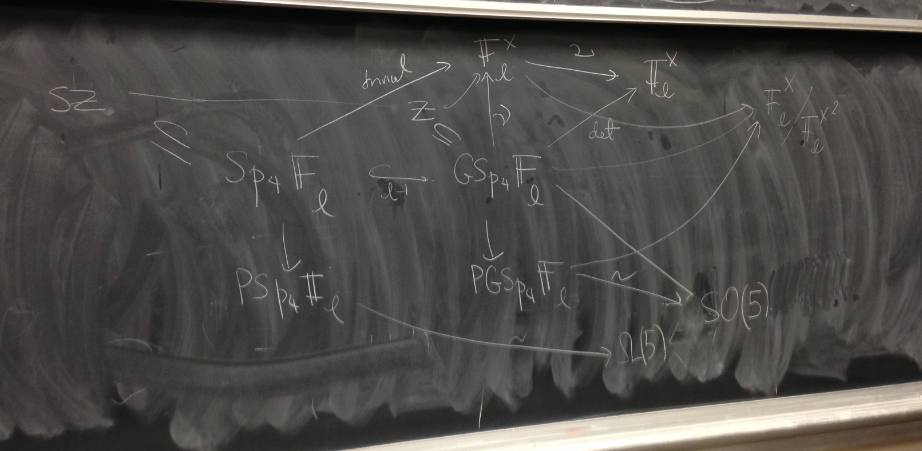
In constrast to his constructions of number fields with Galois group \(\mathrm{PSp}_2(\mathbf{F}_l),\) Zywina actually constructs a family of compatible families whose residual image is generically \(\Omega(V).\) When David told me about this construction (scribbled on a piece of paper) in Frankfurt airport on the way back from Oberwolfach, I was troubled by something which I shall now explain. Without saying so much about the construction (you can read about it here), the compatible families of Galois representations of interest occur inside \(H^2(X_T,\mathbf{Q}(1))\) for a carefully chosen family of non-isotrivial elliptic sufaces \(X.\) As David explained in his talk today, the zero section and the fibres of bad reduction contribute a large Galois trivial summand to \(H^{1,1},\) and the remaining piece is five dimensional. What disturbed me at the time was that this construction was surely liftable to a compatible family of four dimensional representations with generalized symplectic image. After all, Tate’s result on \(H^2(G_{\mathbf{Q}},\mathbf{C}^{\times})\) guarantees that one can lift any projective representation with image in \(\mathrm{PSp}_4(\mathbf{F}_l)\) to a genuine generalized symplectic representation. This representation should then come from a Siegel modular form, since all oddness conditions should be automatic. On the other hand, if you want a family of Galois representations giving rise to a family of Siegel modular forms, especially one for which the maximal difference between any two Hodge-Tate weights in \(\wedge^2 W\) is two, then you expect that they have to come from a family of abelian surfaces, or at least abelian varieties \(A\) of dimension \(2n\) with endomorphisms by the ring of integers in a totally real field of degree \(n.\) However, there is an obstruction to making this work — the corresponding Galois representations will have Hodge-Tate weights \([0,0,1,1],\) and they will have similitude character that is an even finite order character times the cyclotomic character. It’s easy to see that for such a family, the residual representations will (at least half the time) land in \(\mathrm{PGSp}_4(\mathbf{F}_{l})\) and not in the simple index two subgroup, similar to what happens for modular forms of weight two. I thought at the time that I must have been making some group theory error, so after today’s talk we sorted out the details:

PSp_4

In the process of this computation, however, I realized what my error actually was. I was imagining that the original compatible family of Galois representations in \(H^2\) had Hodge-Tate weights \([0,1,1,1,2],\) but they could equally have had Hodge-Tate weights \([0,0,1,2,2].\) And in this latter case, the Galois representation (up to twist) of the corresponding Siegel modular form in \(\mathrm{GSp}_4\) will have Hodge-Tate weights \([-1,0,0,1].\) In particular, we are not looking for classical Siegel modular forms of low weight, but the nasty Siegel modular forms which do not contribute to holomorphic limits of discrete series and only occur in coherent cohomology via \(H^1\) or \(H^2.\) (A reference for this fact is George Boxer’s talk in Barbados.) And now everything makes sense! That is, if you have a family of Galois representations with Hodge Tate weights \([-1,0,0,1]\) and quadratic similitude character, then (with some good luck) you can really have projective representations which land in the right simple group for all but finitely many \(l.\)

A related point: when lifting projective representations using Tate’s theorem, one may have to increase the size of the residue field. In fact, when \(\ell \equiv 3 \mod 4,\) it will not be possible to lift an odd \(\mathrm{PSp}_4(\mathbf{F}_l)\) representation to one in \(\mathrm{GSp}_4(\mathbf{F}_l)\) (there is an obstruction at infinity). Indeed, the natural lift is the group \(\mathrm{Sp}_4(\mathbf{F}_l)\) together with a scalar matrix \(I\) with \(I^2 = -1.\) This suggests what the picture should be motivically: there should be an eight dimensional piece of \(H^2(Y)\) (for some \(Y)\) which admits an involution breaking the representation up into two four dimensional pieces, and these pieces will have coefficients in \(\mathbf{Q}(\sqrt{-1}).\) Can one find such a \(Y\) explicitly? This does remind me of the motivic lifting problems that Stefan Patrikis knows about.

From this analysis, it also becomes clearer why Zywina could find a family of compatible families with residual image \(\Omega(V)\) when \(\mathrm{dim}(V)\) is odd and at least five, but only isolated examples of compatible families with residual projective image \(\mathrm{PSL}_2(\mathbf{F}_l) \simeq \Omega(V)\) with \(\mathrm{dim}(V) = 3.\) In the latter case, the corresponding modular forms will be forced to have odd weight \(k > 1,\) and so the Hodge-Tate weights will differ by at least two, and so Griffiths’ theorem implies that they should not deform in a family. On the other hand, if you want to look for Siegel modular forms which could possibly correspond to geometric families, and you want the similitude character to be an even power of the cyclotomic character times a finite character, then it is possible to escape the specter of Griffiths on your shoulder, but only barely — you will be pretty much forced to work with forms whose HT weights are \([-1,0,0,1].\) Of course, I’m not sure I can prove that any Siegel modular forms of this kind actually exist! (insisting the Mumford-Tate group is big, naturally). My proposal in the previous post to look for these representations using Siegel modular forms would also have only found sporadic compatible families, because to ensure computability and the determinant condition I suggested looking in weights where the Galois representation was regular and had HT weights something like \([0,1,3,4],\) — the gap being necessary to make the multiplier character a square of a Hodge-Tate character.

There is one check left on these musings (though I’m sure it must be correct), namely, that for the surface \(X\) in 1.4 of Zywina’s paper, one should have

\(h^{2,0}(X) = 2.\)

Update: Here’s a proof of this statement:

Proof: The Hodge diamond of a minimal elliptic surface \(\pi: X \rightarrow C\) was computed by Miranda, see IV.1.1 here; I’ll try to give a self contained argument. Let \(\omega_E\) be the Euler characteristic of \(\mathcal{O}_X.\) Let \(L^{-1}\) be the bundle \(L^{-1} = R^1 \pi_* \mathcal{O}_X\) on \(X;\) it is a line bundle because the fibres are elliptic curves, so it makes sense to talk about \(L.\) The bundle \(L\) has positive degree if and only if the fibration is not isotrivial (this is not so hard, but let me give the proof of III.1.6 of Miranda as a reference); let us assume this is the case. From the Leray spectral sequence, there is an exact sequence

\(0 \rightarrow H^1(C,\pi_* \mathcal{O}_X) \rightarrow H^1(X,\mathcal{O}_X) \rightarrow H^0(C,L^{-1}) \rightarrow H^2(C,\pi_* \mathcal{O}_X)\)

Since \(\pi_* \mathcal{O}_X = \mathcal{O}_C,\) the first term has dimension \(g,\) the genus of \(C.\) Since we are assuming that \(L\) has positive degree, the third term is also zero, and hence the irregularity of a non-isotrivial elliptic surface is

\(H^1(X,\mathcal{O}_X) = g.\)

It follows that

\(\chi(\mathcal{O}_X) = h^{0,0} – h^{1,0} + h^{2,0} = 1 – g + h^{2,0}.\)

In our particular case, the genus of \(C\) is zero. On the other hand, as noted in 2.4 of Zywina’s paper, the degree of the minimal discriminant is \(12 \cdot \chi_E = 12 \cdot \chi(\mathcal{O}_X).\) In the example at hand, Zywina computes (see section 8) that \(\chi_E = 3,\) and so

\(h^{2,0} = 3 – (1-g) = 3 – 1 = 2.\)

Posted in Mathematics | Tagged , , , , , , | Leave a comment

Abelian Spiders

This is a blog post about the thesis of my student Zoey Guo, who is graduating this year. (For a blog post on the thesis of my other student graduating this year, see this.)

Let \(\Phi\) be a finite graph. Associated to \(\Phi\) is an adjacency matrix \(M\) such that the largest eigenvalue \(\lambda\) is totally real. Let us call \(\Phi\) abelian if the extension \(\mathbf{Q}(\lambda^2)\) is abelian. For example, all the Dynkin diagrams are abelian.

Several years ago, Scott Morrison and Noah Sydner (of secret blogging seminar fame) asked the following question. Given a finite graph \(\Gamma\), let \(\Gamma_n\) be the graph obtained by adjoining a 2-valent tree of length \(n\) to some fixed vertex \(v\) of \(\Gamma.\) Then can one classify all \(n\) for which \(\Gamma_n\) is abelian? It turns out \(\Gamma_n\) can be abelian for only finitely many \(n,\) unless the graphs \(\Gamma_n\) happen to be one of the two infinite families of Dynkin diagrams. The argument was effective, although not effectively effective. (We did, however, prove a slightly weaker theorem which was sufficient for the intended application which was effectively effective.)

What Zoey does in her thesis is consider the following generalization. Let \(\Gamma\) be a finite graph, and choose \(k\) vertices \(v_i\) of \(\Gamma.\) Now adjoin \(k\) two-valent graphs of varying lengths \(\underline{n} = \{n_i\}\) to latex \(v_i\). Call the resulting graph a \(k\)-spider graph. The main result of her thesis is the following:

Theorem: For any \(\Gamma\) and any fixed \(k\), only finitely many of the corresponding spiders are both abelian and not Dynkin diagrams.

What is more, the theorem is effectively effective. One key ingredient in the finiteness results for \(k = 1\) was the fact that, for characteristic polynomials \(P_n(X)\) of the graphs \(\Gamma_n,\) one can control the factors corresponding to Chebyshev polynomials. Or, if one writes

\(Q_n(t) = P_n(t + t^{-1}),\)

one can control the cyclotomic factors of \(Q_n(t).\) This follows from a theorem of Hironaka-Gross-McMullen, who exploit results by Mann on vanishing sums for roots of unity. However, when \(k \ge 2\), this breaks down completely. In fact, in many examples, the corresponding polynomials \(P_{\underline{n}}(t+t^{-1})\) will be divisible by cyclotomic polynomials of arbitrarily large degree. Here’s an example which Zoey pointed out to me. Consider the disconnected graph consisting of a two copies of the Dykin diagrams \(A_{n-1}\) and a third component \(A_{m}\) for any integer \(m\) (in fact, the construction is much more general, but we will be very explicit here). Since \(\zeta + \zeta^{-1}\) for \(\zeta^{n} = 1\) is an eigenvalue of each connected component corresponding to \(A_{n-1},\) it will be an eigenvalue of multiplicity (at least) two of their union. Now join the three graphs by adding a vertex which is connected to the end of all three graphs; this will be the \(3\)-spider on a point corresponding to the triple \((n-1,n-1,m).\) By the interlacing lemma for graph eigenvalues, \(\zeta + \zeta^{-1}\) will be an eigenvalue of the resulting connected graph. So finding all the cyclotomic factors even for the explicit polynomials coming from \(3\)-spiders on a point seems like a real pain, and so one needs a new argument to deal with roots of unity.

The proof of the theorem comes down to two key steps. First, for any sequence of spiders, all but a uniformly bounded number of eigenvalues will lie in the interval \([-2,2],\) and all the eigenvalues will lie in some uniform interval \([-M,M].\) Of course, this means that the squares of the eigenvalues lie always in \([0,M]\) for some \(M\) and mostly in \([0,4].\) Now imagine the largest such number \(\lambda^2.\) We know that it is algebraic, and we are assuming that it is abelian. The key quantity to control turns out to be the normalized trace of \(\gamma:=(\lambda^2 – 2)^2.\) Work of Cassels shows that, if \(\lambda^2\) is cyclotomic, one can classify all cyclotomic integers for which the normalized trace of \(\gamma\) is small. What kind of an upper bounds do we have? Well, if the degree of \(\lambda\) is very large, then the bulk of the contribution has to come from \(\lambda \in [-2,2]\), or \(\lambda^2 – 2 \in [-2,2]\) (this is the reason why \(\lambda^2 – 2\) occurs above — it is a Chebyshev polynomial). The worst case scenario is that all of the conjugates of \(\lambda^2\) are near \(4\), which will give an estimate on the normalized trace of \(\gamma\) of \(4\) plus a quantity that goes to zero with the degree. However, it is hard for an algebraic number to have too many of its conjugates near any particular integer (in this case, \(4).\) To exploit this, one can note, for example, that

\(3 – x – \log(4 – x) \ge 0, \quad x \in [0,4].\)

If we denote the conjugates of \(\gamma:=(\lambda^2 – 2)^2\) by \(\sigma \gamma\) and suppose that this has degree \(n\), then we deduce that

\(\displaystyle{3n – n \mathrm{Tr}(\gamma) – \log \left(\prod (4 – \sigma \gamma) \right) \ge O(1).}\)

The \(O(1)\) term (which is completely explicit) comes from the fact that finitely many of the \(\sigma \gamma\) are outside \([0,4]\) and so one can not use the previous inequality. Let us consider the inequality. As long as \(\gamma \ne 4\), the logarithmic factor is a norm of the algebraic integer \(4 – \gamma,\) and hence non-negative. So we get an upper bound for the normalized trace which is now \(3\) plus some explicit error term which tends to zero as the degree goes to infinity. This type of idea was first used by Chris Smyth when studying the trace problem of Siegel (see this post). Now \(3\) is still too big to apply the results of Cassels. So one has to also exploit that \((\lambda^2 – 2)^2\) is not too close to \(3\) either (this is the where the inequality above is an equality). In fact, one ends up using not just \(4\) and \(3\) but \(43\) different algebraic integers which are all of the form \(2 + \zeta + \zeta^{-1},\) and where one uses logarithms weighted by various real constants. The precise constants and algebraic integers were optimized by simulated annealing. In the end, one gets an upper bound of the form \(2.4\) plus a very explicit error term, which is enough for the Cassels machine. This gives a complete answer as long as the degree of \(\lambda\) is big enough.

If \(\lambda\) has small degree, then one is also in good shape — given a bound for \(\lambda\) and a bound for the degree, there are only finitely many such algebraic integers, which is enough to prove the theorem. However, this last step — whilst effective — is not at all effectively effective. So another argument is required to make everything work in practice. Note that the degree of the polynomial defining \(\lambda\) certainly goes to infinity, but it may be irreducible reducible, and in particular divisible by many cyclotomic (Chebyshev) factors all of whose roots are in \([-2,2].\) Let’s explain how to overcome this issue in the case of \(3\)-spiders coming from the trivial graph (which is typical of the general case). If you take the \(3\)-spider with legs of length \((a,b,c),\) then, for \((a,b,c)\) big enough, one finds that

\(\displaystyle{\lambda \rightarrow \frac{3}{\sqrt{2}}}.\)

(The limit of the largest eigenvalues of a sequence of infinite spiders will always be an algebraic number.) Importantly, this convergence is exponential. However, it’s easy to see that any algebraic integer all of whose conjugates are uniformly bounded can not be extremely close to any fixed algebraic number, and it easy to give effective bounds to this effect. So one wins in high degree by Cassels type arguments and in low degree by the fact that the eigenvalues converge rapidly to computable algebraic numbers. One annoying issue is that the convergence requires all of the \((a,b,c)\) to tend to infinity, so one has to inductively reduce to the case of \(2\)-spiders with some finite list of possible \(c,\) which entails a certain amount of combinatorial explosion. However, as a complete worked example, one has the following:

Theorem: The complete list of abelian \(3\)-spiders on a point is given by:

  1. The Dynkin diagrams \(A_n,\) \(D_n,\) \(E_6,\) \(E_7,\) \(E_8,\) \(\widetilde{E}_6,\) \(\widetilde{E}_7,\) \(\widetilde{E}_8,\) whose largest eigenvalue is of the form \(\zeta + \zeta^{-1},\)
  2. The \(3\)-spiders \((3,3,3),\) \((2,4,4),\) and \((2,3,7)\) with
    \(\displaystyle{\lambda^2 = \frac{5 +\sqrt{13}}{2},}\)
  3. The \(3\)-spiders \((3,3,7),\) \((2,8,8),\) and \((2,7,11)\) with \(\zeta^{13} =1\) and
    \(\displaystyle{\lambda^2 = \zeta^{11} + \zeta^{10} + \zeta^3 + \zeta^2 + 2,}\)
  4. The \(3\)-spiders \((4,4,4),\) \((3,5,5),\) and \((3,4,9)\) with
    \(\displaystyle{\lambda^2 = 3 + \sqrt{2}.}\)

Now all of this is quite amusing, but you may complain that is doesn’t really have any practical application. However, as it happens, Scott Morrison asked me whether it was possible to find all abelian \(2\)-spiders for some very explicit graph (omitted here), in order to further the classification of finite index subfactors, because the all the current non-number theoretic obstructions could not rule out this family of examples as coming from subfactors. Zoey’s method could be applied to show that every \(2\)-spider in the corresponding family was not abelian. So Zoey’s results have already been used outside her field (see forthcoming work of Morrison and his collaborators) to complete the classification of subfactors of index between \(5\) and \(3 + \sqrt{5}.\) All this, of course, while having the thesis with the best title.

Posted in Mathematics, Students | Tagged , , , , , , , , | Leave a comment

Higher direct images of canonical extensions

I like Kai-Wen’s talks; he gives lots of examples, writes big with big chalk, and clearly explains the key points of the argument. I’m not sure I would classify his thesis as light reading material, but if he produced a video series explaining all the details in lecture format, I would buy the DVD. Speaking of different ideas for disseminating mathematics, I have some thoughts on that, but they will have to wait for another time. For now, I just wanted to make the smallest remark concerning Kai-Wen’s lecture at the Harris conference.

As all my readers surely know (this is code for I am not going to explain why), a key ingredient in the Harris-Lan-Taylor-Thorne argument is the fact the the higher direct images of the of subcanonical automorphic vector bundles under the projection from the toroidal compactification to the minimal compactification of quite general classes of Shimura varieties vanish. In contrast, this does not hold for the higher direct images of the canonical extensions, and when this was first being discussed, it was not entirely clear (at least to me) what was going on. But Kai-Wen’s talk actually does make the situation very clear! That is what I want to talk about.

Let \(X\) be the open Shimura variety, let \(Y\) be a minimal compactification, and let \(Z\) be a toroidal compactification. To avoid silliness, assume that \(Y \setminus X\) has codimension at least two. Let \(W\) be an automorphic vector bundle on \(X\), and let \({W^{\mathrm{can}}}\) and \({W^{\mathrm{sub}}}\) denote the canonical and subcanonical extensions of \(W\) to \(Z\). There’s a short exact sequence

\(0 \rightarrow {W^{\mathrm{sub}}} \rightarrow {W^{\mathrm{can}}} \rightarrow Q \rightarrow 0.\)

Take the pushforward of this to \(Y\). We know that the higher direct images of the first sheaf vanish, and so we obtain an exact sequence

\(0 \rightarrow \pi_*{W^{\mathrm{sub}}} \rightarrow \pi_*{W^{\mathrm{can}}} \rightarrow \pi_*Q \rightarrow 0.\)

The last sheaf is supported on \(Y \setminus Z\), which has fairly small dimension, so its cohomology groups vanish in high degree by Grothendieck. Now let us assume that the higher direct images also vanish for \({W^{\mathrm{can}}}\). It follows that the Leray spectral sequence degenerates (for both \({W^{\mathrm{sub}}}\) and \({W^{\mathrm{can}}}\)), and so we obtain isomorphisms

\(H^*(Z,{W^{\mathrm{sub}}}) = H^*(Z,{W^{\mathrm{can}}})\)

in sufficiently high degree. Now the canonical bundle on \(Z\) is also an automorphic vector bundle, and so Serre duality relates the cohomology of \({W^{\mathrm{sub}}}\) to the cohomology of \({V^{\mathrm{can}}}\) for another automorphic vector bundle \(V\), and relates the cohomology of \({W^{\mathrm{can}}}\) to \({V^{\mathrm{sub}}}\). For example, for modular curves, the Serre dual of \(\omega^k\) is \(\omega^{2-k}(\infty),\) because the canonical sheaf of the modular curve is \(\Omega^1 \simeq \omega^2(\infty)\). Hence (using the assumption on codimensions made above so the numerology works out) we end up with the isomorphism

\(H^0(Z,{V^{\mathrm{sub}}}) = H^0(Z,{V^{\mathrm{can}}}).\)

But this formula says that all cusp forms modular forms of weight \(V\) are cuspidal! So this gives an easy proof of:

Lemma If there exists at least one form of weight \(V\) which is not cuspidal, then at least one of \({W^{\mathrm{sub}}}\) or \({W^{\mathrm{can}}}\) has non-trivial higher direct images under \(\pi\).

Of course, we know from HLTT that it will be the second (because the higher direct images of the first vanish), but we didn’t prove that. Now I just chatted with Kai-Wen, who did one better than this lemma. First of all, remember that there is an automorphic line bundle \(\omega\) on \(X\) (corresponding to “parallel weight”) which is ample, and the corresponding canonical extension to \(Z\) descends to an ample on \(Y\), which we also call \(\omega\). What’s nice about this is that, using the projection formula, one can replace the question about the vanishing of the higher direct images of \(W\) by the vanishing of \(W\) under twists by powers of this bundle. But that means one can translate the problem of asking whether there exists a non-cusp form in the dual weight \(V\) to whether there exists a non-cusp form in weight \(V \otimes \omega^n\) for some arbitrarily large \(n.\) Now as before, we have an exact sequence:

$latex 0 \rightarrow \pi_*{V^{\mathrm{sub}}} \otimes \omega^n \rightarrow \pi_*{V^{\mathrm{can}}}
\otimes \omega^n \rightarrow \pi_*R \otimes \omega^n \rightarrow 0.$

twisted by some arbitrarily high power of \(\omega\), where we have used the vanishing of \(R^1 \pi_* {V^{\mathrm{sub}}}\) and the projection formula. Here \(R\) is just \({V^{\mathrm{can}}}/{V^{\mathrm{sub}}}.\) On the other hand, because \(\omega\) is ample on \(Y\), we know that

  1. \(H^1(Y,\pi_*{V^{\mathrm{sub}}} \otimes \omega^n)\) vanishes for sufficiently large \(n,\)
  2. \(\pi_* R \otimes \omega^n\) is generated by global sections for sufficiently large \(n,\) and so, for such \(n,\) we have \(H^0(Y,\pi_* R \otimes \omega^n) \ne 0\) as long as \(\pi_* R \ne 0\).

So if one shows that \(\pi_* R\) is non-zero then one is done. Certainly \(R\) is non-zero, but analyzing \(\pi_* R\) is a bit more subtle (I jumped the gun a little on the first version of this post, but Kai-Wen told me I needed to be a little more careful). On the other hand, there are many classical examples where one can explicitly construct non-cuspidal forms. For example, one can take \(X = \mathcal{A}_g\) with \(g \ge 2\) to be the Siegel moduli space, and take \(W\) to be the line bundle \(\omega^k.\) Then Siegel himself constructed the so-called Siegel Eisenstein series for high enough \(k\). Kai-Wen also tells me the non-vanishing of \(\pi_* R\) can be proved more generally for \(X = \mathcal{A}_g,\) and so one has:

Lemma [Kai-Wen] Let \(g \ge 2,\) let \(X =\mathcal{A}_g,\) and let \(W\) be an automorphic bundle. Then at least one of higher direct images \(R^i \pi_* {W^{\mathrm{can}}}\) with \(i > 0\) must be non-zero.

In fact, Kai-Wen also tells me he had a proof of (a more general version of) this last result even before HLTT knew about the vanishing of \(R^i \pi_*{V^{\mathrm{sub}}},\) but this argument gives a completely transparent proof of why they can’t both vanish.

Posted in Mathematics | Tagged , , , , , | Leave a comment

Derived Langlands

Although it has been in the air for some time, it seems as though ideas from derived algebraic geometry have begun to inform developments in the Langlands program. (A necessary qualifier: I am talking about reciprocity in the classical arithmetic Langlands program here.)

I want to describe a very simple instance of this which came up in Akshay’s MSRI talk which I linked to last time.

Start by fixing a global residual (GL-)odd Galois representation:

\(\displaystyle{\overline{\rho}: G_{\mathbf{Q}} \rightarrow \mathrm{GL}_N(\mathbf{F}_p)}\)

Let us suppose that \(\overline{\rho}\) is surjective. Associated to this representation is a fixed determinant unrestricted global deformation ring \(R\), and a fixed determinant unrestricted local deformation ring which I will call \(S.\) (Apologies for the notation, but wordpress is not great with lots of subscripts.) I assume that the reader can make the appropriate adjustments to these definitions if the local representation is not irreducible by adding framings. One knows, at least if \(p > 2N+1\), that the map

\(\mathrm{Spec}(R) \rightarrow \mathrm{Spec}(S)\)

is finite. Let us now suppose that \(\overline{\rho}\) restricted to \(G_{\mathbf{Q}_p}\) admits a crystalline lift of some regular weight; associated to this weight is a Kisin local deformation ring which I shall call \(T\). If you like, you can even imagine that we are working in small weight so that \(T\) has nice properties; perhaps it is even smooth. Barry Mazur has made a conjecture for what the (relative) dimension of \(R\) should be over \(\mathbf{Z}_p.\) Namely, it should be given by the Euler characteristic of the adjoint representation, which is equal (see Def.2.1 and the subsequent comment) to

\(\dim B – \ell_0,\)

where \(B\) is a Borel of \(\mathrm{SL}_N(\mathbf{R})\), and \(\ell_0\) is the difference between the rank of \(\mathrm{SL}_N(\mathbf{R})\) and \(\mathrm{SO}_N(\mathbf{R})\). Of course, these quantities can easily be calculated explicity in this (or any) case; for \(\mathrm{SL}(N)/\mathbf{Q},\) \(\ell_0\) is the integer part of \((N-1)/2.\) On the other hand, we may also compute the (relative) dimensions of the rings \(S\) and \(T\), and we find that

\(\mathrm{dim}(S/\mathbf{Z}_p) = N^2 – 1, \quad \mathrm{dim}(T/\mathbf{Z}_p) = N(N-1)/2.\)

(The notation here means the relative dimension.) The Fontaine-Mazur sanity check is to see that, on the associated rigid analytic spaces, the assumption that \(R\) and \(T\) meet transversally inside \(S\) should imply that their intersection only has finitely many points. Indeed, we can compute that the expected dimension of the intersection is exactly:

\( N(N-1)/2 + \dim(B) – \ell_0 – (N^2 – 1) = – \ell_0.\)

When \(N = 2\), we have \(\ell_0 = 0\), and everything is as expected. However, as soon as \(N > 2\), we have \(\ell_0 > 0\), and so the expected dimension is negative. This says that regular algebraic automorphic forms for such \(N\) are much rarer beasts than their counterparts for \(N = 2\), where modular forms are abundant. For example, it is not known if there exists a regular algebraic cusp form for \(\mathrm{GL}(N)/\mathbf{Q}\) giving rise to a \(\overline{\rho}\) as above for any \(N \ge 5\). (Note that forms from smaller groups coming via functorial lifts will fail to give rise to representations with such large image.) Now all of this is a philosophy that has been known and exploited for some time. But suppose we actually try to interpret this heuristic a little more literally. For a start, we do expect that forms of characteristic zero do exist. This means that, in general, there are unlikely intersections of \(\mathrm{Spf}(R)\) and \(\mathrm{Spf}(T)\) inside \(\mathrm{Spf}(S).\) That is, \(R\) and \(T\) will not, in general, be transverse! This is exactly a context in where, to understand the intersection, it makes sense to introduce the derived world (see, for example, the introduction to DAG-V).

In the classical picture, to recover the usual minimal deformation ring, one considers the intersection \(X:= R \otimes_S T.\) However, science now tells us it is more natural to consider the derived tensor product

\(Y = R \otimes^{\mathbf{L}}_{S} T.\)

If \(\ell_0 = 0\), then the cohomology of \(Y\) should exactly recover \(X\) in degree zero and be zero otherwise — that is, the classical context should be related to a completely transverse intersection, and we are still in the usual word of schemes (or even complete local Noetherian rings). However, this will (essentially) never happen when \(\ell_0 > 0.\) Classically, the ring \(X\) may be identified with the ring of endomorphisms generated by Hecke operators on a single extremal degree of cohomology. More generally, the cohomology of \(Y\) should be identified with the ring of Hecke operators acting on the cohomology now in degrees \(q_0, \ldots q_0 + \ell_0\), where the notation is as in Borel-Wallach and is fixed for all time. In particular, the only context in which one should expect the intersection to be transverse (beyond \(\ell_0 = 0\)) is the case when \(\ell_0 = 1\) and \(X\) is a finite ring (which can happen). Indeed, in such contexts, the cohomology over \(\mathbf{Z}_p\) also occurs exactly in one degree. It might be worth noting here that the ring \(S\) is not in general regular, and so \(Y\), a priori, is not even bounded.

On the other hand, science also tells us that the complex \(Y\) has more information than its cohomology; and so one should really think of \(Y\) as the correct object. Unfortunately, I don’t have anything clever to say about derived arguments, but let me use the Fontaine–Mazur heuristic to extract some tiny amount of juice. Since I am not so DAGgy, I will only use algebra that goes back 30 years or more.

Instead of looking at the intersection of \(R\) and \(T\) inside the formal spectrum of \(S\), let us look at their intersection over \(\mathbf{Z}_p\). In this case, all the dimensions have been shifted by one, so, when \(\ell_0 = 0\), their intersection should be infinite (that is, the length over \(\mathbf{Z}_p\)). This is obviously the case, because \(X\) (which by assumption exists) is flat over \(\mathbf{Z}_p\) and so automatically infinite. Well, obvious modulo Serre’s conjecture and Fontaine-Mazur for \(\mathrm{GL}(2)/\mathbf{Q}\), at least. On the other hand, when \(\ell_0 > 1\), then the dimensions don’t add up and the intersection multiplicity should be zero. Thus, assuming the dimensions of the rings are correct, we should have:

  1. If \(\ell_0 = 1\), then the intersection multiplicity is finite and non-zero;
  2. If \(\ell_0 > 1\), then the intersection multiplicity is zero.

In the latter case, we are invoking the conjecture of Serre (proved by Roberts and Gillet-Soulé) that the intersection multiplicity is zero when the dimensions are too small. (Heuristically, one can “move around” classes whose codimension is sufficiently large so they don’t intersect at all, although one cannot literally do this in a local ring!) Actually, even this is a lie, because \(S\) is not necessarily regular, as mentioned above, but pretend for this paragraph that it is. Serre’s fomula tells us that the intersection multiplicity is given by the Euler characteristic of the complex. Let me now suppose that \(Y\) has no characteristic zero cohomology. For example, we could be working in a weight corresponding to a (strongly) acyclic local system (as long as \(\ell_0 \ne 0\)). What we want to compute is the alternating product of the cohomology groups, which should be equal to the alternating product of the integral cohomology groups (everything localized at the appropriate maximal ideal) of the corresponding congruence subgroup of \(\mathrm{GL}_N(\mathbf{Z}).\) Yet this product (without localizing at a maximal ideal) is basically equal to the Reidemeister torsion, which is equal to the analytic torsion, which always vanishes when \(\ell_0 > 1\)! Under our finiteness conditions, when \(\ell_0 = 1\), all the cohomology occurs in just a single degree, and so the multiplicity is just the length of \(X.\) But when \(\ell_0 > 1\), this gives (the expected) refinement of the vanishing of analytic torsion after localizing at a non-Eisenstein maximal ideal, which was one of the questions implicitly raised in the last blog post. To be more precise about our assumptions and conclusions, we have:

Proposition: Let \(\mathfrak{m}\) be a non-Eisenstein maximal ideal of the cohomology of a congruence subgroup of \(\mathrm{SL}_N(\mathcal{O}_F)\) for a CM number field \(F\), and let \(\overline{\rho}\) be the corresponding Galois representation. Assume that:

  1. The required assumptions in C-G hold: (vanishing outside degrees \(q_0, \ldots, q_0 + \ell_0\) after localization at \(\mathfrak{m}\), the representation \(\overline{\rho}\) has big image, local-global compatibility, etc.);
  2. The cohomology localized at \(\mathfrak{m}\) vanishes in characteristic zero.

Then the alternating product of the orders of the cohomology groups localized at \(\mathfrak{m}\) is non-zero if and only if \(\ell_0 = 1\).

One issue with proving this directly using the above argument is that we don’t actually know the dimension of \(R\) in general. So, instead of working with \(Y\), we work instead with the output of the Taylor-Wiles method as in C-G, namely:

\(\displaystyle{Y_{\infty} = R_{\infty} \otimes^{\mathbf{L}}_{S_{\infty}} S_{\infty}/\mathfrak{a}}\)

Here \(S_{\infty}\) is an Iwasawa algebra of diamond operators of dimension \(q + \ell_0\), the ideal \(\mathfrak{a}\) is the augmentation ideal with \(S_{\infty}/\mathfrak{a} = \mathbf{Z}_p,\) and \(R_{\infty}\) is a patched minimal deformation ring of dimension \(q.\) These are relative dimensions, so the transverse case over \(\mathbf{Z}_p\) corresponds exactly to the case when \(\ell_0 = 1\). We note here that the ring \(S_{\infty}\) is regular, so we are in the appropriate context of Serre’s multiplicity formula, and the result follows. (Exercise: we are only using a very special case of the vanishing claim for intersection multiplicities when one component is \(\mathbf{Z}_p\) inside \(S_{\infty};\) the vanishing should be easy to prove directly in this case.) This is good, because it gives a purely Galois theoretic proof (well, really only a heuristic because of all the conjectures one needs to assume) of a result (vanishing of analytic torsion) which is not at all obvious. (Well, not quite; the result is localized at a maximal ideal — which one can’t do analytically — but it only applies to non-Eisenstein maximal ideals.) At any rate, thinking through this example after Akshay’s talk has convinced me that this derived perspective is a very good one.

Posted in Mathematics | Tagged , , , , , , , , , | Leave a comment

Harris 60

I’ve just returned from the excellent MSRI workshop which honored Michael Harris’ 60th birthday, and here is a brief summary of some of the gossip and mathematics I picked up when I was there.

First, let me take note of the nicely designed posters for the conference:

One thing that can be said about the original poster (on the left) is that it does not contain a single mistake. No word on whether a third poster is in the works.

Next up, celebrity fashion. Of course, my main source for celebrity gossip is Richard Taylor, fresh from hobnobbing on the red carpet at the recent breakthrough prize awards.


Richard Taylor and Kate Bekinsdale at the Breakthough Award ceremony

Apparently the hot news from RLT is that flip phones are now back in style. You won’t see Richard or Kate brandish a smartphone; both now proudly sport the retro flip phones as if it’s 2007. Of course, all this comes months after I finally got around to getting my first iPhone.

Finally, something not entirely silly, Akshay gave a very intriguing talk on integral structures in cohomology. It reminded me of a question that we discussed a long time ago near Washington Square Park in NYC. Recall that, for tempered automorphic forms contributing to the cohomology of \(\mathrm{GL}(n)/\mathbf{Q}\), a computation with \((\mathfrak{g},K)\) cohomology shows that each such form occurs in cohomology in degrees \(q_0, \ldots, q_0 + \ell_0\) and contributes (a multiple) of

\(\displaystyle{\binom{\ell_0}{k}}\)

dimensions in degree \(q_0 + k\). Is there any analogue of this for torsion classes or in characteristic p? Assume here that the residual representation also occurs only inside the relevant ranges of cohomology, which should be the case as long as the corresponding residual representation is not Eisenstein. If \(\ell_0 = 0\), there is nothing to say. If \(\ell_0 = 1\), then the result follows from an Euler characteristic argument; that is, the cohomology in each of the two non-zero degrees over \(\mathbf{F}_p\) will have the same dimension. If \(\ell_0 = 2,\) then Poincaré duality shows that the cohomology groups in the two outer degrees will have the same dimension (again we are working with non-Eisenstein classes and trivial coefficients, so from this point of view things look compact), and then an Euler characteristic argument shows that the space appears in some multiplicities of dimensions \((1,2,1),\) as in characteristic zero. Now suppose that \(\ell_0\) is arbitrary. I will assume we are in a multiplicity one situtation and that all the local deformation rings are smooth. The CG-method (under suitable hypotheses) produces a resolution \(P^{\bullet}\) of \(R_{\infty}\) consisting of finite free \(S_{\infty}\)-modules, where \(R_{\infty}\) is smooth of relative dimension \(q\) and \(S_{\infty}\) is free of relative dimension \(n:=q + \ell_0\). To recover the cohomology over a finite field, one takes the quotient of this resolution by the maximal ideal of \(S_{\infty}\) and then takes cohomology. In other words, what we are really computing is

\(\displaystyle{\mathrm{Ext}^*_{S_{\infty}}(R_{\infty},k)}.\)

This answer depends only on the rings involved and not on the resolution. For example, suppose that \(q =0\), which is the same as saying that there are no non-trivial local infinitesimal deformations. Then \(R_{\infty} = \mathbf{Z}_p\), and one can compute the cohomology of this ring using the Koszul complex, and one gets the expected dimensions. Note that if \(R = \mathbf{Z}_p\), then this recovers the automorphic computation, but this is already slightly interesting if \(R = \mathbf{F}_p\) or even \(\mathbf{Z}/p^k \mathbf{Z}.\) However, it seems a little optimistic to expect this pattern to hold in general. I spent some time trying to prove it using commutative algebra, but one problem is that it is not true in that generality. For example, suppose that \(\ell_0 = 3\), and that

$latex \displaystyle{R_{\infty} = \mathbf{Z}_p[[y_1,y_2,y_3]], \quad
S_{\infty} = \mathbf{Z}_p[[x_1,x_2,x_3,x_4,x_5,x_6]],}$

where the map from \(S_{\infty}\) sends the generators to the six possibile monomials of degree two. Then the appropriate dimensions of the ext groups are \(4,14,14,4\). (Thanks to Daniel Erman for this example.) Now this example actually can’t occur globally, because the same computation implies that one the Betti numbers over \(\mathbf{Q}_p\) are also given by these numbers, which violates the previously referenced computation with \((\mathfrak{g},K)\)-cohomology. However, one should easily be able to deform it very slightly to kill off any cohomology in characteristic zero, for example replacing \(y_i\) by \(y_i – \epsilon_i\) for small constants \(\epsilon_i\). Of course this doesn’t disprove anything, but it does strongly suggest that the dimensions over \(\mathbf{F}_p\) could be all over the place, subject to the Poincaré and Euler characteristic conditions. Akshay has also pointed out that the case \(\ell_0 = 3\) is interesting from a different but related perspective: the analytic torsion will vanish in this case, which implies that, at least morally (since we have localized at a maximal ideal), that the alternating product of the the orders of the cohomology groups over \(\mathbf{Z}_p\) should equal one. Is this a consequence of the TW-method? I just thought of this question right now and it may have an obvious answer which Akshay knows, I’ll ask him today and report back. A second obvious question is what happens if one looks only at \(\mathfrak{m}\)-torsion rather than \(\mathbf{F}_p\)-torsion; perhaps that is the more sensible generalization of the characteristic zero question anyway.

Posted in Mathematics, Uncategorized, Waffle | Tagged , , , , , , , | Leave a comment