The distribution of Hecke eigenvalues, Part I

Here is a question I raised at the Puerto-Rico conference during one of the “problem sessions.” Toby Gee seems to remember that I had some half-baked heuristics that predicted both A and B below, but perhaps one of my readers has a more sophisticated suggestion, or even a similarly wild guess (or even a similarly contradictory collection of guesses).

Fix a pair of distinct odd primes \(p\) and \(l\). Now consider a random normalized Hecke eigenform \(f = \sum a_n q^n \in \overline{\mathbf{Z}}\) of weight two and level \(\Gamma_0(N)\), where \(N\) is squarefree and prime to both \(p\) and \(l\). Now take the Hecke eigenvalue \(a_{l}\) and reduce it modulo a random prime \(\mathfrak{p}\) above \(p\).

Question: As one ranges over all newforms of conductor \(< X\), what is the resulting distribution — if it even exists — of \(a_l \in \overline{\mathbf{F}}_p\)?

Let me not be too precise about what random means — for example, there's a question about whether one wants to normalize in some way for Galois conjugates of eigenforms, but none of this will really matter for the very weak questions I have in mind. For example, consider the following two possibilities:

  1. A: The element \(a_l\) lies in \(\mathbf{F}_p\) at least 100% of the time.
  2. B: The element \(a_l\) lies in \(\overline{\mathbf{F}}_p \setminus \mathbf{F}_p\) at least 100% of the time.

Here by 100% I mean as a proportion of all forms as \(X \rightarrow \infty\), although I confess that I can’t even rule out the extreme version of A where 100% really means every single form.

The specifications on the level are designed to rule out some “trivial” examples. At level \(\Gamma_0(N)\) with \(N\) squarefree there will be no CM-forms, which is one cheap way to generate large coefficient fields. The level also prevents twisting by characters (an even cheaper trick). Finally, in general, it is possible to generate large coefficient fields for Galois representations by imposing a local condition at some auxiliary prime \(q\). For example, one can impose some supercuspidal condition so that the *local* residual representation at \(q\) does not land in \(\mathrm{GL}_2(\mathbf{F}_{p^m})\) for any \(m\) not divisible by an arbitrary fixed integer chosen in advance. However, this too is not possible if \(\pi_q\) is forced to be either unramified or special (up to unramified quadratic twist).

Note that there do exist infinitely many semi-stable modular elliptic curves, so \(a_l\) will lie in \(\mathbf{F}_p\) at least infinitely often. This disproves the “extreme” version of B, but doesn’t go very far towards disproving the asymptotic version of B. As for A, every single time you write down a normalized eigenform with coefficients in some field \(E \ne \mathbf{Q}\), you disprove the extreme version of A for a positive density of pairs \((p,l)\). But no finite collection of such forms can disprove A even for a single \(l\) and varying \(p\), because there will always be (many) primes which split completely in any finite collection of number fields.

Here are three questions:

  1. Can you disprove the extreme version of A for all \(p\) and \(l\)?
  2. Can you disprove the super-extreme version of A, namely, show that for all primes \(p\), there exists a newform of squarefree level \(N\) prime to \(p\) such that the residual representation is not defined over \(\mathbf{F}_p\)? (equivalently, replace \(a_l\) by the collection of all \(a_l\) with \(l\) prime to \(Np\).)
  3. Can you give any heuristic that suggests that either A or B (in the weaker form) is either strong or true?
  4. Do you have any guesses as to the distribution of the \(a_l\)?

Right now, as you read this, KB’s computer is churning away in sage generating some data, which will be the topic of Part II. But until then, I would like to hear your opinions/guesses. For me, I think that A is probably false, but I honestly have no feeling for B.

Posted in Mathematics | Tagged , , | Leave a comment

En Passant IV

My students Richard Moy and Joel Specter have uploaded their paper on partial weight one Hilbert modular forms, previously discussed here, to the ArXiv.

Germany now leads the world in both soccer and perfectoid spaces.

This is a recipe for a moist tasty almond cake. Also: quick way to make dessert with stale mint oreo cookies: add brandy and mash together, then add coconut, and, voilà, instant rum balls.

SiriusXM is truly, truly disappointing. They don’t seem to understand that when presenting classical music one should always indicate who the performer is. On top of that, SiriusXM just cancelled one third of its classical stations (that would be one out of three).

Here is Existential Comics, the best comic strip I’ve found since I learnt about Dinosaur Comics from BZ.

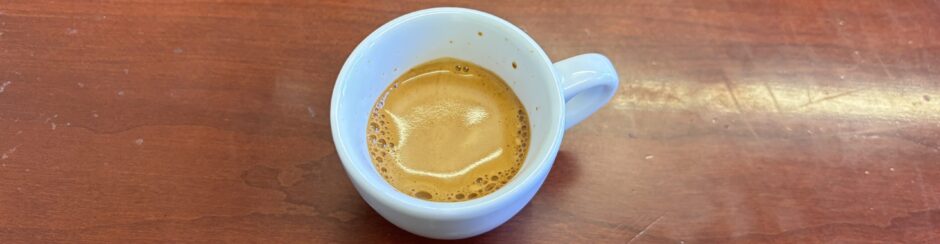
I still go the the Bourgeois Pig to chat with Matt, but I don’t buy anything; instead, I stop off at Intelligentsia first and get a Cortado (which they call a Gibraltar) instead.

What were the two topics which dominated the political conversation in Australia when I visited in 2011? Asylum policy and the Carbon Tax (Caahbin Tax). What are the topics today? The very same. Is it possible that Abbott could make Little Johnny H seem enlightened? Oh, talking about Australia, perhaps you would like to play the white Australia game.

Justice
This is where I like to sit when I talk to Toby about math. My math comes with the imprimatur of justice!

Posted in Waffle | Tagged , , , , , , , , , , , , , , , , , , | Leave a comment

A public service announcement concerning Fontaine-Mazur for GL(1)

There’s a rumour going around that results from transcendence theory are required to prove the Fontaine-Mazur conjecture for \(\mathrm{GL}(1)\). This is not correct. In Serre’s book on \(\ell\)-adic representations, he defines a \(p\)-adic representation \(V\) of a global Galois group \(G_F\) to be rational if it is unramified outside finitely many primes and if the characteristic polynomials of \(\mathrm{Frob}_{\lambda}\) actually all lie in some fixed number field \(E\) rather than over \(\mathbf{Q}_p\). Certainly being rational is a consequence of occurring inside the etale cohomology of a smooth proper scheme \(X\), and one might be motivated to make a conjecture in the converse direction assuming that \(V\) is absolutely irreducible. But being “rational” is just a rubbish definition (sorry Serre), a mere proxy for the correct notion of being potentially semistable at all primes dividing \(p\) (“geometric,” given the other assumptions on \(V\)). And the implication

A character \(\chi: G_F \rightarrow \overline{\mathbf{Q}}_p\) is Hodge-Tate \(\Rightarrow \chi\) is automorphic

doesn’t require any transcendence results at all. One can’t really blame Serre for not coming up with the Fontaine-Mazur conjecture in 1968. The reason for this confusion seems to be the proof of Theorem stated on III-20 of Serre’s book on abelian \(\ell\)-adic representations (with the modifications noted in the updated version of Serre’s book), namely:

Theorem (Serre-Waldschmidt): If \(V\) is an abelian representation of \(G_F\) which is rational, then \(V\) is locally algebraic.

This argument (even for the case when \(F\) is a composite of quadratic fields, the case considered by Serre) requires some transcendence theory. But the implication \(V\) is abelian and Hodge-Tate \(\Rightarrow V\) is locally algebraic (also proved in Serre) only uses Tate era p-adic Hodge theory. The other ingredients for Fontaine-Mazur are as follows: First, there is the classification of algebraic Hecke characters (due to Weil, I think). A key point here is that the algebraicity forces the unit group to be annihilated by some element in the integral group ring. However, the representation \(V\) occurs in \(\mathcal{O}^{\times}_F \otimes \mathbf{C}\) with dimension \(\dim(V|c = 1)\) if \(V\) is non-trivial, so this forces the existence of representations \(V\) of \(G\) on which \(c = – 1\), corresponding to CM subfields. The final step is the theory of CM abelian varieties. So although the result is non-trivial, you can be rest assured, gentle reader, that you are not secretly invoking subtle transcendence results every time you twist an automorphic Galois representation by a Hodge-Tate character and claim that the result is still automorphic.

Posted in Mathematics | Tagged , , , | Leave a comment

Report from Luminy

For how long has Luminy been infested with bloodthirsty mosquitoes? The combination of mosquitoes in my room with the fact that my bed was 6′ long with a completely unnecessary headboard (which meant that I had to sleep on an angle with my ankles exposed) did not end well.

As for the math, there were plenty of interesting talks, most of which I will not discuss here. Jan Nekovar gave a nice talk explaining how one could prove that the cohomology of compact Shimura varieties of \(\mathrm{GL}(2)\)-type were semi-simple. For concreteness, imagine that \(X\) is a Hilbert modular surface associated to a real quadratic field \(F\). Suppose that \(\rho\) is the Galois representation associated to a cuspidal Hilbert modular form of parallel weight two. Then the Langlands-Kottwitz method shows that the semi-simplification of \(\rho^{\otimes 2}\) should occur inside \(H^2\). On the other hand, this argument only ever deals with the trace of Hecke operators and so cannot say anything about semi-simplifications. Nekovar’s argument is to use the Eichler-Shimura relation applied to partial Hecke operators for primes which split completely in both \(F\) and the corresponding reflex field. The point is that these operators satisfy a quadratic relation (with distinct eigenvalues for generic elements of the Galois group), and so act semi-simply on \(H^2\) (imagine everything is compact here). Then, by pure group theory, if the image of \(\rho\) is large enough, the sheer number of such elements is enough to force semi-simplicity. It is perhaps useful to note that if \(V\) is a representation such that \(V^{ss} = (\rho^{\otimes 2})^{ss}\) and \(V\) is geometric and pure, then \(V\) should automatically be semi-simple. This follows from any number of combinations of bits of the standard conjectures, but one way to see it is that if \(W\) is geometric and of weight zero, then (by Bloch-Kato) one should have \(H^1_f(F,W) = 0\). The relevant \(W\) in the example above is \(\mathrm{ad}^0(\rho)\). So in fact one can give an alternate proof of the theorem using the full power of modularity lifting theorems, providing one is willing to omit finitely many primes \(p\). This is really an explanation of why Jan’s result is nice! For example, as soon as one replaces \(\rho^{\otimes 2}\) by \(\rho^{\otimes n}\), one has to start dealing with \(H^1_f(F,\mathrm{Sym}^{2n}(\rho)(-n))\), which gets a little tricky.

Boars
These fellows turned up for the Bouillabaisse.

Ana Caraiani talked about a very nice result concerning the sign of Galois representations associated to torsion classes for \(\mathrm{GL}(n)/F^{+}\) for totally real fields \(F^{+}\) (this was joint work with Bao Le Hung). Namely, the trace of any complex conjugation lies in \(\{-1,0,1\}\) (in fact, the result identified the exact characteristic polynomial, which is more general in small characteristic). The basic strategy is to follow Scholze’s construction and “reduce” the problem to the case of essentially self-dual forms, where one has previous results by Taylor, Bellaïche-Chenevier, and Taïbi. However, there is a problem, which is that the regular self-dual automorphic forms one finds congruences with need not be globally irreducible, and perhaps not even cuspidal. Suppose one can show that they decompose into an isobaric sum \(\pi = \boxplus \pi_i\) where the \(\pi_i\) are self-dual. One runs into problems if too many of the \(\pi_i\) are of dimension \(n_i\) with \(n_i\) odd. However, by considering the weights, only one of the \(\pi_i\) can be odd, because otherwise the Hodge-Tate weight zero would occur with multiplicity which would violate the fact that \(\pi\) is regular. There is still something to check for the even \(n_i\) also, because previous results required some sign assumption on the character \(\eta\) such that \(\pi = \pi^{\vee} \eta\). I believe that even getting to this point required a further assumption on the torsion class not coming from the boundary. In the boundary case, there was also a reduction/induction case which also required careful handling of “odd” dimensional pieces, and some computation of a restriction of Hecke operators from the relevant Parabolic/Levi which required a sign to come out correctly. One clever technical step was working with the cohomology of adelic quotients \(G(F)\backslash G(\mathbf{A})/UK\) where \(K\) is a maximal compact of \(G(\mathbf{R})\) rather than the connected component \(K^0\). The advantage of this is that, in the odd dimensional case, this pins down the trace of complex conjugation to be \(+1\) rather than \(\pm 1\). This is clear when \(n = 1\), and that one should expect it to be true follows for \(n\) odd by taking determinants.

Peter Scholze gave a talk on his new functor. The basic elements in the construction of this functor are as follows. The Gross-Hopkins period map allows one to view the (infinite level) Lubin-Tate tower as a \(\mathrm{GL}_n(F)\)-torsor over the (\(D^{\times}\) Severi-Brauer variety) \(\mathbf{P}^{n-1}_{\mathbf{C}_p}\). So, given an admissible representation \(\pi\), one can form the “local system” \(\mathscr{F}_{\pi}\) on the base, and then take its cohomology. The key technical point of this construction is to show that the result is admissible for \(D^{\times}\), which amounts to proving finiteness of \(K\)-invariants for suitable compact open \(K\) of \(D^{\times}\). The first step is to pull back to the (lowest level) part of the Lubin-Tate tower, which one can do because the GH map splits. Now the map from infinite level to the base of the Lubin-Tate tower is really a \(\mathrm{GL}_n(\mathcal{O}_F)\)-torsor, so one only has to consider the restriction of \(\pi\) to \(\mathrm{GL}_n(\mathcal{O}_F)\). But then using the admissibility of \(\pi\), one can look instead at the regular representation of \(\mathrm{GL}_n(\mathcal{O}_F)\). Now, by some sort of Shapiro’s Lemma, one can pull everything back up to infinite level. At infinite level, however, one can replace the Lubin-Tate space by the corresponding Drinfeld tower. Now taking \(K\)-invariants is something that is “easy” to do, because there is an action of \(K\) on the space, and the quotient by \(K\) is some sufficiently nice object for which one has (again by Peter) some nice finiteness theorems for cohomology. I should probably have mentioned that at some point we are working with coefficients in \(\mathcal{O}^+/p\), i.e. in the almost world. The main application in the talk was to show that when one patches completed cohomology (a la CEGGPS), then one can recover the Galois representation from the result. This essentially amounts to showing that when one patches together suitable admissible \(\pi_i\), one can also patch the functor. This requires more than admissibility of the functor, but some sort of “uniform” admissibility (which is always required for patching). I think the key point here is that if \(\pi_i\) is something patched with a group of diamond operators \(\Delta\), then \(\pi_i\) has a filtration by \(|\Delta|\) copies of the original \(\pi\), and so \(\mathscr{F}_{\pi_i}\) has a corresponding uniformly bounded filtration by \(\mathscr{F}_{\pi}\), and so \(H^{n-1}(\mathbf{P}^{n-1}_{\mathbf{C}_p},\mathscr{F}_{\pi})^K\) has length at most \(|\Delta|\) times the corresponding length for the (fixed for all time) version for \(\pi\). On the other hand, Peter instead pulled out a new piece of kit by patching using ultra-filters. My own feeling about logic is that it is never really necessary to prove anything, and I think PS agreed that it wasn’t strictly required for this particular application. Now I understand that my prejudice may not be justified (for example, it is probably hard to prove various identities concerning orbital integrals in small characteristic directly), but I think it applies in this case. Plus, as a purely expositional remark, if you are going to whip out ultrafilters during a number theory talk then everyone is just going to talk about ultrafilters rather than the beautiful construction!

Posted in Mathematics, Uncategorized | Tagged , , , , , , , | Leave a comment

An Obvious Claim

It’s been a while since I saw Serre’s “how to write mathematics badly” lecture, but I’m pretty sure there would have been something about the dangers of using the word “obvious.” After all, if something really is obvious, then it shouldn’t be too difficult to explain why. It is especially embarrassing when someone asks you to clarify a remark/claim in one of your papers which you claim is “obvious” and you find yourself having no idea what the implicit argument was supposed to be. Such a thing happened recently to me, when Toby asked me to explain why the following was true:

Claim: Let \(N \equiv 3 \mod 4\) be prime, and let \(\epsilon\) be the fundamental unit of \(K = \mathbf{Q}(\sqrt{N})\). Then \(\epsilon = a + b \sqrt{N}\) where \(a\) is even and \(b\) is odd.

Proof of Claim: Between Toby, Kevin, and myself, we managed to come up with the argument below, following a suggestion of Toby Rebecca Bellovin: It’s easy enough to see (obvious) that \(a\) and \(b\) are integers and \(N(\epsilon) = 1\). Hence, it suffices to rule out the case that \(b\) even and \(a\) odd. Write \(a^2 – N b^2 = 1\). It follows that \(a^2 \equiv 1 \mod N\), and since \(N\) is prime, that \(a \equiv \pm 1 \mod N\). Assuming that \(a\) is odd, write \(a = 2NA \pm 1\), and \(b = 2B\). Then the equation above becomes

\(A(NA \pm 1) = B^2.\)

Without loss of generality, assume that \(A\) is positive. Then this equation implies that \(A\) and \(NA \pm 1\) are squares, say \(A = d^2\) and \(NA \pm 1 = c^2\). But then

\(c^2 – N d^2 = (NA \pm 1) – N A = \pm 1,\)

and hence \(\eta = c + N \sqrt{d}\) is a (smaller) unit (in fact, \(\eta^2 = \pm \epsilon\)), contradicting the assumption that \(\epsilon\) was a fundamental unit. \(\quad \square\)

This argument is really a 2-descent on the unit group. As Kevin remarked: “So this is a descent argument in a completely elementary situation which I don’t think I’d ever seen before and which proves something that I don’t think I knew … What’s ridiculous is that if the equation had been a cubic and we were after rational solutions then I would have instantly leapt on descent as one of my main tools for attacking it :-/ We live and learn!”

So what was I thinking when I wrote the paper? The actual claim in the paper is this: “If \(H’\) is the (2 part of the) strict ray class group of \(K\) of conductor \((2)\), then \(H = H’\), where \(H\) is the (2 part of the) class group. The “argument” is as follows:

The proof of [the above] is even more straightforward: it follows immediately from a consideration of the units in \(\mathcal{O}^{\times}_K\) and the exact sequence

\(\mathcal{O}^{\times}_K \rightarrow (\mathcal{O}_K/2 \mathcal{O}_K)^{\times} \rightarrow H’ \rightarrow H \rightarrow 0.\)

Well, at least the word obvious was only implicit here. I could try to place the blame on my co-author Matt here, but honestly the phrasing of the claim does sound a little like something I would write.

Next up: a report from Luminy!

Posted in Mathematics | Tagged , , , , | Leave a comment

Huuuuuge piles of cash

As widely reported today, the first of the “Breakthrough” prizes in mathematics have been announced. Leaving aside the question as to whether such awards are sensible (Persiflage is more sympathetic to capitalist principles than your average pinko marxist mathematician), I think we should all be happy that the inaugural awardees are beyond reproach, something which could not have been taken for granted. So well done to whoever was on the prize committee.

Of the awardees that I know personally, my impression is that, at least in part, they would feel mildly embarrassed by the large amount of cash involved, even if they (presumably) feel gratified by the deserved acknowledgement of their contributions to mathematics. I do hear, however, that a bottle of Chateau d’Yquem 1967 does wonders to wash away any last remaining vestiges of embarrassment, and I am more than willing to help out with the consumption of said beverage if required.

Posted in Mathematics, Politics | Tagged , | Leave a comment

There are non-liftable weight one forms modulo p for any p

Let \(p\) be any prime. In this post, we show that there is an integer \(N\) prime to \(p\) such that \(H^1(X_1(N),\omega_{\mathbf{Z}})\) has a torsion class of order \(p\). Almost equivalently, there exists a Katz modular form of level \(N\) and weight one over \(\mathbf{F}_p\) which does not lift to characteristic zero. We shall give two different arguments. The first argument will have the virtue that the torsion class is non-trivial after localization at a maximal ideal \(\mathfrak{m}\) which is new of level \(N\). The second argument, in contrast, will produce torsion classes at fairly explicit levels. Neither proof, unfortunately, implies the existence of interesting Galois representations unramified at \(p\) with image containing \(\mathrm{SL}_2(\mathbf{F}_p)\). Rather, the classes will come from deformations of characteristic zero classes. (This post is an elaboration of my comment here.)

The first argument: Let \(K/\mathbf{Q}\) be an imaginary cubic extension unramified outside \(p\) with Galois closure \(L/\mathbf{Q}\) with Galois group \(S_3\). There is a corresponding Galois representation:

$latex \rho: G_{\mathbf{Q}} \rightarrow \mathrm{Gal}(L/\mathbf{Q}) = S_3
\rightarrow \mathrm{GL}_2(\mathbf{Q}_p).$

This representation is modular. Suppose for convenience that \(p > 3\). Associated to \(\rho\) is an absolutely irreducible residual representation \(\overline{\rho}\). Let \(R\) denote the corresponding universal unramified deformation. The only characteristic zero deformations are dihedral. Let \(R^{\mathrm{dh}}\) denote the corresponding universal unramified dihedral deformation ring. It’s easy to identify this ring explicitly; it is

\( R^{\mathrm{dh}} = \mathbf{Z}_p[C_E \otimes \mathbf{Z}_p],\)

where \(C_E\) is the class group of the imaginary quadratic subfield \(E\) of \(L\). The ring \(R\) will fail to be \(\mathbf{Z}_p\)-flat exactly when \(R \ne R^{\mathrm{dh}}\). Fortunately, this can be determined purely from the reduced tangent space of \(R\). Note that

\(\mathrm{ad}^0(\rho) \simeq \rho \oplus \eta,\)

where \(\eta\) is the quadratic character of \(E/\mathbf{Q}\). The reduced tangent space of \( R^{\mathrm{dh}}\) is the Bloch–Kato Selmer group \(H^1_f(\mathbf{Q},\overline{\eta})\), where \(H^1_f\) denotes the subring of cohomology classes which are unramified everywhere. So it all comes down to finding \(K\) so that \(H^1_f(\mathbf{Q},\overline{\rho})\) is non-zero. However, an elementary argument using inflation-restriction shows that this is equivalent to showing that the class number \(h_K\) of \(K\) is divisible by \(p\). So we are done provided that we can find a suitable \(K\) with class number divisible by \(p\). (I should mention, of course, that we are using the theorem that \(R = \mathbf{T}_{\mathfrak{m}}\) which was proved by David Geraghty and me.) The last step follows from the lemma below; the argument is essentially taken from this paper of Bilu–Luca.

Lemma: Fix a prime \(p > 3\). There exists an imaginary cubic field \(K/\mathbf{Q}\) of
discriminant prime to \(p\) and class number divisible by \(p\).

Proof: Consider the field \(K = \mathbf{Q}(\theta)\), where

\((\theta^2 + 1)(\theta – t^p + 1) – 1 = 0\),

and \(t\) is an element of \(\mathbf{Q}\) to be chosen later. Note that \(\theta^2 + 1\) is manifestly a unit in \(K\). We may compute that

\((\theta^2 + \theta + 1) \theta = (1 + \theta^2) t^p.\)

Since \((\theta,\theta^2 + \theta + 1) = (1)\) is trivial, it follows that \((\theta) = \mathfrak{a}^p\) for some ideal \(\mathfrak{a}\). We shall show that, for a suitably chosen \(t\), the element \(\mathfrak{a}\) is non-trivial in the class group. If \(\mathfrak{a}\) is trivial, then, up to a unit, \(\theta\) is a \(p\)th power. On the other hand, the rank of the unit group of \(K\) is one, and \(\theta^2 + 1\) is a unit. Hence, it suffices to choose a \(t\) such that:

  1. \(\theta^2 + 1\) generates a subgroup of \(\mathcal{O}^{\times}_K\) of index prime to \(p\). Equivalently, \(\theta^2 + 1\) is not a perfect \(p\)th power in \(K\).
  2. None of the elements \(\theta (\theta^2 + 1)^i\) for \(i = 0,\ldots,p-1\) is a perfect \(p\)th power in \(K\).
  3. The polynomial defining \(K\) is irreducible.
  4. The discriminant of \(K\) is not a square.
  5. The discriminant of \(K\) is prime to \(p\).

By working over the function field \(\mathbf{Q}(t)\) instead of \(\mathbf{Q}\), one finds that the first four conditions hold for all \(t \in \mathbf{Q}\) outside a thin set. (The discriminant \(\Delta\) is always negative, so the signature of the field is always \((1,1)\).) On the other hand, the discriminant of the defining polynomial is \(-3 \mod t\), so if one (for example) takes \(t\) to be an integer divisible by \(p\) then the discriminant will be prime to \(p\). Note that the set of integers divisible by \(p\) will contain elements not in any thin set, because the number of integral points of height at most \(H\) in a thin set is \(o(H)\).

Second Argument: Let \(E = \mathbf{Q}(\sqrt{-23})\), and let \(L = E[\theta]/(\theta^3 – \theta + 1)\) be the Hilbert class field of \(E\). There is a weight one modular form of level \(\Gamma_1(23)\) and quadratic character corresponding to the Galois representation:

\(\rho: \mathrm{Gal}(L/\mathbf{Q}) \rightarrow \mathrm{GL}_2(\mathbf{Q}_p).\)

Lemma: Let \(p > 3\). Let \(q = x^2 + 23 y^2\) be a prime such that \(q \equiv 1 \mod p\). Equivalently, let \(q\) be a prime which splits completely in \(L(\zeta_p)\). Then

\(\# H^1(X(\Gamma_1(23) \cap \Gamma_0(q)),\omega)^{\mathrm{tors}}\)

is divisible by \(p\). More generally, for any prime \(q\), the quantity above is divisible by any prime divisor of \(a^2_q – (1+q)^2\), and \(a_{\ell} \in \{2,0,-1\}\) for a prime \(\ell\) is the coefficient of \(q^{\ell}\) in \(q \prod (1-q^n) (1 – q^{23 n})\).

Proof: This follows from “level–raising” in characteristic \(p\) for weight one forms. Under the hypothesis that \(a^2_q – (1+q)^2\), we find that there is more cohomology (over \(\mathbf{Z}_p\)) in level \(\Gamma_1(23) \cap \Gamma_0(q)\) than is accounted for by oldforms. Assuming that there is no torsion, this is inconsistent with the fact that there are no newforms in characteristic zero, because weight one forms cannot be Steinberg at any place. (The easiest way to see this is that the eigenvalue of \(U_q\) would have to be non-integral — it also follows on the Galois side from local-global compatibility, but this is overkill.) Note that level–raising in this context does not follow from classical level–raising — for the details I refer to you my fifth lecture in Barbados on non-minimal modularity lifting theorems in weight one.

Posted in Mathematics | Tagged , , , | Leave a comment

Math and Genius

Jordan Ellenberg makes a compelling case, as usual, on the pernicious cultural notion of “genius.” Jordan’s article also brought to mind a thought provoking piece on genius by Moon Duchin here (full disclosure: the link on Duchin’s website has the folowing caveat: note: juvenilia! Not that I hate it).

I should first clarify that I am essentially in agreement with many of Jordan’s points, as well as his implicit and explicit recommendations. That said, there is a secondary argument which portrays mathematics as a grand collective endeavour to which we can all contribute. I think that this is a little unrealistic. In my perspective, the actual number of people who are advancing mathematics in any genuine sense is very low. This is not to say that there aren’t quite a number of people doing *interesting* mathematics. But it’s not so clear the extent to which the discovery of conceptual breakthroughs is contingent on others first making incremental progress. This may sound like a depressing view of mathematics, but I don’t find it so. Merely to be an observer in the progress of number theory is enough for me — I know how to prove Fermat’s Last Theorem, how exciting is that*?

Having said this, there are two further points on which I do agree with Jordan. The first is that it is a terrible idea to *prejudge* who will be the ones to make progress, at least any more than necessary (judgements of various levels are completely built in to the academic world in the context of hiring, grants, etc.). This is consistent with Jordan’s point that one should view accomplishments rather than people as genius. The second is that the mere notion of genius has detrimental psychological effects on mathematicians. The depressing effect on enthusiasm for mathematics amongst students has already been mentioned, but I also wanted to note a contrasting effect. There’s a tendency amongst a certain group of students — for concreteness imagine a certain flavour of Harvard male undergraduate — who buys into the notion of genius with themselves as an example. This doesn’t do any favours for anyone; obviously not fellow students who are put off, but also the students themselves who are tempted to learn fancy machinery —- that’s what a genius does! — rather than to really understand the basics. Two clarifying points: first, this in no way applies to all Harvard undergraduates — some of the smartest I have met have been very humble and level headed. Second, when I single out Harvard undergraduates, I am implying a correlation rather than a causation: this is not at all the fault of the Harvard faculty who are generally no nonsense. Then again, Harvard does have Math 55, which is somewhat of a petri dish for this sort of attitude.

Having written this, I now see there is a practical problem in the classroom which I don’t know how to solve. What do you do when you are teaching and one student sticks out like a sore thumb because their understanding of the material (seemingly) far exceeds the rest of the class?

(*) OK, I have not read all the details of the proof of cyclic base change for \(\mathrm{GL}(2)\).

Posted in Mathematics, Politics, Waffle | Tagged , , , | Leave a comment

I don’t know how to prove Serre’s conjecture.

I find it slightly annoying that I don’t know how to prove Serre’s conjecture for imaginary quadratic fields. In particular, I don’t even see any particularly good strategy for showing that a surjective Galois representation — say finite flat with cyclotomic determinant for \(v|p\) —

\(\overline{\rho}: G_{F} \rightarrow \mathrm{GL}_2(\mathbf{F}_3)\)

is modular of the right level. The first problem is that the strategy used by Wiles does not work. The results of Langlands-Tunnell imply the existence of an automorphic form \(\pi\) for \(\mathrm{GL}(2)/F\) which has an associated finite image Galois representation into \(\mathrm{GL}_2(\mathbf{Z}[\sqrt{-2}])\) with projective image \(A_4\) that is “congruent” to \(\overline{\rho}\) modulo a prime above \(3\), but there is no way to realize this congruence in cohomology. An analogous example over \(\mathbf{Q}\) would be that the (known) modularity of a surjective even Galois representation:

\(\overline{\rho}: G_{\mathbf{Q}} \rightarrow \mathrm{SL}_2(\mathbf{F}_4) = A_5\)

has no implications for the modularity of the corresponding even complex representation with projective image \(A_5\) (which is “congruent” modulo \(2\)), because there is no way to relate them via Betti or coherent cohomology.

One context in which we have a fairly satisfactory answer to Serre’s conjecture over imaginary quadratic fields is for representations \(\overline{\rho}\) which are the restriction of an odd representation of \(G_{\mathbf{Q}}\). (I guess one also has modularity in some CM cases, that is, inductions from CM extensions \(H/F\).) So, if we give ourselves modularity lifting results (surely a requirement to get anywhere), one could imagine trying to play some sort of game using the \(3\)-\(5\) switch to construct a chain between a representation which comes from \(\mathbf{Q}\) and the target representation. Or, perhaps, one can play the \(3\)-\(3\) game using abelian surfaces with real multiplication by \(\mathbf{Z}[\sqrt{7}]\). However, there’s a big hole in this strategy: the \(3\)-\(5\) game presupposes that once you know that \(\overline{\rho}\) is modular of some level, you know it at minimal level. So now one runs into the problem of level lowering. Alternatively, if you want to play the \(3\)-\(5\) game Khare–Wintenberger style, you really have to construct minimal lifts. But such lifts will not (in general) exist over imaginary quadratic fields.

This seems to be a serious problem. The only general strategies I can imagine involve being able to push the torsion classes around to different groups using some (as yet unknown) functoriality for torsion classes. (For example, find minimal lifts over some large CM extension \(F’/F\), prove modularity over \(F’\), and then invoke non-abelian base change for torsion classes to recover modularity of the original representation.) The other argument would be to examine the corresponding Eisenstein classes for \(U(2,2)/F\). This seems a little fishy, however; one would really want to see these representations inside (etale) cohomology in order to invoke some kind of Mazur principle, but as we have noted previously, the Galois representations of interest don’t actually live inside the etale cohomology groups that one might want them to. Ultimately, the basic problem is that the classical (Mazur-Ribet) style arguments make strong use the geometry of modular curves (which is certainly missing here) and the more modern approaches (starting with Skinner–Wiles) rely on base change.

Posted in Mathematics | Tagged , , , , | Leave a comment

Thurston, Selberg, and Random Polynomials, Part II.

What is the probability that the largest root of a polynomial is real?

Naturally enough, this depends on how one models a random polynomial. If we take polynomials of degree N which are constrained to have all of their roots to be of absolute value at most one (with respect to the normalized Lebesgue measure on \(\mathbf{R}^N\)), then, as mentioned last time, the probability that the largest root is real is either \(1/N\) in odd degree \(N\) and \(1/(N-1)\) in even degree. A priori, this seems surprisingly small. However, the roots of such polynomials are accumulating on the unit circle, and it’s easier for complex roots to be near the unit circle than real roots. So let’s instead consider the Kac model of polynomials \(f(x)\), where the coefficients are chosen to be independent normals with mean zero. If you ask for the probability that the root whose absolute value is closest to one is real, then I suspect that the answer will be approximately \(1/N\). However, what about the largest root? The first observation is that the expected number of real roots is \(2/\pi \log N\), so a the most naïve guess is that the probability that the largest root is real is approximately \((2/\pi N) \log N\). If you like, you can pause here and guess whether you think this is too high, too low, or about right.

A useful observation is that, instead of considering the largest root, we can consider the smallest root. This is because the map \(a_k \rightarrow a_{N-k}\) is measure preserving and inverts the roots. On the other hand, the behavior of random Kac polynomials in large degree inside the unit circle starts to approximate the behavior of random power series

\(f(x) = a_0 + a_1 x + a_2 x^2 + \ldots \)

where the \(a_i\) are all normally distributed with mean zero and standard deviation one. It’s easy to see that \(f(x)\) will have radius of convergence \(1\) with probability one. So we might instead consider what the probability is that the smallest root of a random power series is real. However, in this case, it is quite elementary to see that this probability \(P_{\infty}\) is strictly between zero and one. Quite explicitly, consider the subspace of power series such that the following inequality holds:

\(\displaystyle{|a_0| + \frac{1}{2} |a_1 – 2| + \frac{1}{2^2} |a_2| + \frac{1}{2^3} |a_3| + \ldots < 1}.\)

This region has positive measure (easy exercise). On the other hand, for all such power series, one can apply Rouché's theorem for the contour \(|2x| = 1\) to see that \(f(x)\) and \(2x\) have the same number of zeroes inside this disc, and hence \(f(x)\) has exactly one root of absolute value less than \(1/2\). By the reflection principle, this root is real. It follows that the probability that the smallest root of \(f(x)\) is real is positive. Equally, one can consider the region:

\(\displaystyle{|a_0 – 1| + \frac{1}{2} |a_1| + \frac{1}{2^2} |a_2 – 8| + \frac{1}{2^3} |a_3| + \ldots < 1},\)

and by applying Rouché along \(|2x| = 1\) and comparing with \(1 + 8 x^2\), the corresponding \(f(x)\) will have exactly two roots inside this ball, and from the inequalities above it follows that neither of them will be real, and hence \(P_{\infty} < 1\).

The same argument shows that if \(P_N\) is the probability that the smallest (or largest) root of a Kac polynomial is real, then there are uniform (independent of \(N\)) estimates \(0 < a < P_N < b < 1\) for all \(N\). Naturally enough, one should expect that \(P_N\) converges to \(P_{\infty}\). This is true, and the rough idea is to show that, with probability approaching one (as \(N \rightarrow \infty\)), one can apply Rouché’s theorem to deduce that the smallest root of \(f(x)\) is real if and only if the smallest roots of its truncation \(f_N(x)\) is real. The key idea here is that, for the truncation \(f_N(x)\), most of the roots of \(f_N(x)\) will be uniformly distributed along the unit circle, and so the contribution of the relevant factor \(\prod |x – \alpha|\) to \(f_N(x)\) will not be too small. Hence one can usually apply Rouché along the contour \(|x| = \beta\) as long as there are no roots of \(f_N(x)\) of absolute value too close to \(\beta\).

The computations above also allow one to give effective gaps between \(P_{\infty}\) and either zero or one (by estimating the measure of the corresponding regions as translates of \(|a_i| \le 1/2^{i+1}\)), although these estimates are not so sharp. Namely, the probability that the smallest root of a random power series is real is at least 0.256% and at most 99.999999999999917%. Some numerical data suggests, however, that the probability that the largest root of a random Kac polynomial (of large degree) will be real is approximately 52%. I have some undergraduates working with me this summer, and one of their projects will be to see if they can prove that the probability is really strictly larger than 50%, or at least to find a good an estimate as they can.

One may ask what happens for other ensembles of polynomials. One natural class to consider is the so-called binomial polynomials, where the \(a_i\) are now normal with mean zero and variance \( n!/i!(n-i)!\). Here the previous argument doesn't (a priori) work. On the other hand, as Boris Hanin (a Steve Zelditch student from Northwestern who is leaving for a postdoc at MIT next year) pointed out to me, it actually does: to fix it, one should scale all the roots of the relevant polynomials by \(\sqrt{N}\), and then there really is a limit distribution as \(N \rightarrow \infty\), given by power series

\(f(x) = \displaystyle{\frac{a_0}{0!} + \frac{a_1 x}{\sqrt{1!}} + \frac{a_2 x^2}{\sqrt{2!}} + \ldots} \)

where the normalized \(a_i\) are normals with standard deviation one. Note that these power series have an infinite radius of convergence with probability one. The probability that the smallest root is real will once again be strictly between \(0\) and \(1\). In order to prove convergence of \(P_N\) (by applying Rouché’s theorem), one needs to know that the relevant 2-point correlation functions behave reasonably enough; I’m hoping to get Boris to work out and write down the details here. Numerically, the limit probability in this case is somewhere around 62%.

Gap Probabilities:

I speculated last time on some conjectural relationship between the space of real monic polynomials \(\Omega_N\) all of whose roots are at most one, and the space of random Kac polynomials of degree \(N\) as \(N\) goes to infinity. But now I wanted to point out a more direct an elementary relationship between ensembles of random real polynomials and our space \(\Omega_N\). A gap probability is the probability that the eigenvalues/roots of some ensemble avoid some region of the corresponding parameter space. Let’s compute this for a very large gap. That is, let’s compute the probability that a random polynomial has all of its roots less than \(T\) as \(T \rightarrow 0\).

Let's consider the Kac model of random polynomials

\(f(x) = a_0 x^N + a_1 x^{N-1} + \ldots + a_N\)

where the \(a_i\) are chosen independently from a normal distribution with mean zero and standard deviation one. Hence we are asking: what is the probability that all the roots of \(f(x)\) have absolute value at most \(T\)? This is simply the integral

\(\displaystyle{\left(\frac{1}{\sqrt{2 \pi}}\right)^{N+1} \int_{P \Omega_N(T)} e^{-|x|^2/2} dx}\)

where \(P \Omega_N(T)\) is the space of polynomials (not necessarily monic) all of whose roots are at most \(T\). There is a map

\(\Omega_N(T) \times [-\infty,\infty] \rightarrow P \Omega_N\)

given by \((\lambda,P) \mapsto \lambda P\) with Jacobian \(|\lambda|^{N+1}\). Hence we can write our quantity as an integral over \(\Omega_N(T)\), which turns out to be

\(\displaystyle{\left(\frac{1}{\sqrt{2 \pi}}\right)^{N+1} \int^{\infty}_{-\infty} \int_{ \Omega_N(T)} |\lambda|^{N+1} e^{-(\lambda^2 – a^2_1 \lambda^2 – \ldots – a^2_N \lambda^2)/2} dx}.\)

We can now compute the integral over \(\lambda\) directly, and then scaling \(\Omega_N(T)\) to \(\Omega_N\) in the usual way, we find that the probability that all the roots have absolute value \(T\) is

\(\displaystyle{ T^{N(N+1)/2} \left(\frac{2}{\pi}\right)^{(N+1)/2} \Gamma(N/2+1) \int_{\Omega_N} \frac{dV}{(1 + T^2 a^2_1 + T^4 a^2_2 + \ldots + T^{2N} a^2_{N})^{N/2+1}}}\)

Now suppose that \(T \rightarrow 0\). Then the integral over \(\Omega_N\) converges to the volume of \(\Omega_N\), and we obtain an exact asymptotic that all the roots are (highly) concentrated at zero. In fact, one can do this computation with any probability measure \(\mu\) which decays sufficiently at infinity.

Curiously enough, we can also ask (in the setting of random polynomials subject to some reasonable measure \(\mu\) for each \(i\)) what the probability is that a random polynomial has \(R\) real roots contingent on all the roots of that polynomial being less than \(T\). It turns out that, as \(T \rightarrow 0\), the answer in this case is simply the ratio of the volume of \(\Omega_{R,S}\) to \(\Omega_N\) (with \(R+2S=N\)). This answer does not depend at all on \(\mu\). The explanation for this is that, having subjected the polynomials to the constraint that all the roots have absolute value at most \(T\) for small \(T\), one is restricting to some tiny region where the measure is constant, and so it is converging to a scaled version of Lebesgue measure.
Posted in Mathematics | Tagged , , , , | 1 Comment