The Artin conjecture is rubbish

Let \(\rho: G_{\mathbf{Q}} \rightarrow \mathrm{GL}_N(\mathbf{C})\) be a continuous irreducible representation. Artin conjectured that the L-function \(L(\rho,s)\) is analytically continues to an entire function on \(\mathbf{C}\) (except for the trivial representation where the is a simple pole at one) and satisfies a functional equation of a precise shape. Langlands later had the profound insight to link this conjecture to functoriality in the Langlands program, which would additionally imply that \(\rho\) is automorphic which implies, inter alia, that \( L(\rho,s) = L(\pi,s)\) for a cuspidal automorphic representation \(\pi\) for \(\mathrm{GL}(N)(\mathbf{Q})\).

This is a beautiful and fundamental conjecture. However, it does appear to be completely useless for any actual applications. The most natural application of Artin’s conjecture is to prove … the Cebotarev density theorem. This is why Cebotarev’s density theorem is so amazing! True, one can upgrade the error estimates if one knows Artin, but to do this one also has to know GRH. And if you know GRH, you are not too far away from Artin anyway, because then \(L(\rho,s)\) at worst has poles on the critical strip, and so you can (essentially) get close to optimal bounds for Cebotarev anyway.

I thought a little bit about applications of Artin’s conjecture when I wrote a paper about it, but I came up empty. Then recently, I had occasion to look at my paper again, and found to my chagrin that when Springer made the final edit they lopped off a sentence in the statement of one of the main theorems. I guess that’s why the good people at Springer get paid the big bucks. (My best ever copy editing job, by the way, was for a paper in an AMS journal.) In a different direction, I guess it also reflects the deep study of this paper by people in the field that nobody has asked me about it. However, I did notice a statement in the paper that could be improved upon, which I will mention now.

To set the context, let \(K^{\mathrm{gal}}/\mathbf{Q}\) be a Galois extension with Galois group \(S_5\), and suppose that complex conjugation in this group is equal to \((12)(34)\). Now suppose that \(\rho\) is a representation of \(\mathrm{Gal}(K^{\mathrm{gal}}/\mathbf{Q})\). We already know that \(L(s,\rho)\) is meromorphic, as proved by Brauer and Artin. One thing that can be proven is that, in the particular case above, \(L(s,\rho)\) is holomorphic in a strip \(\mathrm{Re}(s) > 1 – c\) for some constant \(c > 0\) which I described as “ineffective.” But looking at it again, I realized that it is not ineffective at all, due to a result of Stark. What one actually shows is that if \(L(s,\rho)\) has a pole in the strip \(\mathrm{Re}(s) > 1 – c\), then there must also be another L-function for the same field which has a zero on the real line in this interval. Note that, again from by Artin, it is trivially the case that a pole of one L-function must come from the zero of another L-function, since the product of all such L-functions is the Dedekind zeta function. So the content here is that the offending pole has to be on the real line. One consequence is that, in any particular case, one can rigorously check that the L-function in question has no such zeros, and hence (combined with other results in this paper) that \(\rho\) is automorphic. With help from Andrew Booker, I was able to compute one such example (Jo Dwyer has since gone on to compute a number of other examples.) On the other hand, back to the general case, we do have effective results for zeros on the real line! The result in the paper is stated in terms of the existence of a zero of \(\zeta_H(s)\) for a certain subfield \(H\) of \(K^{\mathrm{gal}}\) of degree twelve. (The definition of \(H\) was exactly what was swallowed up by Springer, so it’s not actually defined in the paper. To define it, note that \(S_5\) has a faithful representation on six points. There is a degree six extension \(E\) which is the fixed field of the stabilizer of a point; then \(H\) is the compositum of \(E\) and the quadratic extension inside \(K^{\mathrm{gal}}.\)) However, the actual argument produces a zero in an Artin L-factor of \(\zeta_H(s)\) which is not divisible by the Dirichlet L-function for the quadratic character of \(S_5.\) Stark shows (Some Effective Cases of the Brauer-Siegel Theorem) that such an L-function does not have Siegel zeros, and also gives an explicit estimate for the largest zero on the real line. In particular, for the \(L(\rho,s)\) of interest, one deduces that they are analytic on the strip \(\mathrm{Re}(s) > 1 – c\) where one can take

\(\displaystyle{1 – c = 1 – \frac{1}{4 \log |\Delta_H|}}.\)

The result of Stark, BTW, is why one could effectively solve the class number at most \(X\) problem for totally complex CM fields which were not imaginary quadratic fields before Goldfeld–Gross–Zagier.

Posted in Mathematics | Tagged , , , , , , , , , , , , | Leave a comment

K_2(O_F) for number fields F

Belabas and Gangl have a nice paper ( Generators and relations for \(K_2({\mathcal{O}}_F)\), which can be found here) where they compute \(K_2({\mathcal{O}}_E)\) for a large number of quadratic fields \(E\). There main result is a method for proving upper bounds for \(K_2({\mathcal{O}}_E)\) in a rigorous and computationally efficient way. Tate had previously computed these groups for small imaginary quadratic fields by hand;  — the problem is finding an efficient way to do this in general. (Brownkin and Gangl had previously found a non-rigorous way of computing these groups using \(K_3({\mathcal{O}}_E)\) and regulator maps, but more on that later.) A good analogy to keep in mind is the problem of computing the class groups of imaginary quadratic fields. In the latter case, however, there are rigorous ways to determine whether an element in the class group is non-trivial, and this is missing from the computation of \(K_2({\mathcal{O}}_E)\).  To produce lower bounds, [BG] use theorems of Tate and Keune to relate the \(p\)-primary part of \(K_2({\mathcal{O}}_E)\) to class groups of \(E(\zeta_p)\), which they can then compute in some cases. One nice example they give is

\(K_2\left({\mathbf{Z}} \displaystyle{\left[\frac{1 + \sqrt{-491}}{2} \right]} \right) = {\mathbf{Z}}/13 {\mathbf{Z}}.\)

Akshay and I used this as one of the examples in our paper; in our context, it implies that the order of the group

\(H_1(\Gamma_0({\mathfrak{p}}),{\mathbf{Z}})\)

is always divisible by \(13\) where \(\Gamma_0({\mathfrak{p}})\) is the congruence subgroup of \(\mathrm{PGL}_2({\mathcal{O}}_E)\) for \(E = {\mathbf{Q}}(\sqrt{-491})\) and \({\mathfrak{p}}\) is any prime — even though the group \(H_1(\Gamma,{\mathbf{Z}}) = ({\mathbf{Z}}/2{\mathbf{Z}})^{26}\) is not so divisible. (Because we are talking about \(\mathrm{PGL}\) rather than \(\mathrm{PSL}\), the cusps are quotients of tori by involutions, so only contribute \(2\)-torsion to \(H_1.\) This group is occasionally infinite; we use the convention that \(\infty\) is divisible by \(13.\)) It’s always nice to see a theoretical argument come to life in an actual computation — fortunately, Aurel Page was kind enough to compute a presentation for \(\Gamma\) in order for us to do this. Now that I think about it, this and many other interesting things didn’t make it into the submitted version of the paper; you’ll have to read the “directors cut” to learn about it.

Alexander Rahm pointed out to me that the computation of \(K_2({\mathcal{O}}_E)\) we used was annotated with an asterisk in [BG], meaning that what was proved was only an upper bound. The issue is as follows. Let \(p = 13\), and let \(F = E(\zeta_p)\), let \(G = {\mathrm{Gal}}(F/E) = ({\mathbf{Z}}/p {\mathbf{Z}})^{\times}\), and let \({\mathrm{Cl}}(F)\) denote the class group of \(F\). What is required is to show, in light of Tate’s work on \(K_2\), is that

\(({\mathrm{Cl}}(F)[p])^{G = \chi^{-1}} \ne 0,\)

where \(\chi: G \rightarrow {\mathbf{F}}^{\times}_p\) is the cyclotomic character. The problem is that \(F\) has degree \(24\), and it is difficult to compute class groups explicitly in such cases. Let \(H = {\mathrm{Gal}}(F/{\mathbf{Q}})\), so there is a canonical decomposition \(H = G \times {\mathbf{Z}}/2{\mathbf{Z}}\). There are two extensions of \(\chi\) to \(H\), given (with some abuse of notation) by \(\chi\) and \(\chi \eta\), where \(\eta\) is the non-trivial character of \({\mathrm{Gal}}(F/{\mathbf{Q}})\). The main conjecture of Iwasawa Theory (Mazur–Wiles) allows one to easily compute minus parts of class groups in terms of \(L\)-values without actually computing with explicit number fields. However, we should not expect this to help us here. Namely, it’s not hard to show that there is an isomorphism \(({\mathrm{Cl}}({\mathbf{Q}}(\zeta_p))[p])^{G = \chi^{-1}} \simeq ({\mathrm{Cl}}(F)[p])^{H = \chi^{-1}}.\) However, the former is trivial by Herbrand’s theorem, because \(B_2 = 1/6\) is not divisible by \(13\). That leaves us with the problem of proving that \(({\mathrm{Cl}}(F)[p])^{H = \chi^{-1} \eta} \ne 0,\) which is a statement about the class group of a totally real cyclotomic extension. Since \(\chi \eta^{-1}\) is an even character, we get some savings by working in the totally real subfield \(F^{+}\) of degree \(12\). Now pari happily tells me via bnfinit and bnfclgp that the class group of this field is \({\mathbf{Z}}/13 {\mathbf{Z}}\), so it looks like we are in good shape. However, pari has the habit when computing class groups of assuming not only GRH but something stronger. What information does bnfinit actually contain? It certainly gives, inter alia:

  1. The Galois automorphisms of \(F^{+}\), using nfisisom(nf,nf).
  2. A finite index subgroup \(V\) of the unit group \(U:={\mathcal{O}}^{\times}_{F^{+}}\), using bnfinit[8][5]

Let me show how, just with this data, one can prove that the relevant part of the class group we are interested in is non-zero. BTW, if you tell pari can you confirm this answer is really correct? (using bnfcertify) it complains, and says the following:

 *** bnfcertify: Warning: large Minkowski bound: certification will be VERY long.
*** bnfcertify: not enough precomputed primes, need primelimit 59644617.

A rough guess (in part) as to what it might be doing: to compute all the invariants necessary for class field theory, one needs to know the full unit group. To do this, one can take the units \(V\) found so far and saturate them in the entire unit group \(U\). For each prime \(q\), one can do this by taking representatives in \(V/q V\) and determining whether or not they are perfect \(q\)th powers. By taking enough primes, on either rules out the existence of such an element, or finds a candidate \(v \in V\) and then checks whether it is a \(q\)th power. On the other hand, from \(V\), one can compute a pseudo-regulator \(R_V\), which is related to the actual regulator \(R_U\) by the unknown index. So to make this computation finite, it suffices to have some a priori bound on the regulator (to give an upper bound on the index), which will ultimately come down to some a priori bound on an \(L\)-value at one, which GRH probably tells you something useful about.

One can identify the automorphims of \(F^{+}\) computed by pari with the elements of the Galois group given by the corresponding quotient of \(H = G \times {\mathbf{Z}}/2{\mathbf{Z}}\) by \((-1,1)\). This group is generated by the image of \(\sigma = (2,1) = \mathrm{Frob}_2\), so it is enough to find the automorphism \(\sigma\) such that \(\sigma \theta – \theta^2 \equiv 0 \mod 2.\) View \(\chi \eta\), a character of degree \(12\), as being valued in \({\mathbf{F}}^{\times}_{13}\). Now choose a random unit, say bnf[8][5][6]} (Warning! I have a feeling that bnfinit does something different each time you run it, which means you might have to tweak the choice of index \(6\) above if you are doing this at home. And by “you,” I really mean “me” in six months time. I guess I should also tell myself that the relevant pari file is \~fcale/Zagier/BG491. We may write down a second unit as follows:

\(\displaystyle{{\epsilon} = \prod_{i=0}^{12} (\sigma^i(u))^{\chi \eta (\sigma^i)} \in ({\mathcal{O}}^{\times}_F/{\mathcal{O}}^{\times p}_F)^{H = \chi^{-1} \eta}}\)

What we have done is apply the appropriate projector in the group ring \({\mathbf{F}}_{13}[H]\) to \(u\). Naturally enough, we can lift \({\epsilon}\) to an actual unit in \(F^{+}\).

Now choose an auxiliary prime \(q\) which splits completely in \(F\), say \(q = 38299\). I chose this because it actually splits completely in \({\mathbf{Q}}(\zeta_{13 \cdot 491})\), which will make a computation below slightly easier. We reduce \({\epsilon}\) modulo a prime \({\mathfrak{q}}\) above \(q\) in \({\mathcal{O}}_{F^+}\) and we find that

\({\epsilon}^{(q-1)/13} \not \equiv 1 \mod {\mathfrak{q}}.\)

What this last computation proves is that \({\epsilon}\) actually generates
\(({\mathcal{O}}^{\times}_F/{\mathcal{O}}^{\times p}_F)^{H = \chi^{-1} \eta}\), which has dimension one by Dirichlet’s theorem. Note also that the inequality above does not depend on the choice of \({\mathfrak{q}}\) — any other choice is conjugate to \({\mathfrak{q}}\) which replaces \({\epsilon}\) by \(\sigma {\epsilon}\) and the latter is a non-zero scalar multiple of the former modulo \(13\)th powers by construction.

On the other hand, let \(\zeta\) be a primitive \(13 \cdot 491\)th root of unity. Then we may consider the projection of \(1 – \zeta\) modulo \(13\)th powers to the \(\chi^{-1} \eta\) eigenspace (the latter is naturally also a character on \(F(\zeta_{491})\)). Remember this eigenspace is generated by \({\epsilon}\). Take \(q = 38299\) again, so \(q – 1 = 13 \cdot 491 \cdot 6\). Then \(2^{6}\) is a primitive \(13 \cdot 491\)th root of unity modulo \(q\). On the other hand,

\(\displaystyle{\left(\prod_{({\mathbf{Z}}/13 \cdot 491 {\mathbf{Z}})^{\times}} (1 -2^{6n})^{n \left(\frac{n}{491}\right)} \right)^{(q-1)/13} \equiv 1 \mod q}\)

(The exponent of \((1 – 2^{6n})\) is just the value of \(\chi \eta(n)\) — remember that the character gets inverted in the projection formula — and that \(\eta^{-1} = \eta\).) This implies that the projection of \((1 – \zeta)\) to the \(\chi^{-1} \eta\)-eigenspace of units modulo \(p = 13\) is trivial, because the image of \({\epsilon}^{(q-1)/13}\) computed above was not \(1 \mod q\). The same is trivially true for the units in \({\mathbf{Q}}(\zeta_{491})\) and \({\mathbf{Q}}(\zeta_{13})\), because the projection of any unit in a subfield of \(F\) can only be an eigenvalue for a character of the correponding quotient of the Galois group. In particular, if \(C\) denotes the group of circular units, we have shown that the map

\((C/13 C)^{\chi^{-1} \eta} \rightarrow ({\mathcal{O}}^{\times}_F/{\mathcal{O}}^{\times 13}_F)^{\chi^{-1} \eta}\)

is the zero map. This proves that the index of the circular units in the entire units is divisible by \(13\). This is enough to prove that \(13\) divides \(h^{+}_F\), but even better, by the Gras conjecture (also proved by Mazur–Wiles, following Greenberg) it follows that the \(\chi^{-1} \eta\)-part of the class group is non-zero, and hence, given the previous upper bound, this gives a proof that

\(K_2({\mathcal{O}}_E) = {\mathbf{Z}}/13 {\mathbf{Z}}.\)

Further Examples: Let’s now look at other examples in [BG]. Consider the following example:

\(\displaystyle{K_2\left( {\mathbf{Z}} \left[ \frac{1 + \sqrt{-755}}{2} \right] \right) =^{?} {\mathbf{Z}}/41 {\mathbf{Z}} \oplus {\mathbf{Z}}/2 {\mathbf{Z}}}.\)

Let \(F = E(\zeta_{41})\), and let \(F^{+}\) be the totally real subfield of \(F\) of degree \(40\).  Well we certainly won’t be able to say so much about the class group of \(F^{+}\). On the other hand, we can do the latter part of the computation, namely, testing that the \(\chi^{-1} \eta\)-eigenspace in the circular units looks like it has index divisible by \(p\) in the entire units. For example,  if \(q = 123821 = 1 + 41 \cdot 755 \cdot 4\), we can compute that

\(\displaystyle{\left(\prod_{({\mathbf{Z}}/41 \cdot 755 {\mathbf{Z}})^{\times}} (1 -2^{n(q-1)/(41 \cdot 755)})^{n \left(\frac{n}{755}\right)} \right)^{(q-1)/13} \equiv 1 \mod q}\)

For good measure, the same congruence holds for the next seven primes which split completely in \(F(\zeta_{755})\). (One also has to check that the multiplicative order of \(2\) for all these primes is co-prime to \(41 \cdot 755\).) But, although this is compelling numerically, it doesn’t prove anything. If \({\epsilon}\) is a generator of \(({\mathcal{O}}^{\times}_F/{\mathcal{O}}^{\times p}_F)^{\chi^{-1} \eta}\), it might be the case that \({\epsilon}^{(q-1)/p} \equiv 1 \mod {\mathfrak{q}}\) for \({\mathfrak{q}}\) above the first thousand primes of norm \(q \equiv 1 \mod p\).  This would simply correspond to a certain ray class group being divisible by \(p\). By Cebotarev, we know that we can find some prime \(q\) for which this congruence does not hold, but explicit Cebotarev bounds tend to be rubbish in practice.

If we re-think our original computation, what we really want is a “generic” unit of \(F^{+}\) in order to project. Since \(F\) is abelian, we actually know how to compute a finite index subgroup of the unit group, namely, by projecting (via the norm map) the group of circular units from some cyclotomic overfield. Of course, this exactly won’t be good enough to find a candidate unit \({\epsilon}\). One approach is to take our lattice \(V \subseteq U = {\mathcal{O}}^{\times}_{F^+}\) and saturate it. Now we only have to saturate it at \(p = 41\). In fact, we only need to saturate the \(\chi^{-1} \eta\) eigenspace, which is one dimensional. That is, it suffices to show that

\(e_{\chi^{-1} \eta} N_{F(\zeta_{41})/F^{+}} (1 – \zeta)\)

is a \(p\)th power in \(F^{+}\). (Before taking the norm, the element is already in \(F^{+}\) up to \(p\)th powers, and \([F(\zeta_{41}):F^{+}]\) has order prime to \(41\).) But if I ask pari to compute the following:

\(\displaystyle{\left(\prod_{({\mathbf{Z}}/41 \cdot 755 {\mathbf{Z}})^{\times}} (1 -\zeta^n)^{n \left(\frac{n}{755}\right)} \right)^{(q-1)/13} \mod \Phi_{41 \cdot 755}(\zeta)}\)

it complains and conks out. Well, probably René Schoof could do this computation, but let’s think about these things a little differently.

Higher Regulators: So far, we’ve been relying on the fact that the fields \(E\) we are considering are abelian, in order to be able to explicitly write down some finite index subgroup of the full unit group using circular units. But what if we want to compute \(K_2({\mathcal{O}}_E)\) for non-abelian fields \(E\)?  For this, I want to talk about an earlier paper of Gangl with Brownkin ( Tame and wild kernels of quadratic imaginary number fields…  oh bugger, this should also be cited as [BG].) Their approach is through the study of higher regulators. Borel constructs a higher regulator map for odd \(K\)-groups (the even ones are trivial after tensoring with \({\mathbf{Q}}\)). For imaginary quadratic fields and \(K_3\), this amounts to a map

\(K_3(\mathcal{O}_E) \rightarrow (2 \pi i)^2 \cdot \mathbf{R},\)

where the co-volume of the image is a rational multiple of \(\zeta_E(2)\). The Quillen–Lichtenbaum conjecture predicts that the covolume differs exactly from \(\zeta_E(2)\) by a factor coming from the torsion in \(K_3({\mathcal{O}}_E)\), which has order dividing \(24\), some slightly mysterious powers of \(2\) which I will ignore, and — the most relevant term for us — the order of \(K_2({\mathcal{O}}_E)\). Now the Quillen–Lichtenbaum conjecture is true. So how does this help to compute anything? Well, first one has to ask how to compute \(K_3({\mathcal{O}}_E)\).  As an abelian group, it is easy to compute, but this is not enough to compute the regulator map. One could give explicit classes in \(\pi_3(\mathrm{BGL}({\mathcal{O}}_E)^{+})\), of course, but that may not be the most practical approach. It turns out that the group \(K_3\) is computable in a natural way because of its relation to the Bloch group \(B(E)\), due to theorems of Bloch and Suslin. (That is, via the Hurewicz map we get classes in \(H_3(\mathrm{GL}_N({\mathcal{O}}_E),\mathbf{Z})\) which turn out to be seen by \(\mathrm{GL}_2.\)) To recall, the Bloch group is defined as the quotient of the pre-Bloch group:

\(\displaystyle{ \sum n_i [x_i], x_i \in E^{\times}, \ \text{such that} \ \sum n_i (x_i \wedge (1 – x_i)) = 0 \in \bigwedge^2 E^{\times}}\)

by the \(5\)-term relation

\(\displaystyle{[x] – [y] + \left[\frac{y}{x} \right] – \left[ \frac{1-y}{1-x} \right] + \left[ \frac{1 – y^{-1}}{1 – x^{-1}} \right] = 0, x,y \in E^{\times} \setminus 1}.\)

Now the Bloch group admits a very natural regulator map

\(B(E) \rightarrow {\mathbf{R}}^{r_2}\)

(where \(E\) has signature \((r_1,r_2)\)) given by (under the various complex embeddings) the Bloch–Wigner dilogarithm

\(D(z) = \mathrm{Im} (\mathrm{Li}_2(z)) + \arg(1-z) \log |z| \in \mathbf{R}.\)

Now all of this is (almost) very computable. Namely, one can replace \(E^{\times}\) by the \(S\)-units of \({\mathcal{O}}_E\) for some (as large as you can) set \(S\), compute the pre-Bloch group, then do linear algebra to find the quotient. Since (roughly) \(K_3({\mathcal{O}}_E) = {\mathbf{Z}}^{r_2} \oplus T\) for an easy to understand finite group \(T\) which has order dividing \(24\), as soon as one has a enough indepdenent elements in the Bloch group (which can be detected by computing \(D(z)\)) you can compute a group \(B_S(E)\) which has finite index in \(B(E)\). Moreover, the dilogarithm is also easy to compute numerically, and so one can compute a regulator \(D_S(E)\) coming from the Bloch group. Now this regulator map is known to be rationally the same as Bloch’s regulator map (by Suslin and Bloch). Assuming this is also true integrally, we expect there to be a formula:

\(\displaystyle{\frac{3 |d_E|^{3/2}}{\pi^2 D(E)} \cdot \zeta_E(2) =^{?} K_2({\mathcal{O}}_F)},\)

at least for primes \(p > 3\).  (The \(3\) is coming from the torsion of \(K_3\), and this formula is probably only true up to powers of \(2\) — this formulation above comes from Brownkin–Gangl.) For \(S\) big enough, \(D_S(E)\) should stabilize to \(D(E)\), which gives a method of computing the order of \(K_2({\mathcal{O}}_E)\). This is what Brownkin and Gangl do. There are two issues which naturally one has to worry about. The first is that it’s not known that the regulator map coming from dilogarithms is the same on the nose as Bloch’s map. However, even granting this (and it should be true), this algorithm will not certifiably end, because one can never be sure that \(D_S(E) = D(E)\). If you compare this to the computation that pari is doing with the class group, the problem is that there is no a priori bounds on the size of the corresponding regulators. Well, I guess this algorithm can sometimes end, namely, when one can be sure if the indicated upper bound for \(K_2({\mathcal{O}}_E)\) matches with a known lower bound. However, we are exactly in a situation in which we are trying to prove a lower bound. For example, when \(E = {\mathbf{Q}}(\sqrt{-755})\), Brownkin and Gangl predict that \(|K_2({\mathcal{O}}_E)| = 2 \cdot 41\) because, for a set of larger and larger primes \(S\), the index formula above stabilizes. So, beyond the issue of relating two different higher regulator maps, we have the problem of determining whether a class in \(K_3({\mathcal{O}}_E)\) is divisible by a prime \(p\) or not. This seems harder than our previous problem of determining whether a unit was divisible or not! (To be fair, however, it seems impossible to find units in \(E(\zeta_p)\) once \(E\) is non-abelian and \(p\) is in any sense large.)

Chern Class Maps: We want to understand whether a class in the Bloch group \(B(E)\) or in \(K_3({\mathcal{O}}_E)\) is divisible by \(p\) or not. Instead of working over \({\mathbf{R}}\), another approach is to work modulo a prime \(q\). (It may seem a little strange to work modulo \(q\) to detect divisibility by \(p\), but bear with me.) Soulé constructed certain Chern class maps, which include a map:

\(c_2: K_3({\mathcal{O}}_E) = K_3(E) \rightarrow H^1(E,{\mathbf{Z}}_p(2)).\)

These maps are the boundary map in the Atiyah–Hirzebruch spectral sequence for étale \(K\)-theory. Now compose this maps with the reduction modulo \(p\) map. Then, after restricting to \(F = E(\zeta_p)\), we may identify \({\mathbf{Z}}_p(2)/p\) with \(\mu_p\), and so, by Kummer and Hilbert 90, we get a map:

\(c_2: K_3(\mathcal{O}_E)/p \rightarrow H^1(F,\mathbf{Z}_p(2)/p) \simeq H^1(F,\mathbf{Z}_p(1)/p) = F^{\times}/F^{\times p}.\)

Keeping track of the various identifications, the image lands in the \(\chi^{-1}\) invariant subspace, where \(\chi\) is the cyclotomic character of \(G = {\mathrm{Gal}}(F/E)\).

Lemma Let \(p > 3\) be a prime which is totally ramified in \(E(\zeta_p)/E\) and suppose that \(p\) does not divide the order of \(K_2({\mathcal{O}}_E)\). Then the Chern class map induces an isomorphism

\(({\mathbf{Z}}/p {\mathbf{Z}})^{r_2} = K_3({\mathcal{O}}_E)/p K_3({\mathcal{O}}_E) \rightarrow ({\mathcal{O}}^{\times}_F/{\mathcal{O}}^{\times p}_F)^{\chi^{-1}}.\)

That is, the image of \(c_2\) in \(F^{\times}/F^{\times p}\) may be taken to land in the unit group, and the ranks of all the groups are the same and equal to \(r_2\), the number of complex places of the field \(E.\)

This lemma follows from Quillen–Lichtenbaum, but it can also be proved directly from the surjectivity of the Chern class map as proved by Soulé, the known rank of \(K_3 \otimes {\mathbf{Q}}\) by Borel, and some knowledge of the torsion of \(K_3\) proved by Merkuriev and Suslin.  It turns out that the hypothesis on \(K_2({\mathcal{O}}_E)\) is necessary not only for the proof but for the lemma to be true.

To detect whether a class in \(K_3\) is divisible by \(p\), it suffices to “compute” the Chern class map above and see whether it is zero. If one ever wants to compute anything, it makes sense to work with the Bloch group \(B(E)\) instead. On the other hand, it seems hopeless to give a “concrete” map:

\(B(E) \rightarrow F^{\times}/F^{\times p}.\)

Even though one can write down elements in the first group somewhat explicitly, it’s hard to imagine a recipe that would produce explicit elements in \(F^{\times}\) with the correct Galois action.

Instead, what we do is reduce modulo \(q\) for some prime \(q \equiv -1 \mod p\). That is, we pass from the Bloch group over \(E\) (which will be generated by \(S\) units for some \(S\)) to the Bloch group of the field \({\mathbf{F}}_q\). The construction over \({\mathbf{F}}_q\) is just the same. By a theorem Hutchinson, this group will have order \(q+1\). The numerology here is intimately related to Quillen’s result that \(K_3({\mathbf{F}}_q) = {\mathbf{Z}}/(q^2 – 1){\mathbf{Z}}\). Now there are some commutative diagrams one has to check commute here; I think the key point to keep in mind is that Quillen’s computation of \(K_3({\mathbf{F}}_q)\) can already be realized in the cohomology group \(H^3({\mathrm{SL}}_2({\mathbf{F}}_q),{\mathbf{Z}})\), and so the map of Bloch groups will be the same as the map on \(K\)-groups via comparison with the Hurewicz map.

Let’s choose a prime \(q \equiv -1 \mod p\) which splits completely in \(E(\zeta_p + \zeta^{-1}_p) \subset F = E(\zeta_p)\). So we have a map \(B(E) \rightarrow B({\mathcal{O}}_E/{\mathfrak{q}}) \otimes {\mathbf{F}}_p = B({\mathbf{F}}_q) \otimes {\mathbf{F}}_p = {\mathbf{F}}_p.\) The Bloch group can be thought of in terms of (a quotient of a subgroup of) the free abelian group of elements of \(\mathbf{P}^1(E)\), so there’s no issue about this reduction map. Moreover, given an element of the Bloch group, we can explicitly compute its image in the latter group. If this image is non-zero, that gives a certificate that the original element is not divisible by \(p\). This will be enough to compute \(K_2({\mathcal{O}}_E)\) as long as the Bloch regulator map agrees with the dilogarithm map.

This argument is still yoked to real regular maps. Let’s try to work entirely with \(c_2\) and finite auxiliary primes \(q \equiv – 1 \mod p\). Another manifestation of the map \(B(E) \rightarrow B({\mathbf{F}}_q) \otimes {\mathbf{F}}_p\) is the map:

\(c_2: K_3({\mathcal{O}}_E) \rightarrow {\mathcal{O}}^{\times}_F/{\mathcal{O}}^{\times p}_F
\rightarrow ({\mathcal{O}}_F/{\mathfrak{Q}})^{\times} \otimes {\mathbf{F}}_p = {\mathbf{F}}_p,\)

where \({\mathfrak{Q}}\) is a prime above \({\mathfrak{q}}\) in \(F\).  Let’s go back to considering the case when \(E\) is an imaginary quadratic field. The image of a generator of \(K_3({\mathcal{O}}_E)\) will map exactly to a non-zero multiple of the non-trivial element unit \({\epsilon} \in F^{\times}/F^{\times p}\). If \(K_2({\mathcal{O}}_E)\) is prime to \(p\), it will even land in \(({\mathcal{O}}^{\times}_F/{\mathcal{O}}^{\times p}_F)^{\chi^{-1}}\). The latter map is exactly computing (up to a non-zero scalar) \({\epsilon}^{(q-1)/p} \mod {\mathfrak{q}},\) and so, purely using the Bloch group, we can check whether this is trivial or not. In particular, given an element of the Bloch group \(B(E)\) which (we think) is a generator, or at least not divisible by \(p\), we can find a prime \(q \equiv -1 \mod p\) such that the reduction to \(B({\mathbf{F}}_q) \otimes {\mathbf{F}}_p\) is non-zero, which will imply that the image of \(c_2\) is non-zero, which will imply that

\({\epsilon}^{(q-1)/p} \not\equiv 1 \mod p.\)

This gives an explicit value of \(q\) for which this is true without ever having to compute \({\epsilon}\). For such a prime \(q\), we can then check that the circular units project to the identity in this space, which will prove unconditionally that \(K_2({\mathcal{O}}_E)\) is divisible by \(p\). (Part of this computation assumed that \(p\) did not divide \(K_2({\mathcal{O}}_E)\), but that’s OK, because to prove that \(p\) does divide this group we are allowed make that assumption anyway). Back to our example. We now want a prime \(q \equiv -1 \mod 41\), which is also a square modulo \(755\). We take \(q = 163\). Now this is not the most attractive computation in the world, because the root of unity \(\zeta\) of order \(37 \cdot 755\) cuts out the extension \({\mathbf{F}}_{q^{300}}\), as we can see by computing the multiplicative order of \(q = 163\) modulo \(41 \cdot 5 \cdot 151\). Let’s do it in baby steps. By choosing a suitable prime \({\mathfrak{Q}}\) in \(E(\zeta_{755})\), we can ensure that

\( \zeta^{755} + \zeta^{-755} = \zeta_{41} + \zeta^{-1}_{41}
\equiv 4 \mod {\mathfrak{Q}}.\)

We write

\(\zeta^{1510} – 4 \zeta^{755} + 1 = F(\zeta) G(\zeta) \mod 163,\)

where \(F(\zeta)\) is any of the four factors of degree \(300\) (there are also two factors of degree \(150\), and factors of degrees \(2\), \(4\), and \(4\).) Now we want to compute, with \(p = 41\), \(q = 163\), and \(r = 755\),

\(\displaystyle{\eta:= \left(\prod_{({\mathbf{Z}}/p r {\mathbf{Z}})^{\times}} (1 -\zeta^n)^{n \left(\frac{n}{r}\right)} \right)^{(q^{300}-1)/p} \mod \mathfrak{Q} = (163,F(\zeta))}\)

Of course, one should first reduce the exponents \(\chi^{-1} \eta(n) = n (n/r)\) modulo \(p = 41\) before taking the powers. (Actually, it’s probably kind of stupid to take a product over \(\varphi(pr) = 24000\) different terms, and one can surely set this up much more effeciently, but whatever.) We find (drum roll) that:

\(\eta \equiv 1 \mod 163.\)

To finish, we have to take an element in the Bloch group \(B({\mathcal{O}}_E)\) and show that it doesn’t vanish in \(B({\mathcal{O}}_E/{\mathfrak{q}}) \otimes {\mathbf{F}}_p = B({\mathbf{F}}_{163}) \otimes {\mathbf{F}}_{41}\). At this point, I email Herbert (Gangl), and he sends me an email with the following beautiful element of \(B(E)\), where \(\alpha^2 = – 755\):

\( \displaystyle{-8 \left[\frac{3 – \alpha}{10}\right] – 10 \left[\frac{7-\alpha}{10} \right] – 8 \left[\frac{3 – \alpha}{100} \right] + \ldots + 6 \left[\frac{7 \alpha + 221}{972} \right]}.\)

(There are \(114\) terms in all! This should be a generator of \(B(E).\)) Into my magma programme it goes, which cheerily reports that the image of this element is non-zero in \(B({\mathbf{F}}_{163}) \otimes \mathbf{F}_{41}\)! So \(K_2\) is really divisible by \(41\). (You might question the veracity of my programme’s output, but more on that below.)

Stark and Beyond: Here are some more general remarks. Let’s still suppose that \(E\) is imaginary quadratic. Take the image of a generator \([M]\) of \(B(E)\), which is defined up to torsion and up to sign. The image of the Chern class map for some \(p > 3\) and \(p\) not dividing \(K_2({\mathcal{O}}_E)\) gives a canonical unit in \({\mathcal{O}}^{\times}_F/{\mathcal{O}}^{\times p}_F\), where \(F = E(\zeta_p)\). Let me a be a bit more careful here: by writing \(F\) as \(F = E(\zeta_p)\), we are choosing a root of unity (this unit depends on this choice). There’s also an automorphism of \({\mathrm{Gal}}(E/{\mathbf{Q}})\) which acts, but this changes the sign of \([M]\), so that is the same ambiguity we had before. What is this canonical unit? It is not just a circular unit, but a canonical one (modulo \(p\)th powers). What is it? More generally, when \(r_2 = 1\), both \(K_3\) and \((\mathcal{O}^{\times}_F/\mathcal{O}^{\times p}_F)^{\chi^{-1}}\) have rank \(r_2 = 1\), so if \(p\) is prime to \(K_2(\mathcal{O}_E)\) we are generating canonical units. It’s tempting here to conjecture some relation to Stark units here, and in particular to the special value of \(L(1,E,\chi^{-1})\), but let me say no more about this. When \(r_2 > 1\), one is no longer in the Stark world, but there is still a canonical map from the Bloch group to the unit group (the group \(\mathbf{Z}^{r_2}\) has no canonical generator when \(r_2 > 1\) — but in the manifestation of this group as a Bloch group, one does have explicit elements.)

Actually, I haven’t even explained how to compute \(c_2\). So far, I have only explained how to compute whether it is zero or not modulo \(p\). To evaluate it exactly requires a further threading of the needle through the previous maps (on the Bloch group), and ultimately uses a test element coming from torsion in \(B({\mathbf{Q}}(\zeta_p + \zeta^{-1}_p))\). Although this is somewhat delicate, and I have not yet proved all of the appropriate diagrams commute (blech), one can work with it in practice and it gives many consistency checks on all the computations. (So, for example, once one has the image of \(c_2\), one can compute the reduction of the corresponding element in the Bloch group in \(B({\mathbf{F}}_{q}) \otimes {\mathbf{F}}_p\) for one prime \(q \equiv -1 \mod p\) knowing its image in the corresponding group for another such prime. Generating the same element of \(\mathbf{F}_p\) for \(p = 13\) and twenty different primes \(q\) is pretty convincing.)

In fact, computing this map exactly is exactly the problem that I was thinking about in the first place. I did compute it explicitly for \(K = {\mathbf{Q}}(\sqrt{-491})\) and \(p = 13\) (and also \(K = {\mathbf{Q}}(\sqrt{-571})\) for \(p = 5\)), and the image of a generator of the Bloch group is not a unit. Instead, it gives a generator of \(\frak{a}^{13}\) for a non-trivial ideal in the class group \({\mathrm{Cl}}(F)\) of \(F = E(\zeta_p)\), indeed, an element of \({\mathrm{Cl}}(F)[p]^{\chi^{-1} \eta}\). (In particular, it gives, having fixed a root of unity, a canonical element of this class group, which is also somewhat mysterious.) Let me also mention the Coates–Sinnott conjecture, higher Stickelberger elements, and work of Banaszak and Popescu which are closely related to the topics in this post (in particular, using Chern class maps to construct Euler systems generalizing the circular unit Euler system, although not so much question of identifying these elements in some explicit way — especially because much less is known about higher analogues of the Bloch group). But perhaps this is enough for now.
Posted in Mathematics | Tagged , , , , , , , , , , , , , , , , , , , | Leave a comment

Intermezzo

Scholze is giving a course at Berkeley! Follow Jared Weinstein’s lecture notes from the course here.

I believe that the lectures are also being recorded and will be available approximately one week after each lecture; I will add a link when it becomes available. Added: Chandan Dalawat in the comments gives the following link.

On a different matter, it was reported to me that it was “common knowledge” amongst graduate students at a certain bay area university that “Sowa the Owl” (Сова = Owl) was in fact Andrei Suslin. I can safely confirm that is almost definitively not the case; Suslin, for one, doesn’t use email. In fact, the only way to talk to him at all is to ambush him outside his algebra class at 1:58. On this matter, I will otherwise confine my remarks to the following:

Consider a “Gowers Colloquium” which consisted of Gowers giving a talk once a week on a topic chosen by the colloquium organizer. Then I wager (and the bar is unfortunately low here) that it would be a more informative and interesting lecture series than the math colloquiums at most universities. (Although that $2000 dinner I had at Harvest restaurant after a Harvard colloquium was pretty nice; we drank a few bottles of decent Chablis, if I remember.) More generally, I think mathematicians talking about work that is not their own (in a seminar/colloquium setting) is not done enough in mathematics. Can anyone tell me how succesfull the Bourbaki seminar is as an actual seminar talk? I worry that speakers might try too hard to impress Serre, I’m not sure.

Posted in Waffle | Tagged , , , , , , , | Leave a comment

100 Posts

Meaningless numerical milestones are a good a reason as any for an indulgent post. Today, I will discuss some facts from this blog which you might not otherwise know about. It will be in the form of an (mercifully short) interview with myself.

When did you start this blog?

I originally started it when I went to the IAS for a special year in 2010-2011, but I never ended up making the blog public at that time. The irreverence has been toned down for the current version. Sample post from the IAS: “Who wears short shorts? Deligne wears short shorts!”

What topics would you like to blog about in the future?

No promises, but here are some thoughts:

  • How does an NSF panel work?
  • What are letters of recommendation really like?
  • Who wore it better: piano v. orchestral arrangements.
  • Langlands versus the world.
  • Book reviews: Frenkel, Ellenberg, Harris.
  • India’s greatest mathematician: Harish-Chandra.
  • The top 1%: class and privilege in academia.

Does that mean you are planning to have less math in the future?

No, the math posts are not really planned in advance, they are just what I happen to be thinking about at the time. The math posts are really the main (if not exclusive) focus of this blog. Although, as one of my graduate students once remarked: “I though your post on swans was your best post ever.” Yeah, thanks for that, I’m working hard to bring you occasional insights into the vast edifice of algebraic number theory, and you like the guy who can wobble around to Saint-Saëns.

What can your readers do for you?

More audience participation! A lot of what I write is speculative, so please don’t refrain from giving your partially formed thoughts in the comments. As the readership of this blog went up, the number of comments has gone down. I think I understand this phenomenon, especially when it comes to math posts. The worst thing that can happen, however, is that you say something completely ridiculous in front of a bunch of senior number theorists. But, if you are not occasionally saying stupid things in front of smart people, then you are doing it wrong.

Does the audience have any questions?

I’m going to take audience questions in the form of random search terms which led to this blog. Perhaps those who came here were disappointed with their search results at the time, but perhaps if they search again this post will provide some answers.

  • 아리조나 윈터스쿨: I recommend going here.
  • review my paper: No thanks!
  • how can i tell how many pages my paper is: Form a bijection with one of the sets defined in Part II of this volume.
  • paskunas conference 2013: Sounds good! Alas, I was not invited.
  • maximal unramified abelian extension of a local field: It’s procyclic, and is generated by roots of unity of order prime to the residue characteristic. Assuming, of course, your local field is of mixed characteristic, which all the interesting ones are.
  • bush is the messiah: This seems to me to be an unverifiable claim.
  • galois reprsentations matrix: Unfortunately, no one can be told what the Matrix is. You have to see it for yourself.
  • honorarium + editor + elsevier: $60 for any processed paper. It is taxable income, however.
  • galoisrepresentations+blog+who?: It’s me!
  • bach mit pedal schiff: Bach without pedal, surely?
  • how do i find out how my paper is being reviewed: Oh, I can tell you that. If you are lucky, the reviewer has completely forgotten about it. Otherwise, the reviewer is currently cursing you for generally ruining his or her life.
  • compute the average rate of change from x = -10 to x = 10. enter your answer as a fraction in simplest terms using a slash ( / ). do not include spaces in your answer: \((f(10)-f(-10))/20\).
  • local even galois representations: I presume you are asking about representations of a local Galois group which are even. For this to make sense, you should probably talk about Galois representations at the infinite prime, that is, representations of \(\mathrm{Gal}(\mathbf{C}/\mathbf{R})\) on which complex conjugation acts trivially. Let me classify those for you: they are all trivial!
  • peter scholze gowers: I don’t think they wrote any joint papers.
  • ila varma grothendieck: Same answer as above.
  • ila varma galois: Same answer as above.
  • danny calegari brilliant; jacob lurie genius: self-googling, I imagine.
  • joel specters math thesis: I shall link to it on this blog after it has been written.
  • representation galois change of characteristic: I assume you are asking about the \(p\)-\(q\)-switch? It is now ubiquitous, but there are plently of good expositions available online.
  • affirmative motives: I guess these are motives which just need a little support. For only a $5 donation to this blog, I will help turn a poor motive into a bold and effective one, simply by twisting.
  • kevin buzzard chess: I’d be surprised if he had the time. I fancy my chances.
  • xxx agol in school: Personally, I rate way Agol schooled \(3\)-manifolds as [T18+], suitable for topologists of ages 18 and above.
  • the math behind a waffle: Aah, sorry about that. I’m more an expert in the waffle behind the math. On the other hand, you can learn about the chemistry of waffles here.
Posted in Waffle | Tagged , , , , , , , , , , , , | 9 Comments

The decline and fall of Publications Mathématiques de l’lHÉS

I want to discuss the decline of a once great journal.

How did IHES go from this:

and this:

to this:

It is a sad state of affairs. To be clear, I am talking about the typesetting here. The old IHES typeface was a delicious rich dark Baskerville (according to this source). The math displays were always a little wonky, but that was more than compensated by the charm of the text. Now? Still the same wonky formulas, and an inferior electronic typeface that is the equivalent of replacing some find fine hand-made Belgian chocolate with a Cadbury flake bar that’s been left out in the sun too long. This is very sad. How good was the typeface? It was so good, some people submitted their papers to IHES precisely for the beauty of the typesetting, even though it doesn’t look like that anymore. I think I even prefer \usepackage{baskervald} to the SMF version.

Posted in Mathematics, Waffle | Tagged , , , , , | Leave a comment

Is Serre’s conjecture still open?

The conjecture in this paper has indeed been proven. But that isn’t the entire story. Serre was fully aware of Katz modular forms of weight one. However, Serre was too timid was prudently conservative and made his conjecture only for weights \(k(\rho) \ge 2\).

Well, perhaps I am overstating the case; we may as well quote Serre himself here:

Au lieu de définir les formes paraboliques à coefficients dans \(\mathbf{F}_p\) par réduction à partir de la caractéristique \(0,\) comme nous l’avons fait, nous aurions pu utiliser la définition de Katz [23], qui conduit à un espace a priori plus grand … Il serait également intéressant d’étudier de ce point de vue le cas \(k =1,\) que nous avons exclu jusqu’ici ; peut-être la définition de Katz donne-t-elle alors beaucoup plus de représentations \(\rho_f\)?

Instead of defining the cusp forms with coefficients in \(\mathbf{F}_p\) by reduction from characteristic 0, as we did, we could have used the definition of Katz [23], which leads, a priori, to a larger space … It would also be interesting to study from this viewpoint the case \(k = 1\) we have ruled out so far; Perhaps Katz’s definition gives more representations \(\rho_f\)?

In his Inventiones paper on the weight in Serre’s conjecture, Edixhoven does give the correct formulation where one allows \(k(\rho) = 1\) and correspondingly also Katz modular forms. The bridge between the two conjectures essentially consists of two further conjectures: first, that Galois representations associated to residual weight one forms are unramified, and second, unramified modular representations come from weight one.

The first progress on this problem was actually pre-Edixhoven, namely, Gross’ companion form paper in Duke. (I have four copies of that paper on my laptop — two called GrossDuke.pdf, one called GrossCompanion.pdf, and one simply called Gross.pdf — does anyone else have scatterbrained naming systems for downloaded pdf files?) Gross deals with both directions in the case when \(\rho(\mathrm{Frob}_p)\) has distinct eigenvalues (I guess the assumption in the direction weight one \(\Rightarrow\) unramified is that the eigenvalues of \(X^2 – a_p X + \chi(p)\) are distinct). Of course, there was the famous matter of the “unchecked compatibilities,” (I’m not one for checking compatibilities myself, to be honest) which have certainly been resolved at this point (does Bryden Cais do this in his thesis? I think he does) The next step was the work of Coleman-Voloch, who deal with the remaining case under the additional assumption that \(p\) is odd. So this leaves the case \(p = 2\). Somewhat more recently, Gabor Wiese showed that weight one Katz modular forms do give rise to unramified representations without any assumptions. So this leaves:

Serre’s Conjecture [Edixhoven formulation]: Let \(\rho: G_{\mathbf{Q}} \rightarrow \mathrm{GL}_2(\mathbf{F}_q)\) be an absolutely irreducible modular representation of characteristic 2. Assume that \(\rho\) is unramified at 2 and that the semi-simplification of \(\rho(\mathrm{Frob}_2)\) is scalar. Then \(\rho\) is modular of weight one.

Now Wiese also explicitly dealt with the case when \(\rho\) was (projectively) dihedral, so we can assume that \(\rho\) is absolutely irreducible with non-dihedral image. Suppose that the Serre level is \(N\). Let \(\mathfrak{m}\) denote the maximal ideal of the weight two Hecke algebra which does not include the Hecke operator \(T_2\). Let’s imagine we are working with Hecke algebras over some sufficiently large extension \(\mathcal{O}_E\) of \(\mathbf{Z}_2\) with residue field \(k\) so to include enough Frobenius eigenvalues. It suffices to prove that

\(\dim_{\mathbf{T}/\mathfrak{m}} H^0(X_1(N)/k,\omega^{\otimes 2})[\mathfrak{m}] \ge 2,\)

because then we will have found two modular forms \(f\) and \(g\) which are Hecke eigenvalues for all Hecke operators away from \(p,\) and by the \(q\)-expansion principle, some linear combination of \(f\) and \(g\) will have to be the square of the desired weight one form.

Let \(R_{\mathrm{loc}}\) denote the Kisin deformation ring at two for \(\rho | D_2\) for the decomposition group \(D_2\) at \(2,\) (this is just the ordinary deformation ring, in the sense of Geraghty). Let \(R^{\dagger}_{\mathrm{loc}}\) denote the augmented deformation which also includes the crystalline Frobenius eigenvalue \(T_2\) (or, to put it differently, the eigenvalue of Frobenius on the “unramified quotient” \(U_2\), where the former is meant in a sense that can and does make sense integrally. By Hensel’s lemma, both pieces of added data are equivalent.) Now one uses the modularity machine, which is OK by Khare-Wintenberger for \(p =2\) because we are in the non-dihedral setting. Let’s patch the Betti cohomology of modular curves following KW, except now working with the modified global Kisin deformation ring \(R^{\dagger}\) which remembers crystalline Frobenius, and the full Hecke algebra \(\mathbf{T}^{\dagger}\) which includes \(T_2.\) Now \(R^{\dagger}_{\mathrm{loc}}\) is a domain with formally smooth generic fibre (this is proved in Snowden’s paper — the ring in question is denoted \(\widetilde{R}_3\) in ibid.). Hence, by Kisin-Khare-Wintenberger method, we obtain an isomorphism \(R^{\dagger}[1/\varpi] = \mathbf{T}^{\dagger}[1/\varpi]\). However, because \(R^{\dagger}_{\mathrm{loc}}\) is in addition Cohen-Macaulay, this can be upgraded to an \(R^{\dagger} = \mathbf{T}^{\dagger}\) theorem. (It might be cleaner to instead patch coherent cohomology — multiplicity one [which always holds with \(T_2\) included] implies that the patched module is free of rank one, which makes it easy to deduce the integral \(R^{\dagger} = \mathbf{T}^{\dagger}\) theorem.) By considering the action of \(\mathbf{T}^{\dagger}\) on coherent cohomology, however, our multiplicity one assumption allows us to deduce by Nakayama that \(\mathbf{T} = \mathbf{T}^{\dagger}\) (more trivially: the space of modular forms with coefficients in \(E/\mathcal{O}_E\) with \(\mathcal{O}_E/\varpi = k\) is co-free of rank one over both of these rings) and so \(R \rightarrow R^{\dagger} = \mathbf{T}^{\dagger} = \mathbf{T}\) is surjective. However, there cannot be a surjection \(R \rightarrow R^{\dagger}\), because there is a map \(R^{\dagger} \rightarrow k[\epsilon]/\epsilon^2\) which is trivial as a Galois deformation but is non-trivial for (the Galois avatar of) \(T_2\). For example, in the trivial case, this just amounts to saying that the trivial representation of \(G_{\mathbf{Q}_2}\) to \(\mathrm{GL}_2(k[\epsilon]/\epsilon^2)\) can be thought of as “ordinary with eigenvalue \(1 + \epsilon.\)” It follows that multiplicity one without \(T_2\) cannot hold.

Thus Serre’s conjecture is true!

Posted in Mathematics | Tagged , , , , , , , , , , , , , | Leave a comment

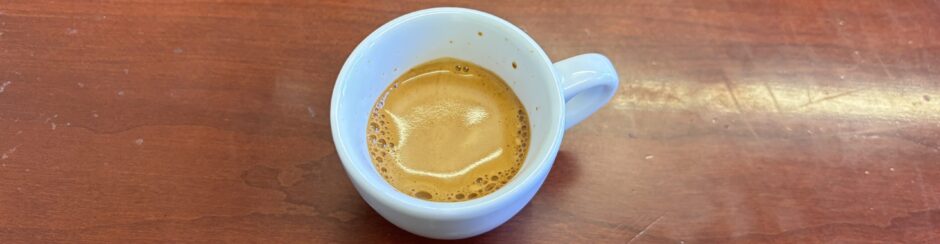
A flat white, please

Thanks to the New York Times, I can now order a flat white at my local cafe instead of an 8 ounce latte. Culture is coming to America, my friends!

Posted in Food, Waffle | Tagged , , , , | Leave a comment

Horizontal Vanishing Conjectures.

Let \(F\) be a number field, and let \(\mathbf{G}\) be a reductive group over \(F\), and let \(\Gamma\) be a congruence subgroup of \(\mathbf{G}(\mathcal{O}_F)\). I can hear BC objecting that this doesn’t make sense without extra choices; if you have such an objection, please make such choices. Matt and I have made various conjectures concerning the vanishing of the completed cohomology groups \(\widetilde{H}^{n}\) in the range \(n > q_0\), where \(q_0\) has been defined for all time by Borel and Wallach. (And what is \(q\), you ask? Well, having just consulted [BW] by downloading a pirated djvu copy, I can tell you that \(2q = \mathrm{dim}(G/K)\) [4.3, p.67]. What’s that, you say — \(q\) isn’t even always an integer? Nope!) Several cases of this conjecture were proved by Peter (in particular, in the Shimura variety context), but the general conjecture seems quite hard (not that the Shimura variety case was a cakewalk!). For example, when \(G = \mathrm{GL}(1)\), then \(q_0 = 0\) and the conjecture is equivalent to Leopoldt’s conjecture. To remind you, one way of stating Leopoldt’s conjecture is that the profinite topology on \(\mathcal{O}^{\times}_F \times \mathbf{Z}_p\) coincides with the topology coming from the \(p\)-adic topology — that is, units are close if they are close modulo powers of \(p\). In contrast, one can ask for the weaker statement that that the profinite topology on \(\mathcal{O}^{\times}_F \times \mathbf{Z}_p\) coincides with the congruence topology, namely, the topology coming from looking at units modulo \(N\) for any ideal \(N\). This turns out to be unconditionally true and not too difficult, although it is not quite as obvious as it may seem (the same can be said of LC). It motivates, however, the following conjecture:

Conjecture (Horizontal Vanishing) Let \(n > q_0\). Then the following direct limit vanishes

\(\displaystyle{\lim_{K} H^n(X(K),\mathbf{F}_p) = 0}\)

as \(K\) ranges over all compact open subgroups of \(\mathbf{G}(\mathbf{A}^f_F)\).

There is an equivalent formulation of this conjecture in terms of group cohomology for arithmetic lattices. Because the conjecture is known for \(\mathrm{GL}(1)\), one can also pass easily enough between \(\mathrm{SL}\) and \(\mathrm{GL}\). For example, for \(\mathrm{SL}_N(\mathbf{Z})\) and \(n > 2\) it has the following formulation: Any cohomology class in \(H^n(\mathrm{SL}_N(\mathbf{Z}),M)\) for a finite discrete module \(M\) capitulates in some congruence subgroup, providing that

\(\displaystyle{n > \left\lfloor \frac{N^2}{4} \right\rfloor}.\)

This vanishing is related to the concept of virtual cohomological dimension. The virtual cohomological dimension of a group \(G\) is the smallest integer \(m\) such that there exists a finite index subgroup \(H \subset G\) such that every cohomology class in degree \(> m\) capitulates in \(H\). The notion being considered here is what one gets by reversing the quantifiers — one only insists that the classes capitulate in smaller and smaller groups (in addition, we insist that \(H\) is a congruence subgroup, although that is not too restrictive when the rank is \(\ge 2).\) There is a trivial bound \(m \ge q_0\), but this bound is not at all sharp. Since this seems an a priori interesting notion, let’s define it:

Definition: pro-virtual cohomological dimension: Let \(G\) be a group, and let \(p\) be a prime. Say that \(\mathrm{pvcd}_p(G) < m\) if, for every discrete \(G\)-module \(M\) annihilated by \(p\), and every cohomology class \([c] \in H^n(G,M)\) for some \(n \ge m\), there exists a finite subgroup \(H\) so that the restriction of \([c]\) to \(H^n(H,M)\) vanishes. Say that \(G\) has pro-virtual cohomological dimension \(< m\) if \(\mathrm{pvcd}_p(G) < m\) for all \(p\).

I have nothing profound to say about whether this concept is relevant beyond the example at hand. As you can see for \(\mathrm{SL}_N(\mathbf{Z})\), the virtual cohomological dimension and pro-virtual cohomological dimension are conjecturally quite different, the latter being given conjecturally by the formula above (at least when \(N > 2\)), and the former by \(\displaystyle{\binom{N}{2}}.\)

I wanted to remark in this post that the Horizontal Vanishing conjecture is, at least after localization at a non-Eisenstein maximal ideal \(\mathfrak{m}\), a consequence of modularity lifting results (in the spirit of [CG]). Namely, the entire point of that method is that the patched complex has cohomology concentrated in a single degree (\(q_0\)), which amounts to saying that cohomology classes in \(H^{q_0 + i}(X(K),\mathbf{F}_p)\) can be annihilated after passing to some auxiliary level coming from some choice of Taylor-Wiles primes. Now many aspects of this argument are still conditional (note that to annihilate classes of deep \(p\)-power level, one would need corresponding local-global compatibility relating Galois representations associated to torsion classes to quotients of Kisin deformation rings, at the very least), but perhaps it is a less hopeless task than trying to prove Leopoldt’s conjecture.

It’s instructive to consider what is possibly the simplest case of this conjecture beyond Shimura varieties, namely, \(\mathrm{GL}(2)\) over an imaginary quadratic field (here \(q_0 = 1\), so the claim is that one can kill classes in \(H^2).\) Here at least one doesn’t have to worry about vanishing of cohomology outside the indicated range. Local-global compatibility is still a problem, but one possibly way to get around this is to work at all p-power levels at once, namely, to patch the completed cohomology groups. (Matt, Toby, and I chatted over roast duck at Sun Wah what patching completed cohomology for general groups should look like.) Since one certainly has Galois representations, one gets “for free” the fact that the patched modules are modules over the appropriate power series ring of the local deformation ring. On the other hand, as Matt cautioned at the ‘Pig, it is no longer so easy to do naive arguments with codimensions, because the patched objects are not finitely generated over the ring of diamond operators, but only over a non-commutative group algebra, which leads into questions relating to the size of the corresponding \(p\)-adic representations, which leads back to questions concerning local-global compatibility in \(p\)-adic local Langlands.

I wonder, however, if there are any softer arguments in any special cases.

Posted in Mathematics | Tagged , , , , , , , , , | Leave a comment

The Abelian House is not closed

Today I will talk about \(\displaystyle{\frac{97 + 26 \sqrt{13}}{27} = 7.064604\ldots}\)

For an algebraic integer \(\alpha\), the house \(\overline{|\alpha|}\) is the absolute value of the largest conjugate of \(\alpha.\) Kronecker proved the following:

  1. If \(\overline{|\alpha|} \le 1\), then either \(\alpha = 0\) or a root of unity.
  2. If \(\overline{|\alpha|} \le 2\) and \(\alpha\) lives in a CM field, then \(\overline{|\alpha|} = 2 \cos \pi/N\).

The first claim is well known. The second claim follows from the first: the CM condition implies that the conjugates of the squares of the absolute value are the squares of the absolute values of the conjugates. Hence, if \(\zeta^2 + \zeta^{-2} = \overline{|\alpha|}^2 – 2\), then \(\zeta\) must be a root of unity by part one. On the other hand, beyond these two results, the respective values of \(\overline{|\alpha|}\) are dense in \([1,\infty)\) (general case) and \([2,\infty)\) (CM case). There are a number of ways to modify this problem. One way is to replace the largest conjugate \(\overline{|\alpha|}\) by the \(d\)-power mean of the absolute values:

\(\displaystyle{M_n(\alpha) = \left(\frac{1}{[{\mathbf{Q}}(\alpha):{\mathbf{Q}}]} \sum |\sigma \alpha|^n \right)^{1/n}}.\)

For such a construction, it makes the most sense to assume either that \(\alpha\) is totally real or lives in a CM field, so that \(|\sigma \alpha| = \sigma |\alpha|\). For example, if one lets

\(\mathfrak{M}_n = \{x \in (1,\infty) | x = M_n(\alpha), \ \sigma c \alpha = c \sigma \alpha\},\)

then Chris Smyth shows (MR0736460) that, for all \(n > 0\), the smallest elements of \({\mathfrak{M}}_n\) are isolated, whereas \({\mathfrak{M}}_n\) is dense for sufficiently large \(x\). In this post, we shall be interested in what happens when one restricts to the class of cyclotomic integers. Namely, let

\({\mathfrak{M}}^{{\mathrm{ab}}}_n = \{x \in (1,\infty) | x = M_n(\alpha) \ \alpha \in \mathbf{Q}^{\mathrm{ab}}\}.\)

In particular, when \(n = \infty\), we obtain the set \({\mathfrak{M}}^{{\mathrm{ab}}}_{\infty}\) consisting of the values \(\overline{|\alpha|}\) for cyclotomic integers \(\alpha\). We call \({\mathfrak{M}}^{{\mathrm{ab}}}_{\infty}\) the Abelian House. As already noted, the values of \({\mathfrak{M}}^{{\mathrm{ab}}}_{\infty} \cap [1,2]\) consist of elements of the form \(2 \cos(\pi/N)\), which includes \(2\) as a limit point. However, the spectrum of \({\mathfrak{M}}^{{\mathrm{ab}}}_{\infty}\) for a short while beyond \(2\) is once again discrete. For example, the main theorem of MR3119783 (previously discussed here) completely computes \({\mathfrak{M}}^{{\mathrm{ab}}}_{\infty}\) in the interval \([0,(5.04)^{1/2}]\) — it has a second limit point at \(\sqrt{5} = 2.2360679\ldots\) and is once again discrete beyond this point. The case \(n =2\) was studied in Cassels (MR0246852) and in MR2786219. In particular, Theorem 9.1.1 of MR2786219 is eqivalent to:

Proposition: The set \({\mathfrak{M}}^{{\mathrm{ab}}}_2 = \overline{{\mathfrak{M}}^{{\mathrm{ab}}}_2} \subset {\mathbf{R}}\) is closed.

Note that \(M_2(\alpha)^2 =: \mathcal{M}(\alpha) \in {\mathbf{Q}}\) (the notation \(\mathcal{M}\) being used in ibid, so this closed subset is countable and is thus very far from being dense. Moreover \(M_{2n}(\alpha)^n = M_2(\alpha^n)\), so the theorem above implies that the closure \(\overline{{\mathfrak{M}}^{{\mathrm{ab}}}_{2n}}\) is also countable and lives inside \({\mathbf{Q}}^{1/n} \cap {\mathbf{R}} \subset {\overline{\mathbf{Q}}} \cap {\mathbf{R}}\). The main goal of the current post is to generalize this result to the abelian house.

Theorem: The closure of the abelian house \(\overline{{\mathfrak{M}}^{{\mathrm{ab}}}_{\infty}}\) is a subset of \({\overline{\mathbf{Q}}} \cap {\mathbf{R}}\). If \(S \subset {{\mathfrak{M}}^{{\mathrm{ab}}}_{\infty}}\) is bounded, then \(\liminf S \in {{\mathfrak{M}}^{{\mathrm{ab}}}_{\infty}}\). However, \(\limsup S\) is not necessarily in \({{\mathfrak{M}}^{{\mathrm{ab}}}_{\infty}}\), that is, the abelian house itself is not closed.

One application of this is to the possible index of subfactors (see here and here for an overview of the problem):

Corollary A: Let \(\alpha \in {\mathbf{R}} \setminus {\mathbf{R}} \cap {\overline{\mathbf{Q}}}\) be a real transcendental number. Then there does not exist a finite depth subfactor \(A < B\) of index in the range \((\alpha – \epsilon, \alpha + \epsilon)\) for some \(\epsilon > 0\).

Corollary B: Let \(\alpha \in {\mathbf{R}} \cap {\overline{\mathbf{Q}}}\) be an algebraic number. Then there does not exist a finite depth subfactor \(A < B\) of index in the range \((\alpha, \alpha + \epsilon)\) for some \(\epsilon > 0\).

Corollary C: The set of indices of finite depth subfactors is a well-ordered subset of \(\mathbf{R}\) of ordinal type \(\omega^{\omega}\). (Random aside: Just like volumes of \(3\)-manifolds according to Thurston and Jørgensen.) I’m assuming here that it is easy enough to construct subfactors of index

\(\prod_{i=1}^{n} 4 \cos^2(\pi/p_i)\)

for distinct odd prime numbers \(p_i\).

Since the main context here is that such indices arise as the spectral eigenvalue of graphs, it might be helpful (for contrast) to note that this latter spectrum is dense in \([\sqrt{2+\sqrt{5}},\infty)\) (MR986863).

This theorem came from my bag of thesis problems. I actually expected it to be the case that \({{\mathfrak{M}}^{{\mathrm{ab}}}_{\infty}}\) was closed, but this turns out to be completely false. On the other hand, the argument I had in mind to prove this theorem was roughly correct. On the third hand, it turns out that the solution to this problem was almost entirely included in a paper of A.Jones from the ’70s (MR0437466) (using the method I roughly had in mind).

Rational Linear subspace of \(({\mathbf{R}}/{\mathbf{Z}})^k\) : Consider the standard torus \({\mathbf{T}}:=({\mathbf{R}}/{\mathbf{Z}})^k\) with coordinates \((x_1,\ldots,x_k)\). We define a rational linear subspace \(V\) of \({\mathbf{T}}\) to be the subspace cut out by any number of equations of the form:

\( \sum a_{i,j} x_i = c_j \)

for integers \(a_{i,j}\) and elements \(c_j \in {\mathbf{Q}}/{\mathbf{Z}}\). Topologically, \(V\) is finite disjoint union of tori. Any connected component of \(V\) is also a rational linear subspace. If all the \(c_j = 0\), then we call \(V\) a rational linear subgroup. Call a point \({\underline{x}} \in V\) rational if \({\underline{x}} = (x_1,\ldots,x_k)\) where \(x_i \in {\mathbf{Q}}/{\mathbf{Z}}\). Given \(V\), the rational numbers \(c_j\) have a common denominator; let \(M\) denote some integer divisible by this common denominator. The map \([m]: {\mathbf{T}} \rightarrow {\mathbf{T}}\) given by multiplication by \(m\) preserves \(V\) whenever \(m \equiv 1 \mod M\).

Definition: For any rational point \({\underline{x}}\) on \(V\) and an admissible integer \(M\), let \(L({\underline{x}}) = L_M({\underline{x}})\) denote the (finite) set of rational points of the form \([m] {\underline{x}} \in V\) for all \(m\) satisfying the following two conditions:

  1. \(m \equiv 1 \mod M\),
  2. \(m\) is prime to \(N\), where \({\underline{x}} = (x_1,\ldots,x_k)\) are elements of \({\mathbf{Z}}[1/N]/{\mathbf{Z}}\).

Of course, this definition comes from looking at the exponent of the conjugates of root of unity which fix an \(M\)th root of unity. We call \(L({\underline{x}})\) the line through \({\underline{x}}\). The notion of line depends on a choice of integer \(M\), although replacing \(M\) by a multiple only (at worst) decreases the size of \(L({\underline{x}})\). Our main technical lemma is the following:

Lemma A: Let \(S \subset V\) be any set of rational points, and let \(M\) be admissible for \(V\). Then the closure of \(W = \bigcup L({\underline{x}})\) of all lines \(L({\underline{x}}) = L_M({\underline{x}})\) for \({\underline{x}}\in S\) is a union of connected rational subspaces \(W^0\) of \(V\).

We shall apply this theorem to \(V = {\mathbf{T}}\) with \(M =1\). However, in order to prove the result (by induction), it is easier to prove this more general statement.

Example: Suppose that \(n = 2\), \(V = {\mathbf{T}}\), and \(M = 2\). If \({\underline{x}} = (1/2,1/q)\), then the line \(L({\underline{x}})\) consists of points of the form \((1/2,p/q)\) with \(p\) odd and prime to \(q\). The closure of all such points is the rational subspace \(x_1 = 1/2\).

We proceed by induction on the dimension of \(V\). We may first claim that we can assume \(V = V^0\) is connected. The connected components of a rational subspace are obtained by replacing the linear equations by their saturation. However, this requires introducing numerators into the constants \(c_j\), and so for this step (as well as several others) we must allow the auxiliary integer \(M\) to increase. If \(V\) is connected, it suffices to show that if the closure is not dense, then the points all lie on a (finite union of) co-dimension \(\ge 1\) rational subspaces \(W\) of \(V\), and then apply the inductive hypothesis.

Choose a rational base point \({\underline{v}} \in V\). After increasing \(M\) again if necessary, we may assume that \(M {\underline{v}} = 0\). Under this assumption, translation by \({\underline{v}}\) preserves lines and sends \(V\) to a connected rational linear subgroup of \({\mathbf{T}}\). After an integral change of basis, any connected rational linear subgroup is linearly equivalent to one of the form \(a_i x_i = 0\) for \(a_i\) either zero or one, and thus, again without loss of generality, we may assume that \(V = {\mathbf{T}}\). Now suppose that \({\underline{v}} \in V\) is a point which is not in the closure of the set of lines. Because the complement of the closure is open, we may assume that \({\underline{v}}\) is rational. Hence, once more translating by \({\underline{v}}\) and increasing \(M\) if necessary, it suffices to show that either \(0\) is in the closure of the set of lines, or the points are all contained in a subvariety defined by a linear equation. Let \({\underline{x}} = (x_1,\ldots,x_k) \in S\), where one may think of the \(x_i\) as being lifted to \({\mathbf{Q}}\). The problem is to construct an integer \(n\) with \(n \equiv 1 \mod M\) and \((n,N) = 1\) such that if \(\|x\|\) denotes the nearest integer to \(x\), then \(\|n x_i\| < \epsilon\) for all \(i\), or to show that all the \(x_i\) satisfy some linear relation in \({\mathbf{Q}}/{\mathbf{Z}}\). Without the congruence condition on \(M\), this is exactly a lemma proved by Davenport and Schinzel in MR0205926. Their proof does not obviously extend to this case, however. I had an idea to replace this analytic argument by using an idea of Cassels using the geometry of numbers. Write \(x_i = a_i/N\) where \(N\) is the smallest common denominator (so the greatest common divisor of the \(a_i\) is one). Let \(\Lambda \subset {\mathbf{Z}}^k\) denote the lattice

\(\Lambda := \{\lambda \equiv m (a_1,a_2, \ldots, a_k) \mod N, \quad m \in {\mathbf{Z}}\}.\)

The basic idea is to break up the problem into two steps: first, find an element of \(\Lambda\) of small length. If this element reduces under the natural map to \(\mathbf{Z}/N\mathbf{Z}\) to a multiple \(m\) of \((a_1,\ldots,a_k)\) which is prime to \(N\) and \(1 \mod M\), then one wins. If not, deform the element both other small vectors, and use the fact that (in an arithmetic progression) one doesn’t have to go very far to find elements prime to \(N\) (by Iwaniec, \(\log(N)\) or so will suffice). In the end, it turns out that this improved version is essentially proved by Jones in MR0437466. (For me, it is easiest to modify his proof of Theorem 1 than read the notation in some of the latter theorems, but all of the required content is here.) In fact, the application Jones had in mind was almost identical to the topic of this post, namely, to study the higher derived sets of \({\mathfrak{M}}^{{\mathrm{ab}}}_n\). For some reason, however, he did not seem to notice the implication that \(\overline{{\mathfrak{M}}^{{\mathrm{ab}}}_n}\) was a subset of \({\overline{\mathbf{Q}}}\), possibly because his formalism was less algebraic than what we consider below.

Consider an infinite set \(S\) of roots of \(k\)-tuples of roots of unity \((x_1, \ldots, x_k)\) which is closed under the action of \(\mathrm{Gal}({\overline{\mathbf{Q}}}/{\mathbf{Q}})\), and view it as a subset of \({\mathbf{G}}^k_m\). Say that a set of \(k\)-tuples of units are constrained by a \(k\)-tuple of integers \(h = (h_1,\ldots,h_k)\) if, for all such tuples,

\((x_1)^{h_1} (x_2)^{h_2} \ldots (x_k)^{h_k} \in \zeta^{{\mathbf{Z}}},\)

for some fixed root of unity \(\zeta\). Since this property is preserved under taking \(d\)th roots for any fixed \(d \in {\mathbf{Z}}\), we also insist that each constraining \(k\)-tuple consists of co-prime integers. A constraint cuts out a subvariety \(Z_h\) of \({\mathbf{G}}^{k}_{m}\), which in general is not geometrically connected. The intersection of any finite number of subvarieties \(Z_{h_i}\) is determined by the saturation of the subgroup of \({\mathbf{Z}}^k\) generated by the \(h_i\). In particular, there exists a maximal finite set of \(h_i\) such that \(Z:= \cap Z_{h_i}\).

Theorem: The supremum of the elements

\(|y_1 + y_2 + \ldots + y_k|^2\)

in \(S\) is equal to the supremum of the quantity

\(|z_1 + z_2 + \ldots + z_k|^2,\)

over \((z_1,\ldots,z_k) \in (S^1)^k \cap Z^0\), where \(Z^0 \subset Z\) is some geometrically connected component of \(Z^0\), and \(Z\) is a variety cut out by constraints for finitely many \(k\)-tuples. The infimum of the houses

\(\overline{|y_1+ y_2 + \ldots + y_k|}\)

is realized by an element of \(S\).

Pulling back under the isomorphism \(\exp: {\mathbf{T}} \rightarrow (S^1)^k \subset {\mathbf{G}}^k_m\), the pre-image of any geometrically connected component \(Z^0\) is a connected rational linear subspace of \({\mathbf{T}}\), and conversely any connected rational linear subspace gives rise to such a \(Z^0\). Write the pre-image of \({\underline{y}} \in S\) as \({\underline{x}} = (x_1, \ldots, x_k)\). Suppose that \({\underline{y}} = (y_1,\ldots,y_k)\) where each \(y_i\) is a roots of unity in \({\mathbf{Q}}(\zeta_N)\) (with \(N\) divisible by \(M\)), so that the denominators of the \(x_i\) divide \(N\). The action of \(G:=\mathrm{Gal}({\mathbf{Q}}(\zeta_N)/{\mathbf{Q}}(\zeta_M))\) on \({\underline{x}}\) via \(\exp^*\) sends \({\underline{x}}\) to \(m x\) for some \(m\) with \((n,m) = 1\). In particular, the conjugates on \(V\) precisely cut out the line \(L_M({\underline{x}})\) of \({\mathbf{T}}\) (with \(M = 1\)). It follows from Lemma A that the closure of \(\exp^*(S)\) consists of a finite union of connected rational subspaces \(W = \coprod W^0\), and hence the closure of \(S\) is the finite union of the sets \((S^1)^k \cap Z^0\) for a finite number of geometrically connected \(Z^0\). This proves the claim concerning the supremum. For the infimum, we argue as follows. There exists a component \(Z^0\) such that the infimum of the largest conjugate of \(y_1 + \ldots y_k\) on \(Z^0\) is equal to the infimum of the houses of elements of \(S\). Let the supremum of \(|z_1 + z_2 + \ldots + z_k|^2\) on this space be \(\beta\). If the desired infimum is equal to \(\beta\), then all elements must the same house, and the result follows immediately. If not, there exists a subset of \(S\) whose largest conjugates are bounded by \(\beta – \epsilon\). But such a set can no longer be dense in \((S^1)^k \cap Z^0\). Hence, replacing \(S\) by this smallest set, we may reduce the dimension of \(Z^0\). Continuing this process, we reduce to the case when either \(Z^0\) is a point or all the houses of elements are the same, and in either case the result follows. Note that the supremum of an algebraic function on \((S^1)^k \cap Z\) will automatically be algebraic — essentially by a rigidity argument. Alternatively, one can write down the equations required for a point to be a local minima, and observe that they are algebraic. To finish the proof of the main claim (except for the claim that \({{\mathfrak{M}}^{{\mathrm{ab}}}_{\infty}}\) is not itself closed) it suffices to note, following a result of Loxton, that any cyclotomic integer of absolute value at most \(B\) can be written as a sum of (at most) \(L(B)\) roots of unity, so, when dealing with the closure of \({{\mathfrak{M}}^{{\mathrm{ab}}}_{\infty}}\), it suffices to consider sums of \(k\) roots of unity for a fixed \(k\).

Returning to what Jones does, his main result is to consider the sets \({{\mathfrak{M}}^{{\mathrm{ab}}}_{\infty}}(k)\) of cyclotomic integers which are the sum of \(k\) roots of unity, and then prove that the \(k-1\)st derived set consists precisely of the element \(\{k\}\). In our context, it may seem as though the \(n\)-th derived set should consist precisely of the maxima of the natural function on the sets \((S^1)^k \cap Z\) where \(Z\) has codimension \(n\). However, there is an extra degeneracy coming from the fact that multiplication by a root of unity doesn’t change the house — so we may insist from the start that \(1\) is always one of the roots of unity of \(S\), imposing the condition \(x_1 = 1\).

The abelian house is not closed

We now prove that \(\overline{{{\mathfrak{M}}^{{\mathrm{ab}}}_{\infty}}} \ne {{\mathfrak{M}}^{{\mathrm{ab}}}_{\infty}}\) by constructing an explicit element of \(\overline{{{\mathfrak{M}}^{{\mathrm{ab}}}_{\infty}}}\) not in \({{\mathfrak{M}}^{{\mathrm{ab}}}_{\infty}}\). Indeed, the corresponding element will neither be cyclotomic nor an algebraic integer (although it will be algebraic). Consider the set of cyclotomic algebraic integers:

\(\beta = \zeta^2 + \zeta – \zeta^{-1}\)

\(\gamma = \zeta^2 + \zeta + \omega \zeta^{-1}\)

where \(\omega\) is a cube root of unity, and \(\zeta\) is (say) and \(p\)th root of unity for prime \(p\). For large \(p\), the Galois conjugates of \(\zeta\) become dense in the unit circle. It follows that the supremum of \(\overline{|\beta|}^2\) is the square of the maximum of the quantity

\(|X^2 + X – X^{-1}|\)

over \(|X|=1\), and similarly the supremum of \(\overline{|\gamma|}^2\) is the maximum of the two quantities

\(|X^2 + X + \omega X^{-1}|, \quad |X^2 + X – \omega^{-1} X^{-1}|,\)

over the same region. One can compute this maximum, and it turns out, perhaps surprisingly, that it is equal to the value

\(\displaystyle{\frac{97 + 26 \sqrt{13}}{27} = 7.064604\ldots} \)

in the first case, which is not an algebraic integer and so not in \({{\mathfrak{M}}^{{\mathrm{ab}}}_{\infty}}\), and is equal in the second case to

\(\displaystyle{\frac{1}{27} \cdot \theta = 8.096242\ldots}\)

where

\(\theta^5 – 446 \theta^4 + 62377 \theta^3 – 3023244 \theta^2 + 57168180\theta – 351065988 = 0,\)

and \(K = {\mathbf{Q}}(\theta)\) has discriminant \(2^2 \cdot 3^5 \cdot 15619\) and Galois closure \(S_5\). These are, perhaps, surprisingly ugly numbers for fairly simple looking maximization problems. It is clear, of course, that neither of these numbers lies in \({{\mathfrak{M}}^{{\mathrm{ab}}}_{\infty}}\), so this proves \(\overline{{{\mathfrak{M}}^{{\mathrm{ab}}}_{\infty}}} \ne {{\mathfrak{M}}^{{\mathrm{ab}}}_{\infty}}\). Moreover, I think it quite likely (and quite provable, perhaps with a certain amount of computational effort) that \(\displaystyle{\frac{97 + 26 \sqrt{13}}{27} = 7.064604\ldots} \) is the smallest number in \(\overline{{{\mathfrak{M}}^{{\mathrm{ab}}}_{\infty}}} \setminus {{\mathfrak{M}}^{{\mathrm{ab}}}_{\infty}}\).

Posted in Mathematics | Tagged , , , , , , , , , , , | Leave a comment

The distribution of Hecke eigenvalues, part II

Here are some numbers from KB promised in my last post.

“For the first 61595 newforms of squarefree level coprime to 15 here’s
the field extension of Z/3Z generated by the \(a_5\) field extensions:”

\([\mathbf{F}_3(a_5):\mathbf{F}_3]\) Total Number Number of Galois conjugacy classes Density of forms Density of conjugacy classes
Totals: 61595 10740 1 1
\(1\) 4623 4623 0.07505 0.4304
\(2\) 2492 1246 0.04046 0.1160
\(3\) 2397 799 0.03892 0.07439
\(4\) 2476 619 0.04020 0.05764
\(5\) 2600 520 0.04221 0.04842
\(6\) 2142 357 0.03478 0.03324
\(7\) 2289 327 0.03716 0.03045
\(8\) 2008 251 0.03260 0.02337
\(9\) 1962 218 0.03185 0.02030
\(10\) 1530 153 0.02484 0.01425
\(11\) 1837 167 0.02982 0.01555
\(12\) 1656 138 0.02689 0.01285
\(13\) 1612 124 0.02617 0.01155
\(14\) 1638 117 0.02659 0.01089
\(15\) 1455 97 0.02362 0.009032
\(16\) 1088 68 0.01766 0.006331
\(17\) 1292 76 0.02098 0.007076
\(18\) 1008 56 0.01636 0.005214
\(19\) 1159 61 0.01882 0.005680
\(20\) 1120 56 0.01818 0.005214
\(21\) 987 47 0.01602 0.004376
\(22\) 990 45 0.01607 0.004190
\(23\) 966 42 0.01568 0.003911
\(24\) 1056 44 0.01714 0.004097
\(25\) 1100 44 0.01786 0.004097
\(26\) 650 25 0.01055 0.002328
\(27\) 783 29 0.01271 0.002700
\(28\) 868 31 0.01409 0.002886
\(29\) 551 19 0.008946 0.001769
\(30\) 420 14 0.006819 0.001304
\(31\) 775 25 0.01258 0.002328
\(32\) 800 25 0.01299 0.002328
\(33\) 759 23 0.01232 0.002142
\(34\) 374 11 0.006072 0.001024
\(35\) 490 14 0.007955 0.001304
\(36\) 576 16 0.009351 0.001490
\(37\) 592 16 0.009611 0.001490
\(38\) 380 10 0.006169 0.0009311
\(39\) 429 11 0.006965 0.001024
\(40\) 680 17 0.01104 0.001583
\(41\) 492 12 0.007988 0.001117
\(42\) 294 7 0.004773 0.0006518
\(43\) 258 6 0.004189 0.0005587
\(44\) 308 7 0.005000 0.0006518
\(45\) 180 4 0.002922 0.0003724
\(46\) 322 7 0.005228 0.0006518
\(47\) 282 6 0.004578 0.0005587
\(48\) 144 3 0.002338 0.0002793
\(49\) 147 3 0.002387 0.0002793
\(50\) 350 7 0.005682 0.0006518
\(51\) 561 11 0.009108 0.001024
\(52\) 260 5 0.004221 0.0004655
\(53\) 106 2 0.001721 0.0001862
\(54\) 378 7 0.006137 0.0006518
\(55\) 0 0 0 0
\(56\) 112 2 0.001818 0.0001862
\(57\) 171 3 0.002776 0.0002793
\(58\) 406 7 0.006591 0.0006518
\(59\) 236 4 0.003831 0.0003724
\(60\) 120 2 0.001948 0.0001862
\(61\) 183 3 0.002971 0.0002793
\(62\) 62 1 0.001007 0.00009311
\(63\) 378 6 0.006137 0.0005587
\(64\) 320 5 0.005195 0.0004655
\(65\) 130 2 0.002111 0.0001862
\(66\) 132 2 0.002143 0.0001862
\(67\) 201 3 0.003263 0.0002793
\(68\) 68 1 0.001104 0.00009311
\(69\) 276 4 0.004481 0.0003724
\(70\) 140 2 0.002273 0.0001862
\(71\) 284 4 0.004611 0.0003724
\(72\) 144 2 0.002338 0.0001862
\(73\) 292 4 0.004741 0.0003724
\(74\) 74 1 0.001201 0.00009311
\(75\) 0 0 0 0
\(76\) 152 2 0.002468 0.0001862
\(77\) 0 0 0 0
\(78\) 78 1 0.001266 0.00009311
\(79\) 79 1 0.001283 0.00009311
\(80\) 160 2 0.002598 0.0001862
\(81\) 81 1 0.001315 0.00009311
\(82\) 0 0 0 0
\(83\) 83 1 0.001348 0.00009311
\(84\) 168 2 0.002727 0.0001862
\(85\) 85 1 0.001380 0.00009311
\(86\) 0 0 0 0
\(87\) 0 0 0 0
\(88\) 0 0 0 0
\(89\) 89 1 0.001445 0.00009311
\(90\) 0 0 0 0
\(91\) 0 0 0 0
\(92\) 0 0 0 0
\(93\) 0 0 0 0
\(94\) 0 0 0 0
\(95\) 95 1 0.001542 0.00009311
\(96\) 0 0 0 0
\(97\) 0 0 0 0
\(98\) 0 0 0 0
\(99\) 0 0 0 0
\(100\) 0 0 0 0
\(101\) 0 0 0 0
\(102\) 0 0 0 0
\(103\) 0 0 0 0
\(104\) 104 1 0.001688 0.00009311

I’ve presented the numbers KB send me in various ways. The first column simply counts the field generated by \(a_5\). The second column normalizes by the order of the field. This is a little like counting two representations which differ by an automorphism of the coefficient field as being “the same.” The final two comments are then the proportion of the first two columns overall.

I’m really not quite sure what to make of this data. It does suggest that A is false, which is perhaps not surprising. It’s not terribly overwhelming evidence for B, but then, law of smaller numbers and all.

AV’s suggestion in the comments that the constants \(C_q\) should be independent of \(q\) must refer to the constants in the second last column, I believe. Of course, it might be the case that \(\mathbf{F}_3(a_5)\) is smaller than \(\mathbf{F}_3(a_2,a_5,a_7,a_{11},\ldots)\), so these numbers aren’t exactly the same as the fields generated by the mod-\(p\) reductions of the eigenforms. If you squint, the numbers in this column do look somewhat constant for \(n < 10\) or so. One can even argue that \(n = 1\) might be artificially inflated exactly because the phenomenon of "slipping into a subfield" mentioned above. So I'm giving the points to AV. (Yes, that's right, there were points available and you missed out because you didn’t play the game.)

Posted in Mathematics | Tagged , , , , , | Leave a comment