A Preview of Barbados/Bellairs

This post is probably not so interesting unless you plan to travel to the Caribbean in a few weeks. The website for the conference is offline, so I thought I might update attendees on what might be happening, at least those who read my blog.

There are two hours of talks in the morning by me and two hours of talks in the evening. Warning: the paragraphs below are not necessarily in one-to-one correspondence with talks.

Part I: I will give an overview of the Taylor-Wiles method in something approaching its original formulation (so without Kisin’s modifications). I may give the circular proof of modularity for \(\mathrm{GL}(1)\) as an example. I will then start talking about modular forms of weight one. I will give the details of local-global compatibility as proved in my paper with David, first in the irreducible case, and then via a modification of this method in the general case (using results which will be in Joel Specter’s thesis).

Background I: Jared and Peter will give a background talk on the geometry of Shimura varieties, with an emphasis on the case of modular curves, and (possibly) also that of Siegel 3-folds (threefolds?).

Part II: I will introduce the general strategy developed by myself and David to prove modularity lifting in the \(\ell_0 = 1\) and \(\ell_0 = \ell_0\) situations, in particular, the details of our patching lemma. I will outline how the method naturally breaks up into several different constituent problems (constructing Galois representations, proving local-global compatibility, proving vanishing of cohomology outside certain ranges, representation theoretic problems arising from Taylor-Wiles primes). I will then apply these strategies to prove minimal modularity lifting theorems for weight one modular forms in the residually irreducible setting.

Background II: David(?) will talk about Kisin’s modification of the Taylor-Wiles method. Toby Gee will talk about how to prove local-global compatibility and what that means in a (somewhat) general setting.

Part III: I will discuss the geometry of local deformation rings for \(\mathrm{GL}(2)\). Topics to be covered here include classical questions of multiplicity one and two, as well as non-minimal modularity lifting theorems in weight one.

Background III: Sug Woo will discuss the relation between cohomology and automorphic forms and how the Eichler-Shimura isomorphism generalizes to higher dimensions. Jack Thorne will discuss Taylor-Wiles primes for \(\mathrm{GL}(n)\).

Part IV: I will talk about my work with David concerning minimal modularity lifting theorems for low weight Siegel modular forms. This will consist of generalizing some of the ingredients from \(\mathrm{GL}(2)\), such as local-global compatibility results, and vanishing results of Lan-Suh. I also discuss an approach to Taylor-Wiles primes in the torsion setting for \(\mathrm{GL}(n)\).

Part V: I will talk about completed cohomology in low degree. I shall explain my results with Matt on the stability of completed cohomology, and the computation of these groups using \(K\)-theory.

Related Research: I have asked a number of people to talk about their recent work on topics related to this conference. This includes George Boxer who has agreed to talk about coherent cohomology and generalized Hasse invariants, and Ila Varma who will talk about local-global compatibility for non-self-dual representations at \(\ell \ne p\).

Posted in Mathematics, Travel | Tagged , , , , , , , , | Leave a comment

The Decline of Western Civilization

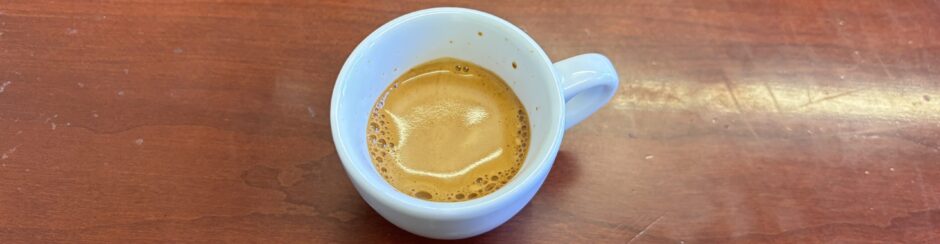
I am often inclined on Saturdays to spend a few hours at the Brothers K cafe. I bring my laptop and some scratch paper, sip away on a cortado, and listen to music on my headphones as I work; it is a pleasant way to pass the time. That is, until the cafe instituted an “open mic night” on early Saturday evenings, which I unfortunately encountered last weekend. The entire enterprise seems more for the benefit of the very small number of people who run the show rather than for the actual patrons. As for me, one moment I was industriously working away and the next I was aurally assailed and had to make a hasty path to the exit. All this, mind you, while I was listening to the Dichterliebe. The horror! It’s enough to make one choke on one’s smoked salmon sandwiches.

One thing that makes the Dichterliebe so wonderful is the piano score, which transcends mere accompaniment. To mention just one example, I love how the piano finale in XVII is foreshadowed in part XII. It’s fun to play and fun to listen to; here is Fischer-Dieskau in an 1956 recording.

Posted in Music, Waffle | Tagged , , | Leave a comment

Are Galois deformation rings Cohen-Macaulay?

Hyman Bass once wrote a paper on the ubiquity of Gorenstein rings. The first time they arose in the context of Hecke algebras, however, was Barry’s Eisenstein ideal paper, where he proves (at prime level) that the completions \(\mathbf{T}_{\mathfrak{m}}\) are Gorenstein for all non-Eisenstein maximal ideals \(\mathfrak{m}\) of \(\mathbf{T}\) except possibly those which are ordinary of residual characteristic two. He also shows that the completions at Eisenstein primes are also Gorenstein, although this is trickier and makes fundamental use of the assumption that the level is prime. The Gorenstein property of various Hecke at non-Eisenstein maximal ideals was crucially used by Wiles to deduce non-minimal modularity lifting theorems. In the late 90’s, including around the time I started graduate school, it seemed as though all Hecke algebras in weight two were going to be Gorenstein (localized at non-Eisenstein ideals). One case remained, however, namely when \(\mathrm{char}(k) = 2\), and

\(\overline{\rho}: G_{\mathbf{Q}} \rightarrow \mathrm{GL}_2(k)\)

has the property that \(\overline{\rho}\) is unramified at \(2\) and, moreover, the image of Frobenius at \(2\) is a scalar. (The other cases having been dealt with by results of Mazur, Wiles, Ribet, and Buzzard.) But then it turned out, amazingly, that \(\mathbf{T}\) was not always Gorenstein. Lloyd Kilford found a counter-example at level \(N = 431\). The natural place to look, of course, is at \(\mathrm{GL}_2(\mathbf{F}_2) = S_3\)-representations. They have to come from a quadratic field \(K\) with class number divisible by three and such that \(2\) splits completely in the corresponding unramified degree three extension of \(K\). It also makes sense to work at prime level, because this will make computing the integral Hecke ring easier. The condition that \(2\) splits in \(K\) forces \(\Delta_K\) to be congruent to \(1 \mod 8\), which certainly means the class number is odd. The condition that \(2\) split in the corresponding cubic field is more subtle; if the class number of the field was \(3\), then this would be equivalent to the primes in \(K\) above \(2\) splitting principally in \(K\), but this can’t happen for norm reasons. So one has to start with a quadratic field \(K\) with \(\Delta_K \equiv 1 \mod 8\) and class number \(h = 3h’\) for some \(h’ > 1\), and such that the class given by \([\mathfrak{p}]\) for the prime above \(2\) does not generate the 3-Sylow subgroup. The smallest prime number with this property is … \(N = 431\). So it fails at the first opportunity! As Kevin once joked to me in a statement that sums up the best of all attitudes towards advising: “If I had known it was going to be that easy, I would have done it meself!”

Nowadays we know, at least in the analogous context when \(p\) is odd and we are in weight \(p\), that the appropriate Hecke algebras are Cohen-Macaulay. But we understand that the reason that these global Hecke algebras have these properties is because the *local* Hecke algebras have nice properties. The idea of deducing facts about the global Hecke algebra in the process of proving modularity lifting theorems started with Diamond, who found the first improvement to the Taylor-Wiles method. Essentially, given an \(R=\mathbf{T}\) theorem, one has a presentation of \(\mathbf{T}\) as a quotient of a (power series over a) local deformation ring by a sequence of parameters. If the local deformation rings are nice (Complete Intersections, Gorenstein, Cohen-Macaulay, etc.) then so is the global Hecke ring. Now this is only true in the contexts where \(\ell_0 = 0\); otherwise one is taking the quotient by “too many” relations (that is, not a sequence of parameters), and so there’s no longer any reason to expect that \(\mathbf{T}\) has those nice properties unless \(\ell_0 = 1\) and \(\mathbf{T}\) is finite.

So now we come to the question: are all local deformation rings Cohen-Macaulay? Well, perhaps there is not really any reason to suppose that they are. Perhaps even worse, there is a paper by Fabian Sander, a student of Vytas, proving that a certain deformation ring is not Cohen-Macaulay. But I am not deterred. My issue is that one has to take the correct deformation ring. And the correct deformation ring is the one that should include the extra data corresponding to the local Hecke operators which may not come (at an integral level) from the Galois representation.

To take a well known example, consider ordinary \(p\)-adic representations of weight \(p\). From a characteristic zero ordinary representation, one can always recover the (unique) eigenvalue of Frobenius on the unramified quotient. But this is not possible at the integral level, because (for example) \(\overline{\rho}\) could be locally trivial. This exactly corresponds to the fact that in weight \(p\), the Hecke operator \(T_p\) does not have to lie in the algebra generated by the other Hecke operators (the “anemic” Hecke algebra — was that term coined by Ken Ribet?). In order to prove modularity theorems, it usually suffices to work with the anemic Hecke algebra, but when one does include data which captures \(T_p\) (or \(U_p\)) the local deformation ring is (in this case) Cohen-Macaulay, as was shown by Snowden. So, for example, I would conjecture that the ordinary deformation ring (in any dimension) which includes the local Galois information corresponding to *all* the Hecke operators is Cohen-Macaulay.

Is there any real evidence for this guess besides the fact that it would be useful? Well, not really. But it would provide a systematic local Galois explanation for why deformation rings are torsion free, which is consistent with the guess that, appropriately defined, one should latex \(R = \mathbf{T}\) theorems on the nose, not just after looking at (say) \(\mathrm{MaxSpec}\). Of course, all of this is in the residually globally irreducible setting. Note that one reason to care about integral modularity statements is that most of the time, one would expect both \(R\) and \(\mathbf{T}\) to be torsion anyway.

Posted in Mathematics | Tagged , , , , , , , | Leave a comment

Robert Coleman

I was very sad to learn that, after a long illness with multiple sclerosis, Robert Coleman has just died.

Robert’s influence on mathematics is certainly obvious to all of us in the field. Most of my personal interaction with him was during my last two years as a graduate student at Berkeley. We would chat in his office, and sometimes have lunch at Nefeli caffe. Kevin and I had recently made some modest progress on Kevin’s crazy slope conjectures, and much of that time with Robert was spent with me presenting crazy ideas and predictions on the white board in Evans Hall while Robert looked on with his classic look of amused skepticism. There would also be the occasional wine and cheese in his office, especially if an old visitor was in town.

I certainly didn’t know him as well as many others did, but I felt very honored that he asked me to accompany him (as a grad student assistant) to China for his ICM address. As it happened, the relevant hotels in China would not allow him to bring Bishop (his guide dog) along with him, so he didn’t end up going.

Mathematically, Robert was very original. I have no plans to attempt to summarize his research, but I just want to discuss one problem which he had thought about in recent years, namely, what the eigencurve looked like at the boundary of weight space — especially in light of the description given by Kevin and Lloyd Kilford when \(N = 1\) and \(p = 2\). Suppose one is given a Fredholm determinant

\(\mathrm{det}(1 – U T) = P(T) = 1 + \sum_{n=1}^{\infty} a_n T^n\)

where \(a_n \in \Lambda = \mathbf{Z}_p[[X]]\), and one wants to understand the spectrum of \(U\) at the “boundary” of weight space, that is, when the valuation of \(X\) goes to zero. For example, an interesting collection of points near the boundary are the classical points with highly ramified nebentypus character. If \(a_n\) is not divisible by \(p\), then the valuation of \(a_n\) at a specialization of \(X\) close to one will co-incide with the valuation of the reduction mod-\(p\) of \(a_n\) as an element of the discrete valuation ring \(\mathbf{F}_p[[T]]\), that is, it will be determined by the smallest non-zero coefficient of \(a_n\) modulo \(p\). Robert’s idea was to study the “halo” of the eigencurve, which intuitively speaking, should be an object cut out by a compact operator \(U_{\chi}\) in characteristic \(p\) with characteristic power series \(P(X) \mod p\). If the valuations of the elements \(a_n(X) \mod p\) define a Newton Polygon \(N\), then the Newton Polygon at some point on the eigencurve which is sufficiently close to the boundary should be a simple multiple of \(N\). This is one of my favourite problems! I know Robert has some ideas on how to approach this problem, but unfortunately I don’t know exactly what they were or how much progress he had made. One natural question is whether this structure will ultimately be purely explainable in terms of \(p\)-adic local Langlands. One even more basic question is what happens numerically on components of the eigencurve corresponding to a representation \(\overline{\rho}\) which is absolutely irreducible after restriction to a decomposition group at \(p\); I presume one sees the same behavior, but has anyone checked this? Perhaps the easiest example to check would be to compute the slopes of forms on \(S_2(\Gamma_1(11 \cdot 2^n),\chi)\), where \(\chi\) has conductor \(2^n\).

Matt Baker has some further recollections of Robert here, and he also invites his readers to share there memories there.

Posted in Uncategorized | Tagged , , | Leave a comment

The Thick Diagonal

Suppose that \(F\) is an imaginary quadratic field. Suppose that \(\pi\) is a cuspidal automorphic form for \(\mathrm{GL}(2)/F\) of cohomological type, and let us suppose that it contributes to the cohomology group \(H^1(\Gamma,\mathbf{C})\) for some congruence subgroup \(\Gamma\) of \(\mathrm{GL}_2(\mathcal{O}_F)\). Choose a prime \(p\) which splits in \(F\) so that \(\pi\) is ordinary at \(v|p\). Hida proves that the corresponding cohomology class lives in a Hida family \(\mathcal{H}\) over the appropriate weight space, which in this case is (up to connected components) just \(\Lambda = \mathbf{Z}_p[[X,Y]]\). However, unlike the classical situation, this Hida family will not be flat, because the specialization to any local system which is not invariant under complex conjugation is necessarily finite. Thus the support \(D\) of \(\mathcal{H}\) has co-dimension at least one over \(\Lambda\). Hida proves that it does indeed have co-dimension one.

What does the support \(D\) of \(\mathcal{H}\) look like? Let us suppose that we are normalizing \(\Lambda\) so that the point \(X = Y = 0\) corresponds to \(\pi\). One can imagine two possibilities:

  1. \(D\) contains the diagonal \(\Delta: X = Y\).
  2. the components of \(D\) passing through \(X = Y = 0\) only contains finitely many classical points.

It seems as though these are the only possibilities. Certainly, by a Zariski closure argument, \(D\) either contains the diagonal \(\Delta\) or intersects it in finitely many points. Hence, it is true that if the first condition does not hold, then the components passing through \([0,0]\) contain only finitely many crystalline automorphic forms. However, there could be more classical points on \(D\), namely, those of parallel weight but non-parallel finite order nebentypus character. To be concrete, the possible points of \(\mathrm{Spec}(\Lambda)\) which may give rise to automorphic forms have (with some normalization) the following shape:

\(1+X \mapsto (1+p)^k \zeta, \qquad 1+Y \mapsto (1+p)^k \xi,\)

where \(\zeta\) and \(\xi\) are \(p\)-power roots of unity, and \(k\) is a non-negative integer. So one is really considering not simply the intersection of \(D\) with the diagonal \(\Delta\), but with the thick diagonal \({\Delta\kern-0.6em{\Delta}}\), which is the union of the infinitely many translates of \(\Delta\) by \(p\)-power roots of unity. In particular, the Zariski closure of \({\Delta\kern-0.6em{\Delta}}\) is all of weight space.

I wrote a paper with Barry Mazur where, as an illustrative example, we found an explicit Hida family which did not satisfy the first condition and claimed that it therefore satisfied the second, whereas we should only have made the weaker claim that \(D\) (which was irreducible in this particular case) contains only finitely many crystalline points. (The main point of the paper was, by studying infinitessimal deformations of Artin representations, to give evidence that \(D\) should only ever contain the diagonal when \(\pi\) is either a base change form or CM.) The error was pointed out to me by David Loeffler.

I am pleased to say, however, that my student Vlad Serban has overcome this error! Namely, suppose one has a non-trivial power series \(\Phi(X,Y) \in \mathbf{Z}_p[[X,Y]]\), and suppose that

\(\Phi((1+p)^k \zeta – 1,(1+p)^k \xi – 1) = 0\)

for infinitely many triples \((k,\zeta,\xi)\) with \(k\) a non-negative integer, and \(\zeta\), \(\xi\), \(p\)-power roots of unity. Let \(D\) be a component of the zero set \(\Phi(X,Y) = 0\) passing through \((0,0)\). Then, after possibly replacing the roles of \(X\) and \(Y\), Vlad proves the following. Either:

  1. \(D\) contains the diagonal \(\Delta\),
  2. \(\Phi(\zeta – 1, \zeta^N – 1) = 0\) for all \(p\)-power roots of unity \(\zeta\), for a fixed \(N \in \mathbf{Z}_p\).

Certainly the latter is possible, because one could have \(\Phi(X,Y) = (1+X)^N – (1+Y)\). In fact, he proves a more general theorem than this for all the components (not necessarily passing through \((0,0)\). After translation, this amounts to working over ramified extensions of \(\mathbf{Z}_p\).

This theorem allows one to prove (with finite computation) that any particular \(D\) only contains finitely many points (when that is true). It also shows, without any computation at all, that \(D\) either contains \(\Delta\), or it only contains finitely many classical points of weight different from \(\pi\). A nice way to think about this theorem is that it is of the flavour as the multiplicative Manin-Mumford conjecture. That is, one is intersecting a sub-variety with a particular arithmetically defined discrete set (inside \({\Delta\kern-0.6em{\Delta}}\)), and one wants to deduce that this can only happen for a well defined geometric reason. In fact, if one replaced \(\Phi(X,Y)\) by a polynomial with coefficients over \(\mathbf{C}\) and specialized to the case when \(k\) is always zero, then this would exactly be the Multiplicative Manin-Mumford conjecture in two dimensions.

As a special case, letting \(k = 0\), one ends up with the following pretty result. Suppose that \(\Phi(X,Y) \in \mathbf{Z}_p[[X,Y]]\) is a power series, and suppose that

\(\Phi(\zeta_1 – 1,\zeta_2 – 1) = 0\)

for infinitely many pairs of \(p\)-power roots of unity. Then the zero set of \(\Phi\) contains a translate of \(\mathbb{G}_m\). This exactly answers the puzzle asked by Jordan here. Explicitly, it says that the only quotients of \(\mathbf{Z}_p[[\mathbf{Z}^2_p]]\) of co-dimension one which have lots of “arithmetic” points really do come from a one-dimensional subgroup!

I think that this special case (with \(k = 0\)) is probably easier than the general case, because one has other methods available. The argument was, however, inspired by a result of Hida which came up during his last number theory seminar at Northwestern. Translated into the language of this post, Hida’s rigidity lemma corresponds to the puzzle of Jordan above in the case when \(\Phi(X,Y) = Y – F(X)\) for some function \(F(X) \in \mathbf{Z}_p[[X]]\).

Posted in Mathematics, Students | Tagged , , , , , | 6 Comments

The congruence subgroup property for thin groups.

I finally had a chance to visit Yale, which (by various orderings) is the fanciest US university at which I had never given a talk (nor even visited). The town itself struck me, at first, as a cross between Oxford and New Jersey. That aside, my coffee research led me to Blue State Coffee, which was more than up to the task of preparing a decent 8 ounce latte. (As a comparison, it is significantly better than Small World Coffee in Princeton. Small World has all the correct hipster attitude without enough of the corresponding aptitude.) Mathematically, I had a great chat with Hee Oh and Gregg Zuckerman over several hours. At one point, I raised the following idle question about thin groups.

Question: Let \(G = \mathrm{SL}_N(\mathbf{R})\) where \(N > 2\). Let \(\Gamma\) be an arithmetic lattice in \(G\). Suppose that \(\Phi \subset \Gamma\) is a subgroup such that the following two conditions are satisfied:

  1. The Zariski closure of \(\Phi\) in \(G\) is \(G\).
  2. The induced map of profinite completions: \(\widehat{\Phi} \rightarrow \widehat{\Gamma}\) is injective.

Then is \(\Phi\) necessarily of finite index in \(\Gamma\)?

If \(\Gamma = \mathrm{SL}_N(\mathbf{Z})\), then the first condition implies that the image of the induced map of profinite completions has finite index; I presume this is true more generally. Hence the question asked can be phrased as follows: “can congruence subgroups be determined by their pro-finite completions?” Alternatively, in the opposite direction, one can ask: “are there thin groups which satisfy the congruence subgroup property?” I have no particular reason to believe that the answer to the question above is positive, and I might even guess that one could write down a counter-example, but I don’t know how to write one down myself.

On the other hand, suppose that the answer to the question is positive. Then it might prove useful for determining whether, given a finitely presented group \(H:=\langle G \ | \ R \rangle\) and an explicit homomorphism:

\(\phi: H \rightarrow \Gamma\)

whether its image has finite index or (even more strongly) whether \(\phi\) is an isomorphism onto a finite index subgroup. Namely, if the image of \(\phi\) does not have finite index, then a positive answer to the question above would imply that \(H\) must have a finite quotient which does not come from \(\Gamma\), and (since finite quotients of \(H\) may be enumerated) this leads to an algorithm which terminates if \(\phi\) has infinite index. On the other hand, if \(H\) does have such a quotient, then certainly \(\phi\) will not be an isomorphism onto a finite index subgroup.

This problem explicitly came up in some work of Curt McMullen (see question 5.6 of this paper), who produced explicit maps of various finitely presented groups into lattices (not quite in \(\mathrm{SL}_N(\mathbf{R})\), but one can of course ask the more general question for lattices in semi-simple groups of rank at least two) and asked whether these maps were isomorphisms onto finite index subgroups. So the hope is that (in the contexts in which one expected the answer to be negative) this could always be answered by considering the pro-finite completion of the finitely presented group in question. Alas, I believe that I explicitly tried to find non-congruence quotients of the associated explicitly presented groups (in contexts where one expected \(\phi\) to have infinite index) and didn’t find any (not that I carried out this computation in anything approaching a sophisticated manner, of course).

Posted in Mathematics, Travel | Tagged , , , , , , | Leave a comment

Short thoughts on my visit to Berkeley

The marine biologists at Monterey Bay Aquarium give their octopuses hand massages. So do the fishmongers at Eataly.

It’s quite an experience to come face to face with this antediluvian monster: Monster

Are you allowed to turn right on red in California? I hope so, because I did so at every opportunity.

Almost mathematics is an endless source of almost humor.

Matt complained that I was not live blogging the hot topics conference from MSRI. But given that they record all the lectures, it seemed somewhat unnecessary.

The winter olympics are still on; don’t forget the greatest ever moment in winter olympic history (video in Dutch, but then Dutch sounds pretty much like English):

Does one ever tire of watching the sunsets in Berkeley?

Wine tasting with Ken in Arlington. Why do I not yet have a wine subscription from Kermit Lynch?

Heavyweight matchup: userxxx versus answer_bot live!

The pork burrito from Gordo Taqueria was simply the best burrito I have had for a very long time.

The initial letters of “perfectoid space” and “Peter Scholze” are both PS. Coincidence? You decide.

What foods do you miss from your native land (those of you who are immigrants)? Answers included sour cherries and instant custard.

A tip to anyone planning to visit wineries in Napa valley: don’t casually turn up around 5:00 only to find that many tasting rooms close before then.

The Maître d’ at Chez Panisse Cafe asked me to give my best wishes to Hendrik Lenstra.

Popular consensus was that the only way the conference could have been better was if Peter Scholze had given every talk.

Cheeseboard Pizza versus Sliver: Cheeseboard wins with a tapenade pizza.

Going to Berkeley and having lunch at MSRI is like going to the grand canyon and never leaving the visitor’s center.

Babette is the place to have lunch and hipster coffee near campus; hat-tip to Tony Wirth.

Kiran is happy that his research is now a hot topic.

Is “perfectoid” a portmanteau of “perfect” and “affinoid” or does it mean “somewhat perfect”?

And men of mathematics now-a-bed
Shall think themselves accurs’d they were not here,
And hold their manhoods cheap whiles any speaks
That thought with us upon this Pres’dents’ day.

Posted in Travel, Waffle | Tagged , , , , , | Leave a comment

Local crystalline deformation rings

I just returned from a very pleasant conference in Puerto Rico courtesy of the Simons Foundation (general advice: if you live in Chicago, always accept invitations to conferences in January). One thing I learnt from Toby Gee was the following nice observation. Suppose that

\(\overline{\rho}: G_{\mathbf{Q}} \rightarrow \mathrm{GL}_2(\mathbf{F}_p)\)

is a modular Galois representation, which for convenience we shall assume is unramified outside \(p\). Consider deformations of this representation which are crystalline with fixed Hodge-Tate weights \([0,k-1]\) where \(k\) is even. According to Kisin, the global minimal crystalline deformation ring contains a point on every component of the corresponding local crystalline deformation ring. (All discussions of components refer to the generic fibres.) One natural question is how many components the local deformation rings actually have (when the weight is very small, it’s usually the case that there is only one such component and it is smooth — this was crucial in the original Taylor-Wiles method before Kisin). For higher weight, one can distinguish between components which are “ordinary” and “not ordinary”, but it is not clear what else there is. (Indeed, Kisin seemed to think some years ago that this would be it, using the meta-argument that amongst any finite set one should be able to distinguish different points by some naturally available property.)

Now suppose we also now assume that \(\overline{\rho}\) is locally reducible. According to Buzzard’s conjectures, all the slopes of the global crystalline lifts of \(\overline{\rho}\) will be integral. Suppose one wants to prove this by local methods. Then one is ultimately led to conjecturing that each component of the local crystalline deformation ring has a fixed integral slope (recall we are in the locally reducible case, this is certainly false for locally irreducible representations in general). As a first consequence, one sees that in very high weights there will be many different components. Moreover, if one takes a different
global representation \(\overline{\varrho}\) which is the same locally as \(\overline{\rho}\), then the set of slopes arising from lifts of \(\overline{\varrho}\) will be the same as for \(\overline{\rho}\). These ideas do not quite give a complete conjectural explanation of why Buzzard’s slope conjectures are true, but it is a good start.

Something that is a little disturbing in this picture, however, is the case when \(\overline{\rho}\) is reducible. It becomes clear that, in high weight, there will be many crystalline representations with reducible residual representations, but the set of components of local crystalline deformation space which have a global point will be a proper subset of the set of components (assuming that components can be distinguished by slope).
For example, all the slopes at level one when \(p = 2\) are (besides the Eisenstein series) \(\ge 3,\) but there certainly exist modular forms of higher tame level with the same local residual representation of slope one. So is there any way to predict when a reducible representation will have a global lift on any component of local deformation space?

In fact, the failure of lifts in the reducible case is an old problem. In the most naive sense, one can find reducible representations at levels where there are no cusp forms, but to play the game honestly we should also allow (globally) reducible lifts. Perhaps the first genuine example corresponds to extensions:

\(1 \rightarrow \mathbf{Z}/p\mathbf{Z} \rightarrow V \rightarrow \mu_p \rightarrow 1\)

where the extension is completely split at \(p\) but ramified at an auxiliary prime \(N\). These representations are locally split and so certainly admit local lifts (namely, \(\mathbf{Z}_p \oplus \mathbf{Z}_p(1)\)). If \(p > 3,\) then such extensions exist whenever \(N \equiv \pm 1 \mod p\), but (by Mazur) one knows that there exist weight two level \(\Gamma_0(N)\) lifts only when \(N \equiv +1 \mod p\) (in fact, one can prove the analogous claim that there only exist global crystalline lifts with the appropriate conductors under the same congruence condition). This is related to the general problem of understanding when certain reducible representations can be lifted to cusp forms, which seems to be a tricky problem (Ken Ribet’s student Hwajong Yoo has thought about this).

This also reminds me of a fact I learnt from Kevin Buzzard. Take the representation

\(\rho: G_{\mathbf{Q}} \rightarrow \mathrm{GL}_2(\mathbf{Q}_2)\)

associated to the cusp form \(\Delta\). Then there exist lattices for this representation such that the corresponding residual representation is any one of the four (three non-split) extensions of \(\mathbf{Z}/2\mathbf{Z}\) by itself which are unramified outside \(2\). (Question: does this immediately imply the same is true for all \(2\)-adic representations coming from level one modular forms?)

Posted in Mathematics | Tagged , , , , | Leave a comment

Gross Fugue

Here are some variations on the theme of the last post, which is also related to a problem of Dick Gross.

In this post, I want to discuss weight one modular forms where the level varies in the “vertical” aspect (that is, \(N\) is a growing power of a fixed prime, rather than simply an increasing integer). First of all, consider the spaces

\(S_1(\Gamma(M \cdot \ell^n),\mathbf{C})\)

for fixed \(M\) and growing \(n\). For example, if \(M = 1\), the corresponding Galois representations are associated to number fields unramified outside a single prime \(\ell\). Given a cusp form \(f\), the twists \(f \otimes \chi\) by a finite order character of \(\ell\)-power order will also be modular (possibly with larger \(n\)), so all the finiteness statements below should be interpreted “up to twist.”

The first observation is that there exist only finitely many exceptional cusp forms (with projective image \(A_4, S_4, A_5\)) because, by a theorem of Hermite, there are only finitely many fields with a fixed Galois group unramified outside a fixed set of primes. (This echos a very general conjecture which says [very loosely] that if one fixes an infinitesimal character and varies the level in a \(\ell\)-adic tower, one should only see finitely many automorphic forms which do not arise via functoriality from constructions using discrete series.)

The second observation is that all the other cusp forms are easy to describe: they are induced from finite order characters of a fixed number of easily determined quadratic fields \(K\).

So far so good. But what happens if one replaces \(\mathbf{C}\) by \(\mathbf{F}_p\), or more generally \(\mathbf{Q}_p/\mathbf{Z}_p\)? Here is the following optimistic guess:

Question: For a fixed prime \(p \ne \ell\), are there only a finite number of non-liftable forms in the \(p\)-power tower?

Here we have to take the usual caveats — not only do we have to take into account twisting, but also the \(\mathbf{GL}_2(\mathbf{Q}_{\ell})\)-action (old forms).

This question is supposed to be a \(\mathrm{GL}(2)\)-analogue of Washington’s famous theorem on the \(p\)-part of the class group in the \(\ell\)-adic cyclotomic tower. We shall see that it is more than an analogy.

What will the source of torsion classes be?

  1. One source are Galois representations: \(\overline{\rho}: G_{\mathbf{Q}} \rightarrow \mathrm{GL}_2(\mathbf{F}_q)\) with big image that are unramified outside \(\ell\) (with \(q\) a power of \(p\)). Of course there are only finitely many such representations for any fixed \(q\), but some heuristics I learnt from Akshay convince me that there should only be finitely many even if one varies \(q\) over all powers of \(p\) (taking into account twisting, of course).
  2. Another source of torsion comes from deformations of big image Galois representations \(\overline{\rho}\) as above, or from representations with projective image one of the exceptional groups. Since each unramified deformation ring will be finite, each \(\overline{\rho}\) should only give rise to finitely many extra torsion classes.
  3. A third source of torsion classes comes from reducible indecomposable representations. The residual representations \(\overline{\rho}\) which arise in this way occur when \(L(0,\chi)\) is divisible by \(p\) for an odd character \(\chi\) of finite order. In particular, there are only finitely many such representations which occur exactly if all but finitely many \(L\)-values \(L(0,\chi)\) are prime to \(p\), where \(\chi\) is an odd character of conductor \(M\) times a power of \(\ell\). But this exactly the content from Washington’s Theorem (the oddness assumption is not, however, necessary).
  4. The final class come from deformations of dihedral representations. If \(\overline{\rho}\) is the induction of a character \(\psi\) of \(K/\mathbf{Q}\), then the tangent space to the unramified deformation ring of \(\overline{\rho}\) gives rise to torsion classes when there are no everywhere unramified classes in \(H^1(\mathbf{Q},\mathrm{Ind}(\psi/\psi^c))\) — the unramified dihedral representations in \(H^1(\mathbf{Q},\eta_K)\) are seen globally. By inflation-restriction, this is equal to a certain invariant part of the class groups of the anti-cyclotomic tower. There are non-vanishing results concerning L-values of Hida that are relevant here, although I haven’t checked to see if they imply the finiteness statement or not.

The only way to start thinking about answering this question is to think in terms of the torsion in the cohomology of modular curves. But, I confess, I do not really have any ideas on how to prove it. (To be honest, I still find Washington’s proof very mysterious.)

On related matters, it would be nice if one could prove — say by analytic means — that \(H^1(X_H(N),\omega)\) has torsion (prime to \(N\)) for all sufficiently large \(N\). Taking \(N\) to be a power of a prime, this would give a different construction of non-solvable Galois representations unramified outside a single prime (for all \(\ell\)) from the one suggested by Dick and carried out in for \(\ell \in \{2,3,5,7\}\) by Dembélé and others. Moreover, although (as in those examples) it would involve the group \(\mathrm{PSL}_2(\mathbf{F})\) as a simple factor, the residue characteristic would be different from \(\ell\) rather than equal to \(\ell\) in the previous constructions. (George Schaeffer told me he tried computing torsion coming from \(X_H(343)\) but didn’t find any.) It might also (for suitable \(H\)) give a lower bound for \(\pi_1(\mathcal{O}_{K})\) where \(K = \mathbf{Q}(\sqrt{-D})\) which is better (at least for some primes) than one gets from class numbers.

Posted in Mathematics | Tagged , , , , , | Leave a comment

The mystery of the primes

No, this is not the sequel to Marcus du Sautoy’s book, but rather a curious observation regarding George Schaeffer’s tables of “ethereal” weight one Katz modular eigenforms (which you can find starting on p.64 here). Let \(N\) be a positive integer, let \(\chi\) be an odd quadratic character of conductor dividing \(N\), and let \(p\) be an a prime not dividing \(N\). Recall that the reduction map between spaces of Katz modular forms:

\(M_1(\Gamma_1(N), \chi, \mathbf{Z}_p) \rightarrow M_1(\Gamma_1(N), \chi, \mathbf{F}_p)\)

is not surjective in general, although it will be surjective for all but finitely many \(p\). For what pairs \((N,p)\) is the map not surjective? As originally observed by Mestre (and predicted by Serre), such pairs do exist. One way to think of the primes which arise in this way are as the primes dividing the torsion subgroup of \(H^1(X_H(N),\omega)\), where \(H \subset (\mathbf{Z}/N \mathbf{Z})^{\times}\) is the subgroup of squares, and \(X_H(N)\) is the corresponding modular curve (as a stack, if necessary) over \(\mathbf{Z}[1/N]\). The reduction mod-p map is Hecke equivariant; let \(\mathfrak{m}\) denote a maximal ideal of \(\mathbf{T}\) in the support of the cokernel. Associated to \(\mathfrak{m}\) is a Galois representation:

\(\overline{\rho} = \overline{\rho}_{\mathfrak{m}}: G_{\mathbf{Q}} \rightarrow \mathrm{GL}_2(\overline{\mathbf{F}}_p)\)

which is unramified at primes not dividing \(N\) (including \(p\)). It is not necessarily the case that \(\overline{\rho}\) does not lift to characteristic zero, although this is typically the case for the examples arising in the tables (and is always the case if the image of \(\overline{\rho}\) contains \(\mathrm{SL}_2(\mathbf{F}_q)\) for some \(q > 5\)). Not surprisingly, it turns out there are no such forms for small \(N\). The reason is that the fixed field \(K\) of the kernel of \(\overline{\rho}\) would be a high degree field with a root discriminant which (for very small \(N\)) would violate the GRH discriminant bounds of Odlyzko, and for smallish \(N\) would still give fields of unusually low root discriminant.

Of course, as \(N\) increases, there do exist many such forms, sometimes in quite large characteristic. However, something peculiar happens in the range of the tables, namely, there is not a single example with \(N\) prime. This leads to the (incredibly) vague question: can this be predicted in advance? If there is going to exist a \(\mathrm{PGL}_2(\mathbf{F}_{199})\) representation unramified outside \(N\) for small \(N\), is it more likely that \(N = 82\) (see here) rather than \(N = 83\)? One can try to use heuristics predicting the number of fields with certain ramification behavior, but these heuristics are much better behaved for fixed Galois groups \(G = \mathrm{PGL}_2(\mathbf{F}_p)\) or \(G = \mathrm{PSL}_2(\mathbf{F}_p)\) and increasing discriminant, not in the regime of fixed root discriminant and Galois group \(G\) as above for varying \(p\). Is there any conspiracy ruling out certain kinds of number fields with small root discriminant ramified at a single prime? For example, if you fix some arbitrary constant, say \(M = 1000\), do there exist infinitely many primes \(p\) such that there is a number field \(K\) different from \(\mathbf{Q}\) which is unramified away from \(p\) and has root discriminant less that \(M\)?

These questions are hard to pin down, because they are really questions concerning the law of small numbers. Namely, they ask about the behavior/distribution of various quantities in the range before asymptotic behavior begins. Since the asymptotic behavior is (in these contexts) already mostly conjectural, it’s probably hard to say anything intelligent about these even more delicate questions. (Idle question: are there similar problems for which one does understand what happens before the asymptotic regime begins, even heuristically?)

Here’s one reason to consider these questions. Suppose one wants to compute “ethereal” Siegel modular forms. At what level does one first expect to find such forms? The numerics above suggest that it might be easier to find such forms at small composite levels rather than prime levels. Is that a reasonable inference?

Posted in Mathematics | Tagged , , , , , | Leave a comment