5 x 5

Perhaps my favourite non-classical album is Time Out by the Dave Brubeck quartet. The most well known piece from that album is “Take Five”, and not undeservedly so. Its distinctive time signature is instantly recognizable, and the saxaphone hook sounds good even on a 80386 running chessmaster 2000. To honour Brubeck (who died recently), here are five different recordings of Take Five.

First, here’s the original 1959 recording which appears on the album:

http://www.youtube.com/watch?v=5RpfoH0drZ8

Second, here’s a recording from 1961:

Next, here’s another recording from ’61. As with the previous recording, the underling structure is very similar. However, note the funky chord on the piano at 0:44 (and a related chord at 0:35 in the second version) which isn’t in the original (where it would occur at 0:49). In the original, there’s a vanilla Eb minor chord (first inversion) paired together with an F in the base line (the piece is in Eb minor, BTW). In the later versions, one still has the F, but now the Eb minor chord has become Eb major in the second inversion. Brilliant!

Moving on, here’s a 1964 recording, which for the first time has some improv on the piano. (The projection onto chronological distance between recordings does a pretty good job preserving the metric which measures differences between harmonic improvisations.)

http://www.youtube.com/watch?v=fOEVfhceVYI

Finally, here’s a 1966 recording; things have gone crazy at this point – the accompaniment has changed, and the drum solo (considered by some [although not me] to be the highlight of the piece) has gone.

http://www.youtube.com/watch?v=faJE92phKzI

Posted in Music | Tagged , , , | Leave a comment

A plea to my Australian readers

It used to be the case that one could listen to grandstand’s coverage of the cricket while following along on cricinfo. Now, the ABC blocks anyone with an IP address outside of Australia from listening in. Does anyone in Australia have a VPN password/connection they can tell me without being in danger of getting fired? Alternatively, does anyone have any technical advice on how to (legally) spoof the ABC so it thinks I’m in Australia? I don’t want to go without my boxing day cricket…

Posted in Cricket | Tagged , , , | Leave a comment

The Two Cultures of Mathematics: A Rebuttal

Gowers writes thoughtfully about combinatorics here, in an essay which references Snow’s famous lectures (or famous amongst mathematicians – I’ve never met anyone else who has ever heard of them). The trouble, however, starts (as it often does) with the invocation of the word “obvious”:

It is equally obvious that different branches of mathematics require different aptitudes.

I do not think that this claim stands up to scrutiny. By “aptitude,” Gowers specifically distinguishes the following two abilities: problem-solving and theory-building. Here algebraic number theory is singled out as area which is firmly tilted towards theory-builders. Yet the vision of algebraic number theory as a rising sea with progress signaled by the application of (to quote Gowers) deep theorems of great generality is not, in my opinion, an accurate reflection on reality.

A good lemma is worth a thousand theorems. Gowers describes various principles of combinatorics which (he suggests) play the role of (a direct quotation again) precisely stated [general] theorems. Yet examples similar to his are readily available in algebraic number theory. Consider, for example, the following Lemma of Ribet (modified from its original formulation):

If a reducible representation \(U \oplus V\) of a group \(G\) deforms continuously into an irreducible representation of \(G\), then either there exists a non-trivial extension of \(U\) by \(V\), or an extension of \(V\) by \(U\).

As a mathematical result, this is not particularly deep. For example, if \(G\) is finite, it relates two well known facts: there are no extensions between irreducible representations (Maschke’s theorem), and representations of finite groups are defined over number fields (and so do not deform). Yet this lemma is a crucial ingredient behind many key results (Ribet’s construction of unramified extensions, the proof of the main conjecture of Iwasawa Theory by Mazur-Wiles, the non-triviality of the Selmer group of an ordinary Elliptic curve with \(L(E,1) = 0\) by Skinner-Urban, and many more). It seems to me (as in the examples Gowers discusses) that the value of this lemma is not in its difficulty, but in the principle it encapsulates: in order to construct extensions of \(U\) by \(V\), try to deform \(U \oplus V\).

It is a common graduate student error to imagine that mathematics consists merely of judicious applications of highly technical machinery. But I am not accusing Gowers of making this mistake; I would expect him to argue that algebraic number theory is not exclusively the domain of theory-builders, but rather only strongly slanted in that direction, and to that end, he might point to Grothendieck. A fascinating essay on Grothendieck may be found here. Grothendieck contrasts his own way of thinking with that of Serre, whom he describes as using the hammer and chisel approach, which might loosely be considered synonymous to “problem-solver” (and I would count Serre as someone who has worked in algebraic number theory). Note that, despite the merits of Grothendieck’s work, he famously failed to prove the Weil conjectures (by “failing” to prove the standard conjectures) and it required Deligne’s use of the tensor power trick (a problem solving technique par excellence) to finish the argument. Thus, while Grothendieck’s role in modern number theory is significant, it would be an error to imagine that it constitutes the whole subject.

Perhaps Gowers would instead argue that what set combinatorics apart from (say) algebraic number theory is not that it requires problem solvers while the latter field does not, but that (in contrast) it is the exclusive domain of problem solvers. There’s a hint of this opinion in the following quote:

One will not get anywhere in graph theory by sitting in an armchair and trying to understand graphs better.

Why is this claim any more convincing than the same statement with the word “graphs” replaced by the word “rings”? I don’t see any a priori reasons why there cannot be a Grothendieck of graphs. If the history of mathematics teaches us anything, it is that the nature of a subject can change quite radically over a relatively short period of time (say 30 years). I am not claiming that there is no difference between combinatorics an algebraic number theory. There may well be a difference in the overall structure of the field, the level of background, the need to understand ideas in a broader conjectural framework, etc. And I might also consider agreeing to the claim that these fields, as they are currently constituted, may well be better suited to different personalities. But it is my opinion that the divide between the type of mathematics required for either subject is not as great as Gowers claims it is.

Gowers main point is that a significant part of the mathematical establishment looks down on combinatorics as not being “deep”, and that this attitude is both harmful and ignorant. On this point, I think that Gowers criticisms are fair, accurate, and valuable. It’s undeniably true that there are many graduate students who fall in love with formalism to the detriment of content, and milder forms of this predujice are pervasive throughout mathematics. To this end, I think Gowers’ essay is timely and relevant. However, I can’t help but sense a little that, perhaps after having spent a career defending combinatorics against ignorant snobs, Gowers suffers from the opposite prejudice, where “theory-builders” are a short distance away from empty formalists, sitting comfortably in their armchairs thinking deep thoughts, studying questions so self referential that they no longer have any application to the original questions which motivated them (this sense also comes from reading some of the remarks on the Langlands programme here).

Posted in Mathematics, Waffle | Tagged , , | Leave a comment

Hilbert Modular Forms of Partial Weight One, Part II

Anyone who spends any time thinking about Hilbert modular forms of partial weight one — see part I — should, at some point, wonder whether there actually exist any examples, besides the “trivial” examples arising as inductions of Grossencharacters. Fred Diamond asked me this very question at Fontaine’s birthday conference in March of 2010. There are various reasons why one should not expect to prove this by pure thought, including the possibility that (for certain levels) there may exist no such forms, and that at any level there may exist only finitely many such forms (more on these heuristics another time). Thus the only way I can really imagine showing that such a beast exists is by explicitly finding an example.

As of today, my students Richard Moy and Joel Specter have found such a form! Here is (roughly) the strategy they use. As with computing weight one classical modular forms, one starts by computing a basis of \(q\)-expansions in some regular weight, divides by some Eisenstein series, takes the intersection of that space with its Hecke translates, and hopes that the resulting space has bigger dimension than the space of CM forms (which one can compute in advance). There are a few hiccoughs which occur along the way, of course. How does one compute \(q\)-expansions of Hilbert modular forms? Since computing uniformizations of surfaces is not realistic, they use the fact that (fortunately!) the \(q\)-expansion of a Hilbert modular form can be recovered from its Hecke eigenvalues. On the other hand, by Jacquet-Langlands, a Hilbert modular eigenform over (say) a real quadratic field corresponds to an eigenform on the arithmetic manifold associated to a quaternion algebra which is ramified at all infinite places, which then allows one to pass from the Hilbert modular variety to an adelic quotient which is now a finite set. Lassina Demebele wrote a magma programme which computes the eigenvalues for Hilbert modular eigenforms by this method, although for some reason the programme requires the level to be squarefree, and the character to be trivial. Using Atkin-Lehner theory, one can construct the entire space of forms by this method.

In practice, Richard and Joel worked with \(F =\mathbf{Q}(\sqrt{5})\), computed the forms of level \(\Gamma_0(N)\) (with \(N\) squarefree) and weight \([4,2]\), then divided by an Eisenstein Series of weight \([1,1]\) level \(\Gamma_1(N)\) and character \(\chi^{-1}\), then computed the Hecke operator \(T_2\) on this space and intersected away. Many (many) bugs later, and various annoying steps overcome (to take a random example, magma can compute the L-values of Hecke characters necessary to find constant terms of Eisenstein series [nice] but only as a complex number, not as an algebraic number [not so nice] so “L-value recognition” had to be coded in), the progams finally worked, and after much grinding away (for all squarefree \(N\) of norm less than \(500\)) they didn’t find anything at all (or at least, anything besides CM forms).

So they started working in weight \([6,2]\), computed away, and eventually found a form \(\pi\) of weight \([5,1]\), level \(\Gamma_1(14)\), and character \(\chi\), where \(\chi\) has conductor \(7\) and is of order \(6\). The coefficient field of the eigenform is, I believe, \(\mathbf{Q}(\sqrt{5},\sqrt{-3},\sqrt{-19})\) (note that it must contain the base field as well as the field of the character). Note that this automorphic form \(\pi\) is Steinberg at \(2\)! In particular, it is not CM, and one doesn’t know whether local-global compatibility holds for the corresponding \(p\)-adic Galois representations even restricted to \(2\).

I should say that finding the form actually turned out to be easier than proving the form exists rigorously. Theoretically, the proof should be easy: one has found a form \(F/E\) for some cuspform \(F\) and some Eisenstein series \(E\) which looks like it is holomorphic. All one needs to do is square it (so it becomes regular), find a candidate form \(G\) of weight \([10,2]\) such that \(G E^2 – F^2 = 0\) (which one can prove since the spaces are finite dimension), and then \(E/F\) has no poles and is thus holomorphic. The problem is that the form \([10,2]\) has non-trivial character, and Lassima’s program only works with trivial character. One can take the \(6\)th power and work with a form of weight \([30,6]\), but this is way beyond what magma can cope with. In the end, Richard and Joel had to come up with a few tricks to do this (which took about three months!), but the final computations are in, and the existence has now been proven.

Posted in Mathematics, Students | Tagged , , , , | 6 Comments

There are no unramified abelian extensions of Q (almost)

In my class on modularity, I decided to explain what Wiles’ argument (in the minimal case) would look like for \(\mathrm{GL}(1)/F\). There are two ways one can go with this. On the one hand, one can try to prove (say) Kronecker-Weber using Selmer groups, but avoiding any kind of circularity (by not assuming class field theory). On the other hand, one can allow oneself to be completely circular in an effort to concentrate on the technical details of Wiles’ arguments. This post concerns the latter, and we “prove” the following:

Theorem: Let \(F\) be a number field which does not contain \(\zeta_p\). Then the Galois group of the maximal abelian extension of \(F\) unramified everywhere is isomorphic to the \(p\)-part of the class group.

To prove this, we will (only) assume the following:

  • Local class field theory.
  • For any ray class group of \(F\), there exists a corresponding abelian ray class field whose Galois group is the ray class group (this is half of global class field theory).
  • The abelian extensions coming from the ray class group are compatible with local class field theory (this is local-global compatibility).
  • The Wiles-Greenberg Selmer group formula.
  • The first three assumptions for \(F = \mathbf{Q}\) are equivalent to giving oneself the cyclotomic extensions and understanding their ramification properties. The last assumption, of course, contains every part of global class field theory (making the argument circular).

    Let \(\Gamma_{\emptyset}\) denote the Galois group of the maximal pro-\(p\) abelian unramified extension of \(F\).
    Let \(\Gamma_{Q_N}\) denote the corresponding group where ramification is allowed at some set of primes \(Q_N\) not containing \(p\), where one also insists that the order of inertia at primes in \(Q_N\) is at most \(p^N\). Formally, we have the universal deformation rings

    \(R_{\emptyset} = \mathbf{Z}_p[[\Gamma_{\emptyset}]], \qquad R_{Q_N} = \mathbf{Z}_p[[\Gamma_{Q_N}]],\)

    and we also have the universal “modular” deformation rings

    \(\mathbb{T}_{\emptyset} = \mathbf{Z}_p[[(F^{\times}\backslash \mathbb{A}^{\times}_{F}/U)^F]], \qquad \mathbb{T}_{Q_N} = \mathbf{Z}_p[[(F^{\times}\backslash \mathbb{A}^{\times}_{F}/U_Q)^F]].\)

    Here $M^F$ denotes the biggest finite quotient of $M$, \(U\) is the obvious maximal open compact, and \(U_Q\) is the variant of \(U\) such that \(U_v = \mathcal{O}^{\times}_v\) is replaced by \(U_{Q_N,v} = \mathcal{O}^{\times p^N}_v\) for \(v \in Q_N\). The half of global class field theory we are assuming gives us a compatible diagram of maps \(R_{Q_N} \rightarrow \mathbb{T}_{Q_N}\) and \(R_{\emptyset} \rightarrow \mathbb{T}_{\emptyset}\). The Wiles-Greenberg formula gives us an equality:

    \(\dim |H^1_{\emptyset}(F,\mathbf{F}_p)| – \dim |H^1_{\emptyset^*}(F,\mathbf{F}_p(1))|= – (r_1 + r_2 – 1),\)

    where for this computation we use that \(\zeta_p \notin F\). In order to annihilate the dual Selmer group, we need to annihilate classes in \(H^1(F,\mu_p)\), which come from extensions \(F(\zeta_p,\sqrt[p]{\alpha})\). We can do this in the usual way, but we have to assume (again) that \(\zeta_p \notin F\), since otherwise one cannot annihilate the class defined over \(F(\zeta_{p^2}) = F(\zeta_p,\sqrt[p]{\zeta_p})\) using a prime \(q \equiv 1 \mod p^2\). We see that we can annihilate the dual Selmer group with \(q:=|Q_N| = \dim H^1_{\emptyset} + (r_1 + r_2 – 1)\) primes. What are the auxilary rings \(S_N\) here? As rings, they are

    \(S_N = \mathbf{Z}_p[(\mathbf{Z}/p^N \mathbf{Z})^q]\)

    the action on \(R_{Q_N}\) is via the inertia group at the auxiliary primes. To make this work, one needs local class field theory; this shows that inertia at \(q\) is acting via \(\mathcal{O}^{\times}_q/\mathcal{O}^{\times p^N}_q\). The action of \(S_N\) on \(\mathbb{T}_{Q_N}\) is given by the structure of \(\mathbb{T}_{Q_N}\) as a module over \(\mathbf{Z}_p[U/U_Q] \simeq S_N\). The compatibility of these actions is given by the compatibility of local and global class field theory. Moreover, if \(\mathfrak{a}_N\) is the augmentation ideal of \(S_N\), then \(R_{Q_N}/\mathfrak{a}_N = R_{\emptyset}\) by definition, and \(\mathbb{T}_{Q_N}/\mathfrak{a}_N = \mathbb{T}_{\emptyset}\) by construction. Thus, in the usual way, one ends up with a map \(R_{\infty} \rightarrow \mathbb{T}_{\infty}\) where:

  • \(R_{\infty}\) is a quotient of a power series ring with \(q – (r_1 + r_2 – 1)\) variables.
  • \(S_{\infty}\) is a power series ring in \(q\) variables.
  • The final thing to understand is the structure of \(\mathbb{T}_{\infty}\) as a module over \(S_{\infty}\). At level \(Q_N\), the annihilator in \(S_N \simeq \mathbf{Z}_p[U/U_Q]\) of \(\mathbb{T}_{Q_N}\) is given by the image of the global units. By Dirichlet’s Theorem, this is generated by at most \(r_1 + r_2 – 1\) generators (assuming again that \(\zeta_p \notin F\)). By patching, it follows (in the limit) that \(\mathbb{T}_{\infty}\) has co-dimension at most \(r_1 + r_2 – 1\), and thus (from dimension considerations) that \(\mathbb{T}_{\infty} = R_{\infty}\), and then (after taking the quotient by \(\mathfrak{a}_{\infty}\)) that \(R_{\emptyset} \simeq \mathbb{T}_{\emptyset}\), which proves that \(\Gamma_{\emptyset}\) is the \(p\)-part of the class group. Note that (as expected) when gluing, we need to take into account all the (finitely many) possible \(R/\mathfrak{m}^N\), \(\mathbb{T}/\mathfrak{m}^N\), the possible maps from the global units to \(S_N\), &. &.

    edit: In order to see the “circularity” more clearly, one may compute the Selmer groups directly. The group \(H^1_{\emptyset}(F,\mathbf{F}_p)\) is equal to \(\Gamma_{\emptyset}/p\), by definition. On the other hand, the group \(H^1_{\emptyset^*}(F,\mu_p)\) by the Kummer sequence is equal to \(\mathcal{O}^{\times}/\mathcal{O}^{\times p} \oplus \mathrm{Pic}^0(\mathrm{Spec}(\mathcal{O}_F))[p]\), and thus the Greenberg-Wiles formula is equivalent to the equality:

    \(|\mathrm{Pic}^0(\mathrm{Spec}(\mathcal{O}_F))[p]| = |\Gamma_{\emptyset}/p \Gamma_{\emptyset}|\)

    or equivalently the claim that the maximal exponent \(p\)-quotient of the class group captures all exponent \(p\)-unramified extensions. (I guess this is very very slightly weaker than \(\Gamma_{\emptyset} \otimes \mathbf{Z}_p \simeq \mathrm{Pic}^0(\mathrm{Spec}(\mathcal{O}_F)) \otimes \mathbf{Z}_p\)).
    Posted in Mathematics, Uncategorized | Tagged , , , | Leave a comment

    The union thugs at the AMS

    After twice failing to achieve a 2/3 majority on previous votes, the AMS busted up the filibuster and railroaded through their new fellows program. The initial implementation was based on having achieved one of several things, the easiest of which was to have given an invited AMS address. There was, however, another condition: you had to have been a full fee paying member of the AMS from 2010 onwards. I had given such an address, but I was not a member of the AMS – mostly out of indifference rather than anything else. The AMS had clearly accounted for this possibility; they were offering indulgences in exchange for cash: for a price, you could retroactively purchase AMS membership for 2010 and 2011 (this was in 2012) and all your sins would be forgiven. There was some ambiguity as to whether one’s invited address had to be before or after Jan 1 2012 (mine was after), and in the end, I did not pony up the cash, and I am not an AMS Fellow (nor, to take a selection of other members of my department, is Andrei Suslin or Kari Vilonen).

    I don’t want to argue here about the merits of this particular program (see some opinions here), but I want instead to ask: should I become a member of the AMS? My department chair is (gently) applying some pressure for me to do so. The issues are mainly financial and moral. It is admissible for me to pay my dues with startup funds; this means that there is no immediate personal cost, although, as my startup funds are by no means infinite, this might eventually have a direct impact on my wallet. On the other hand, some have suggested that having such a fellowship will ultimately be better for one’s salary (this is hard to quantify, however). Note also that it is not so clear how easy it will be to become a member in the near future – there are presumably some really good mathematicians who have not given AMS invited addresses. Finally, there’s the moral argument: I feel a mild distaste concerning the notion that unless I pay up, the AMS will officially sanction my research output as not up to scratch. But maybe one could argue instead that the AMS does all sorts of wonderful things which mitigate such behavior. Please give me your thoughts!

    Posted in Politics | Tagged , | Leave a comment

    András Schiff Plays Bach

    The first Bach CD I ever bought was András Schiff’s recording of the Well Tempered Clavier. My memory is a little hazy, but I think I paid almost $100 (AUS) for the 4-CD set (I ordered it through Allans Music on Collins Street: your typical 20th century classical music store which, in addition to selling CDs, charged exorbitant prices for sheet music which can now be legally downloaded in massive quantities here). I had a chance to see Schiff play live in 2000 (at the Barbican), but, after a tip off from the NY times, I found out he was also giving a Bach recital at Chicago Symphony Hall. His played the complete second book from the 48 (composed, incidentally, 20 years after the first). It was an intense performance that lasted almost three hours, and was one of the best concerts I’ve been to in a while (the audience, as might be expected from a solo Bach concert, was younger and better behaved than the usual crowd of wheezing octogenarians). Schiff eschews the use of the pedal in Bach completely, which perhaps is easier to do when you have such amazing legato.

    It was a little tough finding the right video to post – most of the Well Tempered Clavier on Youtube by Schiff is from his 80’s recording, not his recent one. But then I found this snippet from a masterclass, and, although it’s not the WTC (it’s my favourite Partita), just from listening to the first five seconds of the Rondeau (about 30 seconds in) you get a sense of his magical touch. (Plus, you also get to see Fred Armisen in character as Harry Potter playing the piano!)

    Posted in Music, Uncategorized | Tagged , , , , | Leave a comment

    The Bourgeois Pig is dead to me

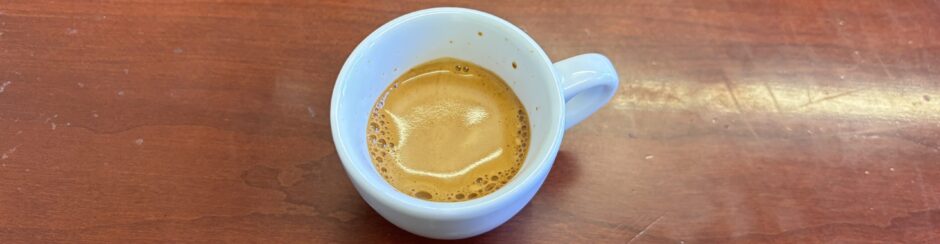
    While on the way to meet up with BF, I stopped by and ordered an 8 ounce latte at the Pig. The result: a foamy scalding hot disaster which brought great shame upon hipster cafes everywhere. It was so bad, I brought it back to the cafe without drinking it. Why would I ever go there again when Intelligentsia is only three minutes drive away? Pig, you are dead to me and I shall not return.

    Posted in Food, Waffle | Tagged , , , | Leave a comment

    How I deal with technical support

    I usually manage to avoid having to make any of those annoying calls to banks, credit card companies, utility companies, etc. because DW does it all for me. However, there are times (for example, when things are in my name) in which I have to make the call. I have, however, a fairly successful strategy for making these calls run smoothly. Namely, I ask whether they think Sachin Tendulkar should retire or not. More than half the time, it leads to better service.

    Posted in Uncategorized, Waffle | Tagged , | Leave a comment

    Schoenberg

    The best show on television…is surely classic arts showcase. It’s RAGE for classical music, by which I mean something like an eclectic classical music version of MTV (during the 80’s). Given the limited range of classical music that makes it onto the radio, it’s one of the few sources to discover “new” music. One clip that particularly electrified me was Christine Schäfer’s performance of Pierrot Lunaire: (apologies for the poor quality):

    I thoroughly recommend the dvd which I own; it also contains a smashing performance of Schumann’s Dichterliebe. (Added personal bonus: the lyric Nach Bergamo, zur Heimat)

    Sticking with the Schoenberg theme, here is Gould again playing the Gigue from Op.25. I think this counts as another successful use of video accompaniment; this time the clip is from the movie 32 short films about Glenn Gould (another personal favourite) (update: due to link rot, this is a different clip of the same recording).

    Posted in Uncategorized | Tagged , , , , | Leave a comment