Jacobi by pure thought

JB asks whether there is a conceptual proof of Jacobi’s formula:

\(\Delta = q \prod_{n=1}^{\infty}(1 – q^n)^{24}\)

Here (to me) the best proof is one that requires the least calculation, not necessarily the “easiest.” Here is my attempt. We use the following property of \(\Delta\), which follows from its moduli theoretic definition: the only zero of \(\Delta\) is a simple zero at the cusp, moreover, the evaluation of \(\Delta\) on the Tate curve is normalized so that the leading coefficient is \(q\).

Let \(p\) be prime. I claim that

\(\Delta(\tau)^{p+1} \prod_{i=0}^{p-1} \zeta^i = \Delta(p \tau) \prod_{i=0}^{p-1} \Delta \left(\frac{\tau + i}{p}\right).\)

Observe that both these expressions are modular forms of level one and weight \((p+1)\) times the weight of \(\Delta\). One can prove this “by hand,” but also by noting that the RHS is equal to the norm of \(\Delta(p \tau)\) on \(X_0(p)\) down to \(X_0(1)\). On the other hand, the RHS also has a zero of order \(p+1\) at \(q = 0\), from which the result immediately follows, since the ratio will be holomorphic of weight zero. If one defines Hecke operators on \(q\)-expansions in the usual way, it also immediately follows that the logarithmic derivative \(q d/dq \log(\Delta)\) is (as a \(q\)-expansion) an eigenform for \(T_p\) of weight two with eigenvalue \(p+1\) for all primes \(p\). In fact, the same argument as above (with \(X_0(p)\) replaced by \(X_0(n)\)) implies that this derivative is also an eigenform for \(T_n\) with eigenvalue \(\sigma_1(n) = \displaystyle{\sum_{d|n} d}\). This is almost enough to determine the \(q\)-expansion uniquely: in particular, it implies that

\(q \cdot \frac{d}{dq} \log(\Delta) = 1 + m \cdot \sum_{n=1}^{\infty} \sigma_1(n) q^n\)

for some integer \(m\), from which it follows that

\(\Delta = q \prod_{n=1}^{\infty} (1 – q^n)^m.\)

To finish the argument, it suffices to check that \(m = 24\), or that \(\tau(2) =-24\). One way to do this is to note (by uniqueness) that \(\Delta\) is a Hecke eigenform, and then use the equation \(\tau(2) \tau(3) = \tau(6)\) which implies that \(m \in \{0,1,2,3,24\}\); the cases \(m = 1,2,3\) are then ruled out by the equations \(\tau(2) \tau(7) = \tau(14)\) and \(\tau(2) \tau(13) = \tau(26)\), and \(m = 0\) is ruled out by the fact that \(q\) is not a modular form. Curiously enough, this determines \(\Delta\) without ever using the fact that it has weight \(12\). Another (more traditional way) is to show that \(1728 \Delta = E^3_4 – E^2_6= q – 24 q^2 + \ldots\). Is there a way to do this final step by pure thought?

Posted in Mathematics | Tagged , , | Leave a comment

En Passant

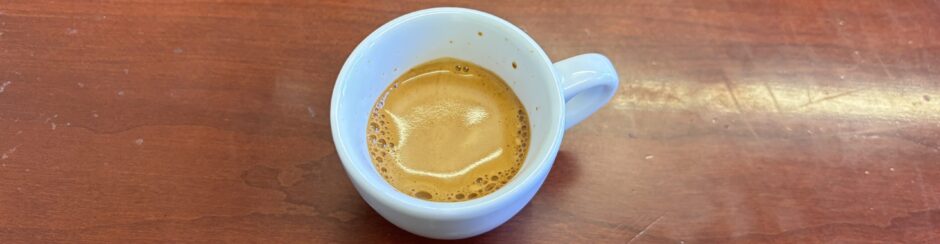
Several times in NYC, I’ve had the chance to visit Eataly, an italian food court/upscale delicatessen run by Mario Batali. You can either sit down at one of the various restaurants for an antipasto plate with a glass of wine, or grab a prosciutto fig sandwich (and a bottle of chinotto) to go. The good news is that Eataly is coming to Chicago.

There’s an updated version of BLGGT on the ArXiv. The numbering (at a quick glance) appears to be consistent with previous versions, although its now at least 20 pages longer. Perhaps (hint hint) one of my readers can update me with the contents?

The latest hot tip for a fields medal: Kai Wen Lan. Go Kai Wen! (In that first link, Kai Wen also exhibits the ability to morph into Shimura, a fields medal worthy feat itself.)

Posted in Food, Mathematics, Uncategorized | Tagged , | Leave a comment

Prokofiev

Glenn Gould is best known (deservedly) for his Bach, but there are other treasures in his discography, including Schoenberg and (perhaps surprisingly) Brahms. Here’s Gould playing some mean Prokofiev:

Posted in Uncategorized | Tagged , | Leave a comment

Remarks on Buzzard-Taylor

Let \(\rho: G_{\mathbf{Q},S} \rightarrow \mathrm{GL}_2(\overline{\mathbf{Q}}_p)\) be continuous and unramified at \(p\). The Fontaine-Mazur conjecture predicts that \(\rho\) has finite image and is automorphic. Buzzard and Taylor proved this result under the assumption the natural assumption that \(\rho\) is odd, that \(\overline{\rho}\) is modular (now uneccessary), but also under the futher two assumptions:

  • \(\overline{\rho}\) is irreducible,
  • \(\overline{\rho}\) is \(p\)-distinguished.
  • (caveat: there are mild extra assumptions required when \(p = 2\).) The point of this post is to note that is seems possible to remove either of these conditions and to wonder whether both can be removed simultaneously.

    Suppose the second condition fails. One may enlarge the ordinary Hecke algebra \(\mathbf{T}\) to include the operator \(U_p\), call the resulting ring \(\widetilde{\mathbf{T}}\). After appropriate localizations, this is different from \(\mathbf{T}\) exactly when \(\overline{\rho}(\mathrm{Frob}_p)\) is a scalar. On the Galois side, let \(R_p\) denote the universal (framed) deformation ring. Then, for any lift of Frobenius, one can define the quadratic extension \(\widetilde{R}_p = R_p[\alpha]\) where \(\alpha\) is an eigenvalue of Frobenius. Fix a weight \(k \ge 2\). If \(R^{\mathrm{ord}}_p\) denotes the ordinary deformation ring, then there is a corresponding quotient \(\widetilde{R}^{\mathrm{ord}}_p\) of \(\widetilde{R}_p\) which records ordinary deformations together with the action of Frobenius on the unramified quotient. The \(\overline{\mathbf{Q}}_p\)-points of these local deformation rings are the same (since \(k \ge 2\)). The usual Taylor-Wiles-Kisin method produces an isomorphism of the type \(\widetilde{R}[1/p] = \widetilde{\mathbf{T}}[1/p]\), where \(\widetilde{R}\) is the global deformation ring which takes into account the extra data at \(p\). This isomorphism holds for all weights \(k \ge 2\), which is enough to get an isomorphism on the corresponding ordinary families.

    If \(\rho(\mathrm{Frob}_p)\) has distinct eigenvalues, one may now deduce Buzzard-Taylor (by the same argument as BT). If \(\rho(\mathrm{Frob}_p)\) is scalar, then one has to make a slight adjustment. To see what to do, note that if \(f(\tau)\) is the desired weight one form, then the old space \(f(\tau), f(p \tau)\) can no longer be diagonalized with respect to \(U_p\). Instead, it should give rise to a surjective map \(\psi: \widetilde{\mathbf{T}} \rightarrow \mathcal{O}[\epsilon]/\epsilon^2\) such that the image of \(\mathbf{T}\) is \(\mathcal{O}\). Conversely, if there is such a map \(\psi\), this produces the ordinary old forms necessary to recover \(f\) (both forms have the same Hecke eigenvalues away from \(p\), so one can determine the \(q\)-expansions). From the modularity result, it suffices to construct such a map on the Galois side. Yet this exists precisely because \(\rho\) comes with two distinct unramified quotients.

    DG and I used these these flavours of deformations rings for a somewhat different purpose (although we required more precise integral information concerning \(\widetilde{R}^{\mathrm{ord}}_p\) coming out of a very nice paper of Snowden). On the other hand, as far as the argument above goes, it was apparently known to RLT many years ago (as I learnt by chatting with TG whilst drinking an $8 can of Boddingtons in Toronto).

    Suppose one assumes instead that \(\overline{\rho}\) is reducible. Recall that one has maps \(R^{\mathrm{ps}} \rightarrow R\) and \(R^{\mathrm{ps}} \rightarrow \mathbf{T}\) for a suitable pseudo-deformation ring \(R^{\mathrm{ps}}\). In higher weights, Skinner-Wiles essentially prove that \(R[1/p]^{\mathrm{red}} = \mathbf{T}[1/p]\), which should be sufficient to construct the required overconvergent forms \(f_{\alpha}\) and \(f_{\beta}\) in weight one. While chatting with PA over espresso today, it also seems reasonable that (using appropriate framings, as above) one may generalize this to the case where \(\overline{\rho}\) is no longer \(p\)-distinguished, as long as the characteristic zero eigenvalues \(\alpha\) and \(\beta\) are distinct. The problem, however, with the \(\alpha = \beta\) case is that one needs to promote a non-reduced quotient \(R \rightarrow \mathcal{O}[\epsilon]/\epsilon^2\) to a map from \(\mathbf{T}\), and the methods of Skinner-Wiles in the reducible case only give information about the reduced quotients of \(R\). Is there any way around this?
    This seems (pretty close) to the only remaining obstruction for a complete solution to the weight one odd case of Fontaine-Mazur.

    Posted in Mathematics | Tagged , , | Leave a comment

    Winning the Chocolate

    Once a month, there is an (unrated) round robin blitz tournament at the Evanston chess club. The time controls are set on five minutes (a little slow for me, I usually play one minute games online), but it’s nice to play over the board for a change. The best players are rated around 2000, which means (for me at least) that every game is in play. There’s even a prize for the top two finishers (a chocolate bar), so the goal is to “win the chocolate.” So far, I’m 3 for 4 on the chocolate. Slightly amusingly, two of the players are dead ringers for Michael Schein and David Geraghty respectively (current record: 2:0 against MS and 1:1 against DG). As for my record against (actual) mathematicians, I’m 1:1 against Serre (I beat him playing the King’s gambit, then lost the second game playing the French), and I’ve won and lost many games of bughouse against Noam Elkies (to some extend this doesn’t count, since at bughouse it’s often more important how strong the weaker player is.)

    Posted in Chess | Tagged , , , , | Leave a comment

    Why it is good to be Pure

    There do not exist any regular pure motives \(M\) over \(\mathbf{Q}\) which are not essentially self dual. Here is why. \(M\) gives rise to a compatible family of Galois representations for each rational prime \(v\) such that the characteristic polynomial \(R(X)\) of Frobenius is independent of this choice. By purity, the eigenvalues \(\alpha\) of \(R(X)\) are algebraic integers lying in a CM-field such that \(|\iota \alpha|^2 = p^{w}\) for some integral weight \(w\) and any complex embedding \(\iota\). In particular, if \(\alpha\) is a root of \(R(X)\), then \(\alpha^c = p^w/\alpha\) is a root of \(X^n R(p^w/X)\). Since \(R(X)\) has coefficients in \(\mathbf{Z}\), it follows that \(\alpha^c\) is also a root of \(R(X)\), from which one may deduce that \(R(X) = X^n R(p^w/X)\) (edit: up to the appropriate constant which makes the RHS monic – this doesn’t affect any of the arguments). Yet this implies that \(M^{\vee}(w) \simeq M\), by the Cebotarev density theorem. (Caveat: it really says that the \(p\)-adic avatars of \(M\) are essentially self-dual. Perhaps deducing the result for \(M\) actually requires the standard conjectures.)

    This argument no longer applies if one relaxes the conditions slightly; there do exist non-self dual motives of rank three with coefficients;  Bert van Geemen and Jaap Top found some explicit examples with coefficients in an imaginary quadratic extension of \(\mathbf{Q}\). The point where the argument above fails is that it identifies the polynomial \(X^n R(p^w/X)\) with the complex conjugate polynomial \(R^c(X)\), which need not equal \(R(X)\) anymore.

    Stefan Patrikis and Richard Taylor use a similar argument in their recent paper to prove a nice result. Start with a regular pure motive \(M\) over \(\mathbf{Q}\) (so by the above remarks, it is essentially self dual). Suppose that the corresponding \(v\)-adic Galois representation:

    \(\displaystyle{r_v: G_{\mathbf{Q}} \rightarrow \mathrm{GL}_n(\mathbf{Q}_v)}\)

    is not absolutely irreducible. One may ask: are the irreducible constituents \(s_v\) themselves essentially-self dual? They show that the answer is yes. Let \(S(X)\) denote the corresponding characteristic polynomials. If \(S(X)\) lies in \(\mathbf{Z}[X]\), then the same argument above applies to \(s_v\). But it may be the case that the representation \(r_v\) only decomposes over an extension of \(\mathbf{Q}\). By looking at the eigenvalues, it trivially follows that each of the \(S(X)\) may be defined over some CM field \(F/F^{+}\). More importantly, by a technical argument which I will omit but which is not too difficult, one may find a fixed CM field \(M/M^{+}\) which contains all the polynomials \(S(X)\) (one may even do this [in some sense] independently of \(v\), although we won’t use that here). Consider the Galois representation \((s_v)^c\), where \(c\) is acting on the coefficients. Let \(\alpha\) be a root of \(S(X)\). Then \(\alpha^c = p^w/\alpha\) is now a root of \(X^m S(p^w/X)\), and so \(S^c(X)\) and \(X^m S(p^w/X)\) coincide. Since \(X^n R(p^w/X) = R(X)\), we deduce that \((s_v)^c\) is a sub-representation of \((r_v)^c = r_v\). In particular, \((s_v)^c\) and \(s_v\) are both sub-representations of \(r_v\). But the Hodge-Tate weights of \(s_v\) and \((s_v)^c\) are the same! (Literally, the Hodge-Tate weights of \((s_v)^c\) are the Hodge-Tate weights of \({}^c (s_v)\) where \({}^c(s_v)(g) = s_v(c g c^{-1})\), but since \(s_v\) is a representation of \(\mathbf{Q}\), conjugation by \(c\) is conjugation by a matrix, so there is an isomorphism \(s_v \simeq {}^c(s_v)\).) It follows (from the regularity assumption) that \(s_v = (s_v)^c,\) and then the argument above implies that \(s_v\) is self-dual.

    One may use this argument as follows. As in BLGGT, one may find a prime \(v\) such that all of the \(s_v\) are residually irreducible, and so (if \(v\) is sufficiently large) are also potentially modular (by BLGGT again). In particular, either all of the \(r_v\) are reducible or they are irreducible for a set of density one set of primes. Moreover, any regular motive over \(\mathbf{Q}\) is potentially modular, which is only three adjectives away from the complete reciprocity conjecture!

    Patrikis and Taylor do something slightly more general, instead of pure regular motives over \(\mathbf{Q}\), they consider essentially self-conjugate regular compatible systems (with coefficients) of \(G_{F}\) for some CM field \(F/F^{+}\). For reasons alluded to above, the coefficients live in some CM-field \(M\). This extra generality (mostly) adds some notational complexity to the argument above. (To see the type of complications that arise, consider an elliptic curve \(E\) with CM and then restrict to the CM field \(F\). Then any reducible constituent \(s_v = \chi_v\) is related not to its complex conjugate \(\chi^c_v\) acting on \(M\), but the complex conjugate \({}^c \chi^c_v\) of this where complex conjugation is now acting on the coefficients \(M\) and on the Galois group \(F\).) As expected, one obtains (using BLGGT) some nice consequences, like potential automorphy of regular polarizable compatible systems, as well as irreducibility (for a density one set of primes) of Galois representations associated to RAESDC automorphic form \(\Pi\).

    Posted in Mathematics | Tagged , | 4 Comments

    Hilbert Modular Forms of Partial Weight One, Part I

    Let \(\pi\) be an algebraic Hilbert modular cuspform for some totally real field \(F^{+}\). Then, associated to \(\pi\), one has a compatible family of Galois representations:

    \(r_{\lambda}(\pi): G_{F^{+}} \rightarrow \mathrm{GL}_2(\mathcal{O}_{\lambda})\)

    which are unramified outside finitely many primes (this is the work of many people). The expectation is that this representation should satisfy local global compatibility at all primes. This is known if \(\pi\) has regular weight, and also if \(\pi\) has parallel weight one. However, this is not known, even  for the case \(p \ne \ell\) (Here \(\ell\) is the characteristic of \(\mathcal{O}/\lambda\)). The problem is that these representations are constructed via congruences, not from geometry. Deforming in families does give some control, and indeed one can prove that, for \(v|p\) and \(p \ne \ell\),

    \(\mathrm{WD}(r_{\lambda}(\pi)|_{G_v})^{\mathrm{F}\text{-}\mathrm{ss}} \prec \mathrm{rec}(\pi_v)\)

    which is a way of saying you get the correct answer up to the monodromy operator \(N\), and moreover the monodromy operator on the Galois side can only be more degenerate than the automorphic side. In English, if (for example) \(\pi_v\) is Steinberg, then one may deduce (as expected) that the image of inertia on the Galois side is unipotent, but not necessarily that it is non-trivial. In fact, by solvable base change, this is really the only problem one has to worry about (so we shall assume we are in this case below).

    The usual methods for computing the monodromy \(N\) are all geometric (nearby cycles), and, as it seems hopeless to try to construct any (conjectural) motive associated to \(\pi\), there doesn’t seem to be much one can do.

    One does, however, have the following strategy, which I learnt from Martin Luu, which should suffice for all but finitely many primes \(\lambda\) for which \(r_{\lambda}(\pi)\) is ordinary. Namely, take the \(\lambda\)-adic Galois representation associated to \(\pi\), and prove that it is potentially automorphic using extensions of the Buzzard-Taylor idea (which has been employed by Sasaki, Kassaei, Pilloni and others in the case of Hilbert modular forms of parallel weight one, but should also apply in this context). The result is that one shows that \(r_{\lambda}(\pi) |G_{E^{+}}\) for some totally real extension \(E^{+}/F^{+}\) is now associated to a cuspidal automorphic form \(\Pi\) of the right level. How does this help? Well, now using what we know from local global compatibility (which is ok in the unramified case), we deduce that \(\Pi_w\) for some \(w|v\) is associated to the corresponding local Galois representation \(r_{\lambda}(\pi)|_{G_w}\). Now this representation has the property that it looks unipotent on inertia mod \(\lambda^n\) for all \(n\), but, assuming local-global compatibility fails, is actually unramified at \(p\). In particular, the semi-simplification is given by two characters whose ratio is the cyclotomic character, whereas \(\Pi_w\) is an unramified principal series. This implies that the Satake parameters \(\{\alpha_w,\beta_w\}\) satisfy \(\alpha_w/\beta_w = N(w)\), which contradicts Ramanujan. We are not done yet, because one  doesn’t have purity in partial weight one. However,  one can appeal to bounds coming from Rankin-Selberg, and this is enough to obtain a contradiction.

    The only obvious examples of partial weight one HMF (which are not of parallel weight one) are CM, and since those are potentially unramified, the monodromy operator will always be trivial on the autormophic side (and hence also on the Galois side). So this suggests (but does not beg) the question: do there actually exist any partial weight one (but not parallel weight one) Hilbert modular forms which are not CM? Stay tuned for part II!

    Posted in Mathematics, Students | Tagged , | 2 Comments

    Even Galois Representations mod p

    Suppose that \(\overline{\rho}: G_{\mathbf{Q}}: \rightarrow \mathrm{GL}_2(\overline{\mathbf{F}}_p)\) is a continuous  irreducible Galois representation. What does the Langlands program say about such \(\overline{\rho}\)? When \(\overline{\rho}\) is odd, the situation is quite satisfactory, the answer being given by Serre’s conjecture. For example, having fixed a Serre weight \(k \ge 2\) and a Serre level \(N\), one knows that there will only be finitely many such representations and they will all come from classical modular forms for \(\mathrm{GL}(2)\).

    When \(\overline{\rho}\) is even, however, there is an equally good (if conjectural) description of such representations. First, the dihedral representations are well understood by class field theory, so let us assume we are not in this case. Then, replacing \(\overline{\rho}\) by the adjoint representation \(\mathrm{ad}^{0}\overline{\rho}\) and restricting to some (any) imaginary quadratic field, one obtains an irreducible (conjugate) self-dual representation, which, by the generalization of Serre’s conjecture, should come from an automorphic representation for \(U(3)\). It follows that, as in the odd case, there will (conjecturally) only be finitely many such \(\overline{\rho}\) for a fixed pair \((N,k)\). However, things are even better in the even case. Namely, if one fixes \((N,k)\) but allows \(p\) to vary, then there will still only be finitely many even representations, in contrast to the odd case where (for \((N,k) = (1,12)\) for example) such representations occur for infinitely many \(p\). The reason is that all such representations will have to arise from a fixed finite dimensional space of automorphic forms determined by \(N\) and \(k\), and thus (by the pigeonhole principle) there will exist an automorphic \(\Pi\) for \(U(3)\) whose \(\mod p\) representation extends to an even representation of \(\mathbf{Q}\) for infinitely many \(p\). By multiplicity one, it would follow that \(\Pi \simeq \Pi^c \simeq \Pi^{\vee}\) and hence \(\Pi\) itself must come from  the adjoint representation of a form from \(\mathrm{GL}(2)\) over \(\mathbf{Q}\), which would imply (since we are in regular weight) that the representations are odd. Note that it is important in the definition of Serre weight here that \(k \ge 2\); if one allows \(k = 1\) then there exist representations in characteristic zero which give rise to mod \(p\) representations for all \(p\).

    Here’s a specific example in which one can prove finiteness. Suppose that we consider representations with \(k=2\) and \(N=1\). Then there are no such even \(\overline{\rho}\) for a stupid reason, because the determinant will be cyclotomic (Tate deals with the case \(p=2\).) Now consider the case when \(k=2\) and \(N=4\).  In the even case, the determinant must be the cyclotomic character times the unique (odd) character of conductor \(4\). Let’s prove that there are no such representations. Tate like arguments reduce to the case when the representation has image containing \(\mathrm{SL}_2(\mathbf{F}_p)\) and \(p \ge 7\). Now take the auxiliary imaginary quadratic field to be \(\mathbf{Q}(\sqrt{-1})\). The corresponding adjoint representation now is unramified outside primes above \(p\) (the quadratic extension eliminating the ramification at \(2\)) and is Fontaine-Laffaile with weights \([-1,0,1]\) at primes dividing \(p\). Using the lifting results of BL-G-G-T, we may lift this to a compatible family of self-dual representations of level one and weight zero which is potentially modular. Because these representations are potentially modular and are not CM, we  know that they are all irreducible by Blasius-Rogawski. We now specialize these representations to \(p=5\), and because the Hodge-Tate weights are sufficiently small (\([0,1,2]\)) and \(\mathbf{Q}(\sqrt{-1})\) is also small, we can use results of Fontaine and Abrashkin to deduce that the corresponding \(5\)-adic representation is reducible, which is a contradiction. We thus deduce (using Khare-Wintenberger for the odd case) that there do not exist any irreducible finite flat group schemes \(G\) of type \((p,p)\) over \(\mathrm{Spec}(\mathbf{Z}[\sqrt{-1}])\) whose generic fibre admits descent data to \(\mathbf{Q}\). This entire argument is really just a version of the Khare-Wintenberger proof of Serre’s conjecture  for \(U(3)\). Unfortunately, one doesn’t quite have enough modularity lifting theorems at this point to deduce Serre’s conjecture completely for \(U(3)\).

    These arguments are quite general. For example, there should only exist finitely many even representations \(\overline{\rho}: G_{\mathbf{Q}}: \rightarrow \mathrm{GL}_n(\overline{\mathbf{F}}_p)\) (whose image contains \(\mathrm{SL}_n(\mathbf{F}_p)\)) of fixed Serre weight and level  even when one ranges over all primes \(p\), providing \(n > 2\).

    Posted in Mathematics | Tagged | Leave a comment

    Why Blog?

    The reasons for running a blog are various; they run the gamut from narcissism to simple self-aggrandizement. Time will tell which type of blog this will be. I’m not really looking to find an audience beyond those people I already know in real life. Perhaps, on some level, this blog is intended to compensate for the fact that I am terribly lazy about updating my friends with what is happening in my life.

    Posted in Waffle | Leave a comment