What would Deuring do?

This is an incredibly lazy post, but why not!

Matt is running a seminar this quarter on the Weil conjectures. It came up that one possible way to prove the Weil conjectures for elliptic curves over finite fields is to lift them to CM elliptic curves using Deuring’s theorem. But after some discussions we couldn’t quite work out whether this was circular or not.

Certainly if you can lift to a CM elliptic curve and lift Frobenius to an endomorphism \(\phi\) of the lift you get Weil immediately; the degree of \(\phi\) is \(p\) which implies the norm of \(\phi\) is \(p\), but for imaginary quadratic fields the norm coincides with the absolute value. But how did Deuring prove his theorem?

The most obvious way to lift an (ordinary, say) elliptic curve \(E/\mathbf{F}_p\) to characteristic zero is to note that, by the Weil conjectures, the order \(\mathcal{O} = \mathbf{Z}[\phi]\) generated by Frobenius lies inside an imaginary quadratic field \(K\) (this is equivalent to the Weil conjectures), and so one can consider \(\mathbf{C}/\mathbf{Z}[\phi]\). To make things simple, if the order is maximal, then this is defined over the Hilbert class field \(H\) of \(K\), and since \(p\) splits principally in \(K\) (since \(\phi\) has norm \(p\)) it follows that \(p\) splits principally in \(H\) as well by class field theory, and so the CM elliptic curve is also defined over \(\mathbf{Z}_p\) and gives a lift. Of course, this argument uses the Weil conjectures! Without that, the ring \(\mathcal{O}\) lives inside a real quadratic field and it’s not clear what one can do.

One approach is to prove the existence of the canonical lift, which automatically will have extra endomorphisms and thus be CM since it lives in characteristic zero. This doesn’t depend on the Weil conjectures. But the canonical lift is a construction I associate more with Serre-Tate than with Deuring. But it’s certainly possible that Deuring’s argument was via the canonical lift.

Some might say that the easy way to solve this is simply to look in one of Deuring’s papers. But instead I will try to call upon my readers (possibly either number theorists who speak German or Brian Conrad) to save me the work and tell reveal all in the comments!

Posted in Mathematics | Tagged , , , , , | 3 Comments

A random curve over Q

Let \(X/\mathbf{Q}\) be a smooth projective curve. I would like to be able to say that the motive \(M\) associated to \(X\) “generally” determines \(X\). That is, I would like to say it in a talk without feeling like I’m telling too much of a fib. But is this true? There are two issues. Recall that, by the Torelli Theorem, the Jacobian together with a principle polarization determines \(X/\mathbf{C}\). So there are two things to worry about:

  1. Knowing \(M\) only recovers the Jacobian up to isogeny, and you can certainly have two different curves with isogenous Jacobians, even isomorphic Jacobians with different polarizations.
  2. Knowing \(X/\mathbf{C}\) does not determine \(X/\mathbf{Q}\).

To overcome the second issue, it is sufficient and necessary to assume that \(\mathrm{Aut}_{\mathbf{C}}(X)\) is trivial. Let me ignore the first point, since I both assume it generically doesn’t happen but since I can’t even address the second point yet I haven’t thought about it yet.

Perhaps this is obvious to a geometer, but I don’t see why a “random” curve \(X/\mathbf{Q}\) doesn’t have automorphims. My model of a random curve is to take, for example, an embedding of \(M_g\) into projective space and then count points by the ambient height function and see what ratio of points has trivial automorphisms. (Presumably any other counting function like Faltings height or whatever will more or less be the same.) Certainly a generic \(\mathbf{C}\)-point of \(M_g\) has no automorphisms (at least for \(g > 2\)), but since \(M_g\) is of general type for large enough \(g\) I don’t whether one can find enough rational points which are generic!

Probably the most natural way to answer this is to give a positive answer to the following question:

Question: Does \(M_g\) contain a subvariety \(X\) which is unirational over \(\mathbf{Q}\) and has dimension strictly greater than the hyperelliptic locus?

Or, to put it more naturally, can you just explicitly write down enough generic curves which don’t have any automorphisms to see that they dominate any point count?

Posted in Mathematics | Tagged , , | 16 Comments

ArXiv x 3

Three recent arXiv preprints this week caught my interest and seemed worth mentioning here.

The first is a paper by Oscar Randal-Williams, which considers (among other things) the cohomology of congruence subgroups of \(\mathrm{SL}_N(\mathbf{Z})\) in the stable range. This is definitely something I have talked on the blog about a number of times, including here and here. To recall; Matthew Emerton and I proved that the completed cohomology groups

\(\widetilde{H}^d(\mathbf{F}_p) = \lim H^d(\mathrm{SL}_N(\mathbf{Z},p^n),\mathbf{F}_p)\)

are independent of \(N\) for \(N\) sufficiently large with respect to \(d\), and are moreover finite vector spaces with a trivial action of \(G = \mathrm{SL}_N(\mathbf{Z}_p)\). I later explained moreover how these groups are the cohomology groups of the homotopy fibre of the map from \(\mathrm{SK}(\mathbf{Z};\mathbf{Z}_p)\) to \(\mathrm{SK}(\mathbf{Z}_p;\mathbf{Z}_p)\). But now the Quillen-Lichtenbaum conjecture shows (thanks to Blumberg and Mandell) how the homotopy groups of these spaces are identified with Galois cohomology groups, which allows one to compute the maps between homotopy groups and understand (at the very least) the cohomology groups in degrees less than \(p\). Since one has a Hochschild-Serre spectral sequence

\(E^{i,j}_2 = H^i(G(p),\widetilde{H}^j(\mathbf{F}_p)) \Rightarrow H^{i+j}(\mathrm{SL}(\mathbf{Z},p),\mathbf{F}_p),\)

this allows one to compute the cohomology of \(\mathrm{SL}(\mathbf{Z},p)\) over \(\mathbf{F}_p\) in low degree by analyzing this spectral sequence. I later came to suspect that for regular primes \(p\) this spectral sequence degenerated immediately at least in degrees less than \(p\) or so, which would allow one to compute the cohomology groups in degree \(d\) explicitly for all large regular \(p\). Actually the prediction was slightly stronger: in the range of cohomology degrees at most \(d\) one only had to avoid a finite set of primes (those dividing \(B_{2k}\) for small \(k\) together with the set of primes \(p\) which divided the finitely many zeta values \(\zeta_p(3), \zeta_p(5), \ldots \zeta_p(2k+1)\) also for small \(k\)). Oscar not only proves this but goes one step further, by showing that it degenerates in small degrees for any prime \(p\), even as a \(\mathrm{SL}(\mathbf{F}_p)\)-module. This implies, for example, that, with \(H^1(G(p),\mathbf{F}_p) = M\) being more or less the adjoint representation, that

\(H^4(\mathrm{SL}_N(\mathbf{Z},p),\mathbf{F}_p) = \mathbf{F}_p \oplus \wedge^2 M \oplus \wedge^4 M\)

for \(p > 5\) if and only if \(p\) does not divide the \(p\)-adic zeta function \(\zeta_p(3)\), and

\(H^4(\mathrm{SL}_N(\mathbf{Z},p),\mathbf{F}_p) = \mathbf{F}_p \oplus \mathbf{F}_p \oplus \wedge^2 M \oplus \wedge^4 M\)

otherwise. Note this condition implies that \(p\) is irregular but is much more restrictive. But it does actually happen! The only known primes with this property are \(p = 16843\) and \(p=2124679\).

Part of my original interest in this problem came from Benson Farb and Tom Church — they noted that these groups should be stable in the weaker sense that they should be “independent of \(N\)” more or less exactly in the sense that there is a uniform description as above (proved later by Andrew Putman), but this left open the question of what the groups actually were. Of course my feeling is that the completed cohomology groups are more “fundamental” and the cohomology at finite level is really just a frothy mix of unwinding what happens in the limit, but one has to admit that this new result is pretty satisfying.

————————

The second is a paper by Will Sawin and Melanie Wood. I remember 20 years ago or so being one of three BPs at Harvard asked to give a small presentation to the Harvard “Friends of Math” (Will Hearst and the gang), along with William Stein and Nathan Dunfield. One memory was that my talk was a chalk talk and theirs were both involved much snazzier technology. But I also remember that Nathan talked about his very nice paper with Bill Thurston on random 3-manifolds. In Melanie and Will’s new paper, they beautifully exploit many of the recent progress on “random groups” (much of it due to the authors themselves) to show that the profinite completion of a random 3-manifold (in the sense of a random Heegaard splitting for larger and larger genus) itself has a limiting distribution.

Here is just one immediate corollary of their results which ties into previous problems considered both by Nathan and me and also Nigel Boston and Jordan Ellenberg. (Actually I say corollary, but I am just guessing that this should easily be a corollary without actually doing any of the computation so any error here is due to me!)

Expected Corollary: For a fixed prime \(p > 2\) and a “random” 3-manifold \(M\), there is a positive probability that:

1. There is a surjection: \(\pi_1(M) \rightarrow \mathrm{SL}_2(\mathbf{Z}_p)\),
2. The corresponding tower of covers \(M_n\) coming from congruence subgroups all have trivial first Betti number.

The point of course being that (as in Boston-Ellenberg) one can deduce this from the more restrictive condition that the kernel \(N\) of the map

\(\pi_1(M) \rightarrow \mathrm{SL}_2(\mathbf{F}_p)\)

has \(N/N^p = (\mathbf{F}_p)^3\) and no larger, and hence it can be phrased as the pro-finite completion of \(\pi_1(M)\) surjecting onto one pro-finite group but not some other finite group. (Here \(N/N^p = (\mathbf{F}_p)^3\) can I think be weakened to \(N/N^p[N,N] = (\mathbf{F}_p)^3\) by an argument of Simon Marshall). I guess another way of saying this is that the pro-p completion of the cover \(N\) can be described explicitly as the \(p\)-congruence subgroup of \(\mathrm{SL}_2(\mathbf{Z}_p)\).

Of course, this work also raises the very natural question:

Question: What is the distribution of \(\widehat{\pi_1(M)}\) on arithmetic 3-manifolds? What about congruence arithmetic 3-manifolds?

The main point of course is that the existence of Hecke operators imposes a lot of extra structure, which one certainly expects (and can be numerically observed) changes the distribution of any given finite group occurring. Here I think the sensible question is to ask for a conjecture rather than a theorem, of course! (Maybe the first sensible question is actually to give a good conjecture for the distribution of the abelianization of these groups…)

————————

The last paper is this one by Peter Kravchuk, Dalimil Mazáč, and Sridip Pal, which I am even less qualified to talk about, which gives remarkable upper bounds for the smallest Laplacian eigenvalue of a (closed) hyperbolic orbifold of fixed genus. For example, when \(g = 2\), they give the bound \(\lambda_1 < 3.8388976481\), which is not too shabby given that there is an example with \(\lambda_1 = 3.83888725\ldots\)! The paper has a number of other gems, including more or less identifying the complete spectrum of all \(\lambda_1\) as comprising a set of isolated points combined with the entire interval \([0,\alpha]\) for some \(\alpha = 15.8\ldots\).

Posted in Uncategorized | Tagged , , , , , , , , , , , , , , , , , , | 2 Comments

What would a good ICM talk look like?

Now that the ICM has (unsurprisingly) become a virtual event, it might be worthwhile thinking a little bit about what would constitute a good talk in this new setting. There’s a certain electricity to talks given in person, and I think that many speakers give better talks when they have an opportunity to read the audience. Certainly the zoom talks I have most enjoyed watching are those where I’ve been able to interact with the speaker, but that clearly becomes impossible once the audience is large enough.

So an ICM of zoom talks (on a St Petersburg schedule in the middle of the night in Chicago) does sound a little uninspiring. But what would be better? pre-recorded zoom lectures sound even worse. The idea of a polished video presentation has some appeal, but possibly it is also unrealistic. The sound and audio quality of a standard zoom lecture are OK if you are interested enough in the material, but I think one should expect a general ICM audience to be a little less forgiving. (Yes, plenty of people give terrible colloquia, but at least there are usually cookies.) And even with access to high quality audio and video, is it just going to be someone standing in front of their blackboard?

I have tried once to make a mathematics video which was something other than me giving a lecture, and honestly, it took me a lot of time and didn’t turn out that great. But as Tim Gowers says on Terry’s blog, this should at least be an opportunity for speakers to try something.

Any thoughts? I guess the speakers have a few months to come up with some ideas!

Posted in Mathematics, Politics | Tagged , , , , | 3 Comments

Boxes for Boxer

My brother texted me on Monday saying that there were seven (or so) boxes pilled up (outside!) in front of the mathematics department and all addressed to George Boxer. My first thought was that this was a transatlantic move gone horribly wrong, so I emailed the department looking for volunteer graduate students to haul the boxes inside. I managed to acquire the boxes the next day:

Boxes

Now the boxes turned out not to contain the entire sum of George’s possessions (nor a large pile of cash, unfortunately), but somewhat more hilariously it consisted of reprints from our recently published paper (previously blogged about here). This was amazingly silly for a number of reasons. First, at 350 pages, the paper is kind of bulky, and certainly AFAIK nobody asked for reprints. Second, George Boxer hasn’t been at Chicago for a few years (though admittedly that is his listed address on the paper). Third, if IHES is going to send 17,500 pages of math to one of the four authors, perhaps it might have made more sense to send it to Vincent Pilloni who is five minutes away from IHES rather than to Chicago? Looking more closely at the boxes it seems as though the big boxes contain eight copies of the paper and the one small box contained two. But actually there were only 5 big boxes rather than six, so only 42 copies in total rather than 50. That makes me suspect that one of the boxes went missing. Possibly a porch pirate ran off with a box before they were carried inside (look for copies on the black market at 57th street books), or maybe there is a box floating in the Atlantic somewhere… Anyway, I now have a large collection of bulky (but still surprisingly light — perhaps recycled paper) reprints in my office. I think it should make good fort building material for LC.

Fort Building Material

Posted in Mathematics | Tagged , , , , | 6 Comments

Simons Annual Meeting

The last time I traveled for math was when I gave the Coble lectures at UIUC pre-pandemic (at least pre-pandemic as far as the US goes). A few months ago it seemed like one could begin to start traveling again, so I agreed to go to the Simons Conference scheduled for Jan 13-14 in NYC. While I’m prepared as the next person to acknowledge that we have to start living with the coronavirus and live our lives accordingly, traveling during might be the absolute peak of omicron in NYC seems a little unwise. Hence I sadly cancelled my trip today. I was hoping to get a chance to chat with people about Mumford 4-folds, and I had already decided on going to Rezdôra for a pasta tasting menu plus wine tasting menu. But it is not to be. It’s honestly quite surprising to me that many other people seem very happy to go to the same meeting. I can’t quite tell if they have a higher tolerance for risk or if one of us (or both) are simply not estimating the risk accurately. If it goes ahead, I hope it goes well for everyone there!

Update: Cancelled!

Posted in Mathematics, Travel | 3 Comments

Schur-Siegel-Smyth-Serre-Smith

If \(\alpha\) is an algebraic number, the normlized trace of \(\alpha\) is defined to be

\( \displaystyle{T(\alpha):=\frac{\mathrm{Tr}(\alpha)}{[\mathbf{Q}(\alpha):\mathbf{Q}].}}\)

If \(\alpha\) is an algebraic integer that is totally positive, then the normalized trace is at least one. This follows from the AM-GM inequality, since the normalized trace is at least the \(n\)th root of the norm, and the norm of a non-zero integer is at least one. But it turns out that one can do better, as long as one excludes the special case \(\alpha = 1\). One reason you might suspect this to be true is as follows. The AM-GM inequality is strict only when all the terms are equal. Hence the normalized trace will be close to one only when many of the conjugates of \(\alpha\) are themselves close together. But the conjugates of algebraic integers have a tendency to repel one another since the product of their differences (the discriminant is also a non-zero integer.) In an Annals paper from 1945, Siegel (bulding on a previous inequality of Schur) proved the following:

Theorem [Siegel] There are only finitely many algebraic integers with \(T(\alpha) < \lambda\) for \(\lambda = 1.7336105 \ldots\)

Siegel was also able to find that the only such integers with noramlized trace at most \(3/2\) are \(1\) and \((3 \pm \sqrt{5})/2 = \phi^{\pm 2}\) for the golden ratio \(\phi\) (We will also prove this below). On the other hand (generalizing these examples), one has

\(\displaystyle{T(\left((\zeta_p + \zeta^{-1}_p)^2\right) = 2 \left(1 – \frac{1}{p-1} \right),}\)

and hence the optimal value of \(\lambda\) is at most \(2\). Sometime later, Smyth had a very nice idea to extend the result of Siegel. (An early paper with these ideas can be found here.) Consider a collection of polynomials \(P_i(x)\) with integral coefficients, and suppose that

\(Q(x) = -\lambda + x \ – \sum a_i \log |P_i(x)| \ge 0\)

for all real positive \(x\) where \(Q(x)\) is well-defined, and where the coefficients \(a_i\) are also real and non-negative. Now take the sum of \(Q(x)\) as \(x\) ranges over all conjugates of \(\alpha\). The key point is that the sum of \(\log |P_i(\sigma \alpha)|\) is log of the absolute value of the norm of \(P_i(\alpha)\). Assuming that \(\alpha\) is not a root of this polynomial, it follows that the norm is at least one, and so the log of the norm is non-negative, and so the contribution to the sum (since \(-a_i\) is negative) is zero or negative. On the other hand, after we divide by the degree, the sum of \(\lambda\) is just \(\lambda\) and the sum of \(\sigma \alpha\) is the normalized trace. Hence one deduces that \(T(\alpha) \ge \lambda\) unless \(\alpha\) is actually a root of the polynomial \(P_i(x)\). So the strategy is to first find a bunch of polynomials with small normalized traces, and then to see if one can construct for a constant \(\lambda\) as close to \(2\) as possible some function \(Q(x)\) which is always positive.

One can make this very explicit. Suppose that

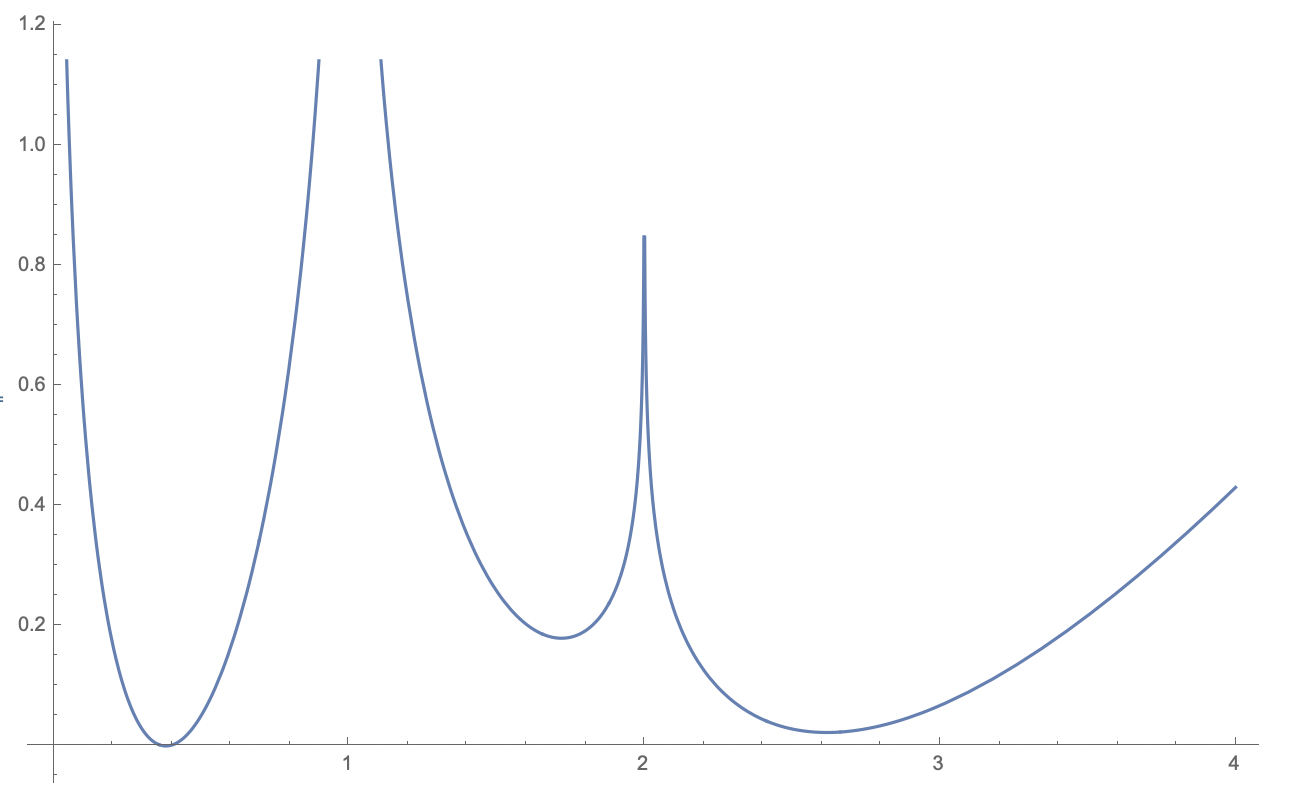
\(\displaystyle{Q(x) = -\lambda + x – \frac{43}{50} \cdot \log |x| – \frac{18}{25} \cdot \log |x-1| – \frac{7}{50} \cdot \log|x-2|,}\)

Calculus Exercise: Show that, with \(\lambda = 1.488753\ldots\), that \(Q(x) \ge 0\) for all \(x\) where it is defined. Deduce that the only totally real algebraic integer with \(T(\alpha) \le \lambda\) is \(\alpha = 1\). The graph is as follows:
a positive function

One can improve this by increasing \(\lambda\) and modifying the coefficients slightly, but note that we can’t possibly modify this with the given polynomials to get \(\lambda> 3/2\), because \(T(\phi^2) = 3/2\). Somewhat surprisingly, we can massage the coefficients reprove the theorem of Siegel and push this bound to \(3/2\). Namely, take

\(\displaystyle{Q(x) = -\frac{3}{2} + x – a \log |x| – (2a-1) \log |x-1| – (1-a) \log|x-2|,}\)

and note that the derivative satisfies

\(Q'(x)x(x-1)(x-2) = (x^2-3x+1)(x-2a),\)

Hence the minimum occurs at either \(x=2a\) or at the conjugates of \(\phi^2\) where \(\phi\) is the golden ratio. Since \(\phi^2-1 = \phi\) and \(\phi^2-2 = \phi^{-1}\), one finds that

\(Q(\phi^2) = -\frac{3}{2} + \phi^2 + (2-5 a) \log \phi,\)

and so chosing \(a\) so that this vanishes when, we get

\(\displaystyle{a = \frac{2}{5} + \frac{1}{2 \sqrt{5} \log \phi} = 0.864674\ldots} \)

and then we find that \(Q(x) \ge 0\) for all \(x\) where it is defined with equality at \(\phi^2\) and \(\phi^{-2}\). So this reproves Siegel’s theorem by elementary calculus. Of course we can strictly improve upon this result by including the polynomial \(x^2 -3x + 1\), for example, replacing \(Q(x)\) by
.
\(\displaystyle{P(x) = Q(x) – \frac{1}{15} \cdot \log |x^2 – 3x + 1| + \left(\frac{3}{2} – \lambda\right)}\)

where \(\lambda = 1.5444\ldots \) is now strictly greater than \(3/2\). By choosing enough polynomials and optimizing the coefficients by hook or crook, Smyth beat Siegel’s value of \(\lambda\) (even with an explicit list of exceptions), although he did not push \(\lambda\) all the way to \(2\). This left open the following problem: is \(2\) the first limit point? That is, does Siegel’s theorem hold for any \(\lambda < 2\)? This was already asked by Siegel and it became known as the Schur-Siegel-Smyth problem. Some point later, Serre made a very interesting observation about Smyth's argument. (Serre's original remarks were in some letter which was hard to track down, but a more recent exposition of these ideas is contained in this Bourbaki seminar.) He more or less proved that Smyth’s ideal could never prove that \(2\) was the first limit point. Serre basically observed that there existed a measure \(\mu\) on the positive real line (compactly supported) such that

\(\int \log |P(x)| d \mu \ge 0\)

for every polynomial \(P(x)\) with integer coefficients, and yet with

\(\int x d \mu = \lambda < 2\)

for some \(\lambda \sim 1.89\ldots \). Since Smyth’s method only used the positivity of these integrals as an ingredient, this means the optimal inequality one could obtain by these methods is bounded above by Serre’s \(\lambda\). On the other hand, Serre’s result certainly doesn’t imply that the first limit point of normalized traces of totally positive algebraic integers is less than \(2\). A polynomial with roots chosen uniformly from \(\mu\) will have normalized trace close to \(\lambda\), but it is not at all clear that one can deform the polynomial to have integral coefficients and still have roots that are all positive and real.

I for one felt that Serre’s construction pointed to a limitation of Smyth’s method. Take the example of \(Q(x)\) we considered above. We were able to prove the result for \(\lambda = 3/2\) by virtue of the fact that \(Q(x)=0\) at these points. But that required the fact that the three quantities:

\(\phi^2, \phi^2 -1 = \phi, \phi^2- 2 = \phi^{-1}\)

were all units and so of norm one. The more and more polynomials one inputs into Smyth’s method, the inequalities are optimal only when \(P_i(\alpha)\) is a unit for all the polynomials \(P_i\). But maybe there are arithmetic reasons why non-Chebychev polynomials (suitably shifted and normalized) must be far from being a unit when evaluated at \((\zeta + \zeta^{-1})^2\) for a root of unity \(\zeta\).

However, it turns out my intuition was completely wrong! Alex Smith has just proved that, for a measure \(\mu\) on (say) a compact subset of \(\mathbf{R}\) with countably many components and capacitance greater than one, that if Serre’s (necessary) inequality

\( \int \mathrm{log}|Q(x)| d \mu \ge 0\)

holds for every integer polynomial \(Q(x)\), then you can indeed find a sequence of polynomials with integer coefficients whose associated atomic measure is weakly converging to \(\mu\). In particular, this shows that Serre’s example actually proves the maximal \(\lambda\) in the Schur-Siegel-Smyth problem is strictly less than \(2\), and indeed is probably equal to something around \(1.81\) or so. Remarkable! I generally feel that my number theory intuition is pretty good, so I am always really excited when I am proved wrong, and this result is no exception.

Exercise for the reader: One minor consequence of Smith’s argument is that for any constant \(\varepsilon > 0\), there exist non-Chebyshev polynomials \(P(x) \in \mathbf{Z}[x]\) such that, for primes \(p\) say and primitive roots of unity \(\zeta\), one has

\( \displaystyle{\log \left| N_{\mathbf{Q}(\zeta)/\mathbf{Q}} P(\zeta + \zeta^{-1}) \right|} < \varepsilon [\mathbf{Q}(\zeta_p):\mathbf{Q}]\)

for all sufficiently large primes \(p\). Here by non-Chebyschev I mean to rule out “trivial” examples that one should think of as coming from circular units, for example with \(P(\zeta + \zeta^{-1}) = \zeta^k + \zeta^{-k}\) for some fixed \(k\). Is there any other immediate construction of such polynomials? For that matter, what are the best known bounds for the (normalized) norm of an element in \(\mathbf{Z}(\zeta)\) which is not equal to \(1\), and ruling out bounds of elements in the group generated by units and Galois conjugates of \(1-\zeta\)? I guess one expects the class number \(h^{+}\) of the totally real subfield field to be quite small, perhaps even \(1\) infinitely often. Then, assuming GRH, there should exist primes which split completely of order some bounded power of \(\log |\Delta_K|\), which gives an element of very small norm (bounded by some power of \([\mathbf{Q}(\zeta):\mathbf{Q}]\)). However, this both uses many conjectures and doesn’t come from a fixed polynomial. In the opposite direction, the most trivial example is to take the element \(2\) which has normalized norm \(2\), but I wonder if there is an easy improvement on that bound. There is an entire circle of questions here that seems interesting but may well have easy answers.
Posted in Mathematics | Tagged , , , , , | 5 Comments

Polymath Proposal: 4-folds of Mumford’s type

Let \(A/K\) be an abelian variety of dimension \(g\) over a number field. If \(g \not\equiv 0 \bmod 4\) and \(\mathrm{End}(A/\mathbf{C}) = \mathbf{Z}\), then Serre proved that the Galois representations associated to \(A\) have open image in \(\mathrm{GSp}_{2g}(\mathbf{Z}_p)\). The result is not true, however, when \(g=4\), as first noted by Mumford (in this paper).

The goal of this polymath project is to find an “explicit” example of such a Mumford \(4\)-fold over \(\mathbf{Q}\). There are a number of things I have in mind for what “explicit” might mean (this is, after all, supposed to be a polymath project so I’m not supposed to know how to do everything). But here is one way: associated to \(A\) is a compatible family of Galois representations

\(\rho_p: G_{\mathbf{Q}} \rightarrow \mathrm{GSp}_8(\mathbf{Z}_p)\)

such that, for some integer \(N\), the Galois representations \(\rho_p\) are unramified outside \(Np\), and for all other primes \(q\) the characteristic polynomial of \(\rho_p(\mathrm{Frob}_q)\) is equal to

\(Q_q(T) \in \mathbf{Z}[T]\)

for some polynomial which does not depend on \(p\). Then for example one could hope to give a list of the polynomials \(Q_q(T)\) for a collection of primes \(q\).

Here is the strategy to find such Galois representations.

We start by choosing a totally real cubic field, which for reasons to possibly be explained later should perhaps be \(F = \mathbf{Q}(\zeta_7)^{+}\). (One reason: it is the Galois cubic field of smallest possible discriminant.)

Step I: Find a Hilbert modular form over \(F\) of weight \((1,1,2)\) with coefficients in \(F\).

The idea here will be to follow the strategy employed by Moy-Specter (following Schaeffer) to compute a Hilbert modular form of weight \((1,3)\) over the field \(\mathbf{Q}(\sqrt{5})\). Namely, Let \(W\) denote the space of Hilbert modular forms of weight \((2,2,3)\) of some fixed level. Now divide by some suitable Eisenstein series of weight \((1,1,1)\) to get a space \(V\) of meromorphic forms of weight \((1,1,2)\). This will contain the (possibly zero) space \(U\) of holomorphic forms of weight \((1,1,2)\). The holomorphic forms will be preserved under the action of Hecke operators whereas \(V\) in general will not be. Hence one can start computing the intersection of \(V\) with its Hecke translates, which will also contain \(U\). Either you eventually get zero, or you (most likely) end up with an eigenform which you can hope to prove is holomorphic by proving its square is holomorphic.

Some Issues: The way that Moy-Specter compute the (analogue) of \(W\) is to use Dembélé’s programs to compute the Hecke eigensystems of that weight, and then use the fact that \(q\)-expansions are determined by the Hecke eigenvalues for Hilbert modular forms (suitably interpreted, one has to compute spaces of old forms of lower level etc.). The same idea should certainly work, but note that we are working here in non-paritious weight (that is, not all weights are congruent modulo \(2\)). My memory is that the current programs on the contrary assume that the weight is paritious. This would have to be fixed! Perhaps this is an opportunity for someone to code up Dembélé’s algorithms in sage?

Step II: Suppose one finds such a form \(\pi\). Note that I am also insisting that the coefficient field be as small as possible, namely the field \(F\) itself. Even though \(\pi\) is of non-paritious weight, there are still associated Galois representations (Some relevant references are this paper of Patrikis and also this paper of Dembélé, Loeffler, and Pacetti). More precisely, there are nice projective Galois representations, and these lift to actual representations, but they will not be Hodge-Tate; rather, up to twist (making the determinant have finite order, for example), they will have Hodge–Tate weights \([0,0]\), \([0,0]\), and \([-1/2,1/2]\). But now consider the tensor induction (twisted by a half!) of this representation from \(G_F\) to \(G_{\mathbf{Q}}\), that is, for \(\sigma \in \mathrm{Gal}(F/\mathbf{Q})\), the representations

\(\varrho:=\rho(\pi) \otimes \rho^{\sigma}(\pi) \otimes \rho^{\sigma^2}(\pi)(1/2)\)

Now these representations will be crystalline with Hodge-Tate weights \([0,0,0,0,1,1,1,1]\). Moreover, they will be symplectic, have cyclotomic similitude character, and (this is where the assumption on the coefficients of \(\pi\) comes in) will also have Frobenius traces in \(\mathbf{Q}\). OK, I literally have not checked any of those statements at all, but it kind of feels like it has to be true so that’s what I’m going with. The point of insisting that the coefficients of \(\pi\) was just \(F\) is to make the coefficients of this new system in \(\mathbf{Q}\). But this means (at least conjecturally) that these Galois representations have to come exactly from an abelian variety of Mumford’s type, because the Galois representations tell you that the Mumford-Tate group has Lie algebra \((\mathfrak{sl}_2)^3\).

Step III: Find this family in a different way. One issue with the construction above is that the Galois representations are not obviously motivic (or even satisfy purity!), so they certainly don’t provably come from an abelian variety. But it might be easier to find the actual variety once one knows its exact level. I’m not quite sure what I mean by “find” here — it’s an open question as to whether these Mumford 4-folds are Jacobians so I’m not entirely sure what one should be looking for.

Step IV: Bonus: prove that these \(4\)-folds have \(L\)-functions with meromorphic continuations (at least for \(H^1\) but it’s worth checking the other degrees as well) using triple product \(L\)-functions.

Some Further Remarks: There are a number of relevant papers by Rutger Noot that one should be aware of (An particularly relevant example: this one). There are restrictions on the possible level structures that can arise for Hilbert modular forms of this weight (in particular, they can’t be Steinberg at some place), so make sure not to waste time computing at those levels. This is related to the fact that the corresponding Shimura variety is compact. The actual associated Shimura variety is isomorphic to \(\mathbf{P}^1\) over the complex numbers; there’s some discussion in section 5.4 of Elkies’ paper. These Shimura curves naturally have models over the reflex field, which is \(F\) in this case, but actually they can sometimes be defined over even smaller fields, such as \(\mathbf{Q}\). Now I confess I am confused by a number of points, in increasing order:

  1. What is the exact relationship between the model of this Shimura curve over \(\mathbf{Q}\) and the moduli problem? This is an issue both with understanding the moduli problem but also (because of the stackiness issues) differences between fields of moduli and fields of definition.
  2. Does this Shimura curve have points over \(\mathbf{R}\)? I think so. If I understand Shimura’s paper here, I think the answer is yes.
  3. Does this Shimura curve have points over \(\mathbf{Q}\)? I think so! Assuming it has points over \(\mathbf{R}\) you only need to check all other finite primes, and the one that is most worrying is \(p=7\) but you don’t really even need to check that one either if the others all work.
  4. Assuming it is \(\mathbf{P}^1_{\mathbf{Q}}\), does that help at all? At the very least it provides succor that lots of \(A\) should exist over \(\mathbf{Q}\), but it’s not so clear how to go from a point to an equation. (Consider the easier case of Shimura curves corresponding to fake elliptic curves, for example.) Given a complex point, can one at least reconstruct some complex invariants of \(A\) such as its periods? Probably understanding this Shimura curve and its relationship with the moduli problem (over different fields) as concretely as possible would be a “second track” in this problem. (Presumably an advantage of a polymath project is that you can attack it from several angles at once.)

Thoughts welcome!

Posted in Mathematics | Tagged , , , , , , , , , , , , | 2 Comments

59,281

The target audience of this blog (especially the mathematics) is usually professional mathematicians in the Langlands program. I do sometimes, however, have posts suitable for a broader mathematical audience. Very rarely though do I have anything (possibly) interesting to say to a popular audience. In my recent talk in the Number Theory Web Seminar, I gave a talk about some math that I’ve discussed with Soundararajan (and which will possibly be written up at some day) about the “average” digit of \(1/p\) in its decimal expansion, in particular, discussing the distribution of primes for which the average digit of \(1/p\) is less than, equal to, or greater than \(4.5\) respectively. An easy argument using Cebotarev shows that the density of primes for which the average is exactly \(4.5\) is \(2/3\). More subtle, however, is that there are more primes for which the average is less than \(4.5\) than greater than \(4.5\), but still the (upper and lower) density of primes for which the average is greater than \(4.5\) is still positive, assuming GRH (the actual percentages of primes with digit average less than, equal to, and greater than \(4.5\) are approximately 28%, 67%, and 5% respectively).

I think the talk went well, and one reason I suspect is that it was self-contained. Moreover, quite a lot of the setup was completely elementary, although certainly it did move towards deeper topics (Kummer’s Conjecture and work of Patterson and Heath-Brown on equidistribution of Gauss sums, and work of Granville–Soundararajan on the distribution of L-values), it was a result that could more or less be appreciated by an undergraduate.

I decided that this was the time — if ever — that I should make a video post. I decided to make a “numberphile” style video — complete with brown paper and a title consisting of a single number — by taking my talk and significantly scaling back the mathematical content. My first attempt was, to put it mildly, a bit of a disaster. First of all, the aspects of making a video that I know nothing about (lighting, audio, glare, video, editing) were unsurprisingly a complete mess and a distraction from the actual mathematics. Second, my resident expert felt that it was still a bit too long, a bit too much like a recording of some lecture, and lacking a hook. So I cut down the script and made a second even more elementary version. This version (unfortunately) no longer has me writing on physical brown paper, but it might at least reach a bare minimum audio/video quality.

Just in case you want to skip the video and skip straight to the challenge problem, here it is:

Guess/Conjecture: Let \(p \ne 2,5\) be prime, and let \(C(p)\) denote the average of the digits of \(1/p\) in its decimal expansion. (Since the digits repeat this makes sense.) Then the maximum of \(C(p)\) for all primes is achieved by \(p = 59281\), with:

\(\displaystyle{C(59281) = \frac{486}{95} = 5.11 \ldots} \)

\(\displaystyle{
\begin{aligned}
\frac{1}{59281} = & \ 0.\overline{000016868811254870869249843963495892444459438943337662994} \\
& \ \overline{88875018977412661729727906074458932879} \end{aligned}}\)

A rough heuristic why this should be true: if the period of \(p\) is sufficiently large, then, if the digits are sufficiently random, the probability that the average deviates that much from \(4.5\) becomes exponentially small. Since there are not that many primes with small period, this leads to the heuristic that all but finitely many primes should have \(C(p)\) very close to \(4.5\). Moreover, it suggests finding them as factors of \(10^n – 1\) for small values of \(n\). (\(59281\) is a factor of \(10^{95} – 1\).) Making the above idea more precise suggests that it is highly unlikely to find a counterexample with period more than \(400\) or so. Now pari/gp can’t factor most numbers of this form even for small \(n\), but there is a second competing heuristic. If \(p\) is too large and still has small period, then because \(1/p\) starts out with a bunch of zeros, this suppresses the digit average. So any big prime factors of \(10^{n} – 1\) that pari/gp doesn’t find probably won’t be counterexamples anyway. Note this secondary effect also explains why \(C(p)\) can be significantly less than \(4.5\) — if \(p = (10^q – 1)/9\) is prime, for example, then \(C(p) = 9/q\). Since one expects infinitely many primes of this form (\(q = 2, 19, 23, 317, 1031, \ldots\)) one expects that \(C(p)\) can be arbitrarily small.

That said, I certainly have not done any significant computation on this question — possibly pari/gp is not finding \(10\) digit factors of \(10^n – 1\) for odd \(n < 400\) --- it was just an idle question I added to the end of my talk for fun. Hence:

  1. I offer a beer to the person who finds the first counterexample.
  2. I offer a bottle of fine Australian wine to the first person who proves the result. Proofs assuming GRH, for example, are certainly acceptable.

Probably the first thing to try (in order to look for a counter-example) would be to test all primes \(p < 10^{10}\) (say) which are factors of \(10^n - 1\) for some odd \(n < 1000\) or so.

Edit 08/25/21: Update from the youtube link: Matthew Bolan has carried out the computation I suggested above, using in addition information about the factorization of \(10^n – 1\) for small \(n\) given at the Cunningham Project (Jonathan Webster told me about this link). The current records for the primes \(p\) with the six highest values of \(A(1/p)\) are given in the following table. (I had already found the four smallest of these primes in my initial search.) After this computation, it looks like my beer is pretty safe!

Prime \(A(1/p)\) Period
\(59281\) \(5.115789474\) \(95\)
\(307627\) \(4.898734177\) \(79\)
\(9269802917\) \(4.866028708\) \(209\)
\(53 \) \(4.846153846\) \(13\)
\(173\) \(4.813953488\) \(43\)
\(561470969\) \(4.803108808\) \(193\)
Posted in Mathematics | Tagged , , , , , , , , | 14 Comments

Divisors near sqrt(n)

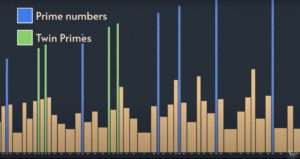
Analytic Number Theory Alert! An even more idle question than normal (that’s because it comes from twitter). Alex Kontorovich noted with pleasure the following pictorial representation of the integers from a Veritasium youtube video, where prime numbers are represented by \(1 \times n\) rectangles and all other numbers represented as \(a \times b\) rectangles (of area \(n\)) for some \(a > 1\).

This leads to the natural followup questions. How much horizontal space does it take to graph the first \(X\) integers this way if one either:

  1. Plots the integers \(n\) as \(a \times b\) with \(a \le b\) as big as possible?
  2. Plot the integers \(n\) as \(a \times b\) with \(a = 1\) if \(n\) is prime, and otherwise with \(a\) as small as possible, that is, the smallest divisor of \(n\) greater than \(1\)?

(From the graph, it actually appears that the second algorithm is actually used.)

In both cases, there is a trivial upper bound \( \ll X^{3/2}\). On the other hand, simply by considering products of primes in the interval \([X^{1/2}/C,X^{1/2}]\) for some constant \(C > 1\) you get at least a constant times [corrected] \((X^{1/2}/\log X)^2\) integers less than \(X\) with \(a \gg X^{1/2}\), and hence a lower bound (in both cases) of \(\gg X^{3/2}/(\log X)^2\). But neither of these bounds are presumably best possible. What then are the precise asymptotics? This seems like the type of question Kevin Ford might be able to answer. Actually, this might be a question that Kevin Ford already knows how to answer. I summon his spirit from the whispers of the internet to come and answer this for me. But if that doesn’t work, anyone else should feel free to give an answer or make a guess.

Update: Friend of the blog Boaty McBoatface emails me to say:

I think the second one is quite easy.

I think you just want to compute

\(\displaystyle{\sum_{p < X^{1/2}} p F(X/p, p)}\)

where \(F(y,p)\) is the number of integers \(\le y\) with all prime factors \(\ge p\). (This has a name, the Buchstab function).

Here the \(X/p\) should be \(\lfloor X/p \rfloor\) but this is of little consequence.

Using the trivial bound \(F(y,p) \le y\) shows that essentially all the contribution is from \(p > X^{1/2 – \varepsilon}\), and in this range a number \( \le X/p\) has all its prime factors \( \ge p\) if and only if it is in fact a prime \( \ge p\) . So in fact you want to compute

\(\displaystyle{\sum_{p \le X^{1/2}} p \pi(X/p)}.\)

There are various ways to do this more or less carefully, but by splitting into ranges \(cX^{1/2} < p < (c + 1/N) X^{1/2}\), summing over \(c = 0,1,2,\ldots, N-1\) and then letting \(N \rightarrow \infty\) I think one gets

\(\displaystyle{ \frac{4X^{3/2}}{(\log X)^{2}} \int^1_0 (1 – c^2) dc \sim \frac{8}{3} \cdot \frac{X^{3/2}}{(\log X)^{2}}}.\)

The first question is definitely much harder and, as you guess, feels pretty close to the kind of stuff Ford and Tenenbaum do in their work.

Posted in Mathematics | Tagged , , , | 5 Comments