Today’s post is about work of my student Abhijit Mudigonda, who is graduating next spring and is currently applying for postdocs.
The general modularity (or potential modularity) conjecture for abelian varieties over \(\mathbf{Q}\) is hopeless in general when the dimension \(g \ge 3\). On the other hand, one is in better shape if one restricts to abelian varieties with extra endomorphisms. The “easiest” case is the case of CM varieties, where potential modularity follows from a theorem of Hecke. One of the problems considered by Abhijit is the potential modularity of abelian fourfolds over \(\mathbf{Q}\) or over totally real fields. The case when the Mumford-Tate group is \(\mathrm{GSp}_8\) seems hopeless, but my first impression was that all other cases were on the table; more or less. Abhijit has clarified which bits are “more” and which bits are “less”!
One (by no means the only interesting) case comes from examples of Mumford, which have trivial endomorphisms over \(\mathbf{C}\) but nonetheless have extra symmetries, and which I mentioned previously in this post. Since that time, there has been quite a lot of progress. In particular, there is the paper of Bouchet, Hanselman, Pieper, and Schiavone which realizes a versal (along a particular Mumford Shimura curve) family of such varieties as the Jacobians of a family of hyperelliptic curves.
In an orthogonal direction, Abhijit first understood and corrected what I said in the previous post, and understood precisely the right arithmetic conditions one should look for on the corresponding Hilbert Modular Form of weight \((1,1,2)\). (For example, unlike what I claimed, the coefficients of the form are definitely not in \(F\) but rather in some CM extension which disappears after twisting due to the interaction of the Galois action of the field and the coefficients.) This involved understanding not only the theory but also developing the computational theory of Hilbert Modular Forms of non-paritious weights. These are interesting beasts in that they are not algebraic in the sense of Buzzard-Gee. Correspondingly, the theory of Hecke operators is a bit tricky. Assume that \(F\) has narrow class number one, and let \(P = (\pi)\) be prime, with \(\pi\) totally positive. One can define the action of operators \(T_{\pi}\), and for an eigenform the corresponding eigenvalues will all live over a finite extension of \(F\). But if one wants to define an operator \(T_P\) depending only on the prime \(P\), then one has to normalize in such a way that the resulting eigenvalues now generate a field of infinite degree over \(F\). For example, if \(F\) is real quadratic, the weight is \((2,1)\), and \(\varepsilon^2\) is some totally positive unit of \(F\) (all totally positive units are squares if the narrow class number is one) then the eigenvalues of \(T_{\pi}\) and \(T_{\varepsilon^2 \pi}\) are related by the formula:
\[\lambda_{\varepsilon^2 \pi} = \varepsilon^2 \cdot |\overline{\varepsilon}| \cdot \lambda_{\pi}.\]
The only way to normalize this (at least up to twist) is to divide by a factor of the form \(\pi \sqrt{|\overline{\pi}|}\). However, then one has to enlarge the coefficient field by \(\sqrt{|\overline{\pi}|}\) and moreover do this for every prime \(\pi\).
Relatedly, although one can form a Galois representation associated to any eigenform, no global twist of this eigenform will be de Rham or even Hodge-Tate at all places above \(p\), nor will it fit into any compatible system. The more natural object to consider is the projective representation whose adjoint representation is de Rham at all places above \(p\). One example to keep in mind is the case of weight \((1,2)\). Then one can form a Galois representation with (generalized) Hodge-Tate weights \([0,0]\) at one embedding and \([-1/2,1/2]\) at the other, and no twist will be Hodge-Tate, but the adjoint representation will have weights \([0,0,0]\) and \([-1,0,1]\). Abhijit sorts all of this out and actually implements it all in Magma. This was actually a substantial undertaking, which involved additionally plenty of work even for higher weights with non-trivial nebentypus. This was of a completely different order of difficulty than what was done for this paper — writing a program that can be used by others is completely different to writing some code that worked in one specific example!
Returning to modularity, the first step to showing that a Mumford fourfold over \(\mathbf{Q}\) is potentially modular is extracting the associated projective \(2\)-dimensional representation and showing it (potentially) corresponds to a HMF over some field of degree \(3d\), whose weights are \(1\) and \(2\) with multiplicity \(2d\) and \(d\) respectively. Even then, that isn’t quite enough to show that \(H^1(A)\) is potentially modular, since one doesn’t yet have a transfer
\[\mathrm{GL}(2) \times \mathrm{GL}(2) \times \mathrm{GL}(2) \rightarrow \mathrm{GL}(8).\]
In practice, Abhijit has spent more time dealing not with these Mumford examples but with other interesting fourfolds which do have non-trivial geometric endomorphisms, including some that also have exceptional Hodge classes in higher degrees. Just like for Mumford fourfolds, this ultimately leads to a “factorization” of the corresponding Tate modules where there is a delicate interplay between the following:
- The fields of definition of the corresponding endomorphisms,
- The fields of coefficients of the compatible systems which occur (sometimes potentially) as “factors” of the compatible system of Tate modules.
Another ingredient is his construction of twisted PEL Shimura varieties, which allows the Moret–Bailly arguments to work even when the geometric endomorphisms are not defined over a totally real field. (The exact field where the endomorphisms are defined plays a key role in the structure of the conjectural Sato-Tate group and the factorization of the compatible system.) Rather than try to state his results precisely, as well as the consequences for modularity (some cases are still in progress) let me just show one chart from Abhijit’s upcoming preprint indicating the classes of fourfolds which he proves are potentially modular:
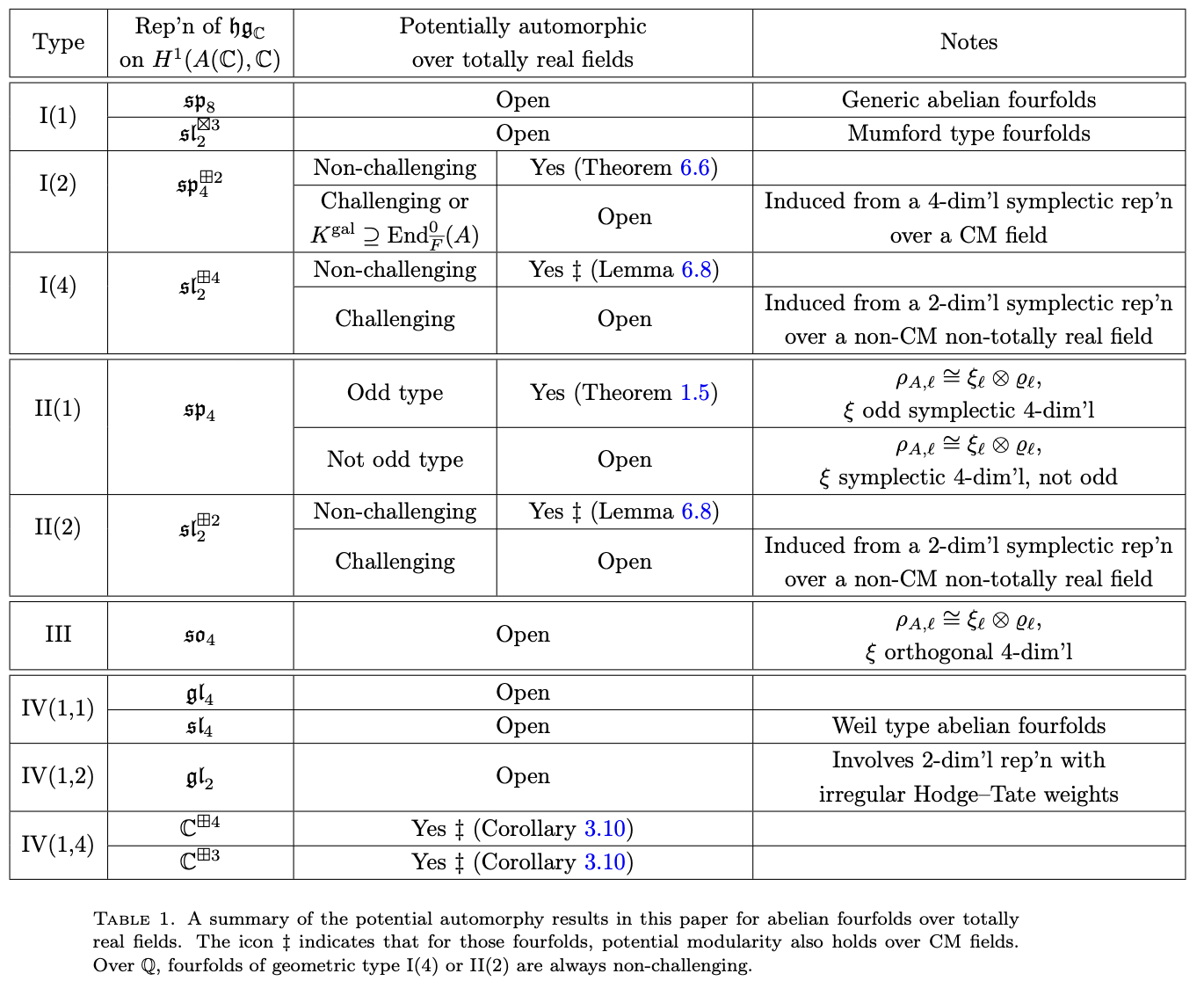
As I suggested above, my a priori expectation was that one should be able to (potentially) handle almost all of the atypical fourfolds over totally real fields, at least up to the triple product issue mentioned above, as well as some other troublesome cases (like the induction of an abelian surface over an imaginary quadratic field). And indeed, some of the cases marked “open” above are so marked because they are still in progress. But Abhijit found that there were examples of fourfolds with non-trivial geometric endomorphisms whose modularity seems out of reach. To my surprise, there exist \(4\)-folds over totally real fields \(F\) which (ultimately) give rise to representations
\[\rho: G_F \rightarrow \mathrm{GSp}_4(\overline{\mathbf{Q}}_p)\]
occurring as constituents (possibly as tensor factors) whose algebraic monodromy group is \(\mathrm{GSp}_4\) but where the similitude character is totally even rather than totally odd. (It’s still true that the trace of complex conjugation is \(0\).) These monstrous objects should be associated to some very nasty automorphic forms. (A simpler degenerate compatible system of this kind can be obtained by tensoring an even compatible system with projective image \(A_5\) and a CM compatible system with Hodge-Tate weights \([0,1]\); this also gives a symplectic compatible system with Hodge-Tate weights \([0,0,1,1]\) which is even, but of course not with big monodromy group.)
In addition to all of this, Abhijit also found some interesting non-CM forms of weight \((1,3)\) which should be related to the modularity of \(H^2(X)\) for various elliptic surfaces one may be able to write down explicitly. He also has an upcoming paper with a number of authors giving a uniform algorithm to compute the graded rings (and hence, models, by Baily-Borel) of Hilbert modular varieties (I’ll add a link when that becomes available.) Finally, he has also made some intriguing new numerical observations about elliptic curves over \(\mathbf{Q}\) and their relationship with certain Hilbert Modular Forms. These are still too preliminary to discuss here, but I’m sure he would be happy to tell you about them in person, and I hope to return to them in a future post.