
The goal of this continuing sequence of posts is to recognize the reality in how our subject is changing and how we should adapt.
Even in a hypothetical world where AI was infallible, essentially omniscient, benevolent, a wonderful expositor, and freely available, I believe that many people would still want humans to maintain and develop a deep understanding of mathematics. They would not want to leave mathematics entirely to the machines, any more than they would want to abandon other large swathes of human thought. For this post, I will take that desire as a starting assumption.
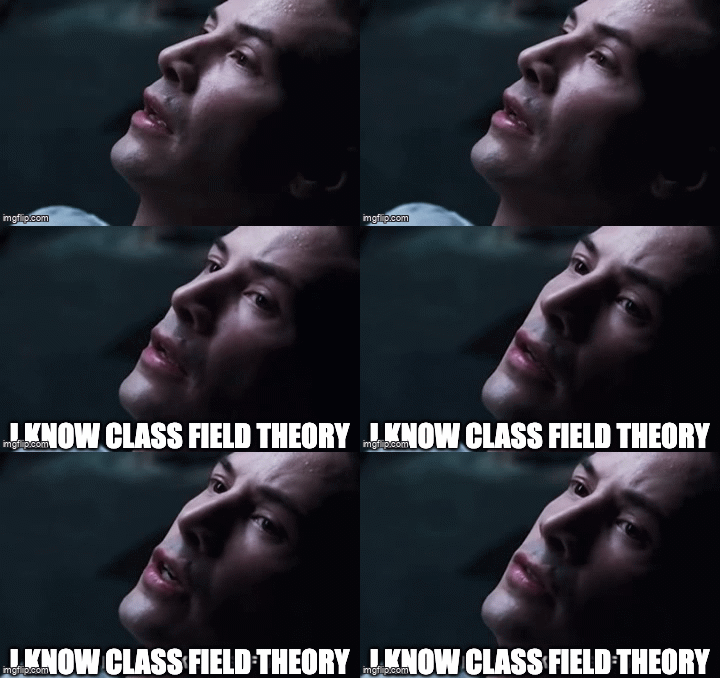
My core belief is that understanding mathematics is hard and AI is not going to fundamentally change that, even if it makes proving theorems in mathematics much easier. I remember driving to Wisconsin and listening to Jordan Ellenberg on Lex Fridman’s podcast. What struck me most from the podcast was the discussion of Fermat’s Last Theorem. Fridman was essentially arguing that since the statement of Fermat’s Last Theorem was so simple, there must inherently be a simple explanation of why it was true. This reflects a philosophical idea about science and mathematics that I think is fundamentally untrue: that any truth that is simple to state will ultimately be true for a simple reason. The easiest proof of Fermat may well not be the one found by Wiles (or maybe it will be). But consider instead something much older and established in mathematics, namely class field theory. If I hold any position in this post with conviction, it would be that, even with superhuman exposition, a human could not acquire a good understanding of the statements and proofs of class field theory without years of dedicated study^*. This is not an isolated example. Maintaining and developing human understanding across mathematics requires people who can devote substantial parts of their lives to it. If we value that understanding, there is a case for supporting those people and the communities in which they work, rather than leaving the whole enterprise to whoever wants to work on it in their spare time. That is a central part of the case for mathematics as a profession.
What is important to recognize, however, is that mathematics as a profession will surely be changing rapidly. Daniel Litt has told us that we need to be honest not only about the aspects of our field that will break with AI, but also about the aspects that are already broken. This is an amazing opportunity to fix some of these things! If we are going to defend mathematics, at least in part, as a means of increasing human understanding, then we ought to be rather more demanding about whether our own practices actually contribute to this understanding.
To me, there are (at least) four natural systemic issues in mathematics that we have to address. Addressing any one of them will require consensus building to achieve the massive shift necessary in our community norms. I plan to devote a blog post to each of the issues, so for now I will just introduce them. I am not attempting to be prescriptive, but rather simply to think aloud and hope for suggestions.
One thing we need to do in particular is ask whether our institutions and practices reward the production of mathematical understanding, or merely activities that we have come to treat as evidence of it. With AI, activities such as producing proofs will no longer be quite so closely coupled with understanding.
- Journal Articles: The journal system was, to put it politely, already struggling before AI. There are too many papers, and the refereeing system is bursting at the seams. At least in mathematics we have a large number of high-quality journals, which helps diffuse the power of editorial boards, given the career importance of publications. [Imagine a field where success could come only from publishing in a single journal; such fields exist.] As we go forward, we very much have an opportunity to reconsider how the publication system works in a radical way. If we don’t abandon it altogether, then we need to redefine what we hope to get out of it. I already have anecdotal evidence that submission rates to top journals are rising sharply, and I doubt that the current refereeing system can sustain such an increase. I don’t think it is as simple as demanding better exposition — it’s not unreasonable to expect AI to vastly improve in this dimension as well. If mathematics is a conversation, then what we would like to achieve are strands of interesting conversations that people are both invested in and listening to. This touches, in part, on the question of insularity raised below.
- Seminar Talks: I would say that the median mathematics seminar could (perhaps harshly) be described as a waste of time for both the participants and the speaker. If we are to claim that fostering mathematical understanding is one of our main goals, we certainly haven’t made much of an effort to reward good talks. One institutional obstruction has always been the expectation that people talk about their own work. What often gets lost when one does this is an explanation of why the broader question being addressed is interesting in the first place, the methods that have been used most successfully in the field in the past, and the most promising questions to consider in the future. (One can do this in a talk about one’s own work, but people frequently do not.)
- Insularity: The past few decades have seen an explosion in mathematics. But I feel this has come at the cost of mathematicians being less able to communicate; not only with people in other areas of mathematics, but sometimes even within their own field. Some have argued that this is an inevitable consequence of the growing difficulty of mathematics, but I suspect that once a mathematical subcommunity reaches a certain size, the impetus to reach out diminishes, to all our detriment.
- Ego: Perhaps the thorniest question of all: how do we shape the incentives in our field to produce better outcomes? For all that we emphasize understanding, it would be insane not to acknowledge the importance of ego, and the way that the desire to be the first person to prove something has motivated many of us. This moment is going to require a great deal of humility. If human understanding of deep mathematics is what we want to defend, it ought also to be what we reward.
^*: now I have the following in my head:
Since I started writing this post, there has appeared both a panel session on closely related topics, and a post by Tim Gowers as well. Many of the themes discussed there overlap with what I have said. I think this is a feature rather than a bug, since I think more mathematicians need to be part of the conversation of where our subject is going.
I agree with Jacob when he points out that the motivation to prove something is a non-trivial part of what it is for many people to be a mathematician (Gowers acknowledges this as well), and that we shouldn’t assume that exposition is a niche that will remain only the domain of humans. When I initially started to write this blog post, I had a rather long discussion about reasons why people do mathematics, but I was not entirely happy about it. As Michael points out, he wrestled with exactly this issue in his book. Geordie Williamson I think gave a great sense of how mathematicians have reacted to various new results discovered by AI, as well as echoing the need for mathematicians not to put their heads in the sand. Peter Scholze’s comment that there already is a bottleneck in human understanding was a very interesting point. The remarks by Michael (and many others) about the ramifications for AI for society are of course vastly more important than the future of pure mathematics, but I am going to restrict myself to mathematics. Finally, the idea that there are people like Peter Scholze continuing to do mathematics without any AI is a pleasing one.
Re the journal issue; here is an unbaked thought (thinking out loud) to try to capitalize on the compulsive button clicking and seeing it as a feature rather than a bug, to use your words.
What if we put some good effort to organize a vast system of “wiki’s” (a la stack project) some well-structured repos, where results have various status: Lean-verified, human-verified, human-digested (with an attached human article appearing in a serious journal). It should have a top down format as a wiki and it could welcome inputs from anybody. Stuff constructed on an uncertified page will maintain a similar uncertified component.
You could easily imagine a future where the totality of mathematicians, button-clickers and autonomous agents will produce in each area of math the analogous of 100K papers as per today. But yet, I think we will have at that point also agents able to package this and explain how much it is changing the architecture of the wiki and what new fundamental phenomena are really arising.
Now the articles and journals. We might have not so many of them. The point of an article should be to summarize the most important directions of a sub-area (with references to this Universal-Wiki) and clarify where the field is heading, what are the new phenomena to explore and the new problems to tackle.
Ideally each such article provides a sense of direction to humans on how to navigate the Universal-Wiki and at the same time it provides both human mathematicians (“theoretical mathematicians”) and compulsive button clickers (“experimental mathematicians”) as well as autonomous agents directions to do more contributions to the wiki and continue to build the large architecture.
It could be that at some point agents will want also to contribute to the big directions and submit to the journals. And it could as well be that autonomous thinkers will begin suggesting directions we are uninterested in (maybe unwisely!) or perhaps brand new directions.
You will probably have much more refined thoughts on this in your upcoming post!
Regarding Ego, priority and Scholze. Let me continue on the analogy with physics and think of theoretical mathematicians and experimental mathematicians.
First of all the experimental mathematicians. Well if we have such a wiki it will be easy to keep records. There will be folks with an insane score on problems that have popularity in the architecture. Those will gain status, reputation, prizes, i.e. all of the reward we need to keep ourselves engaged.
Second the theoretical mathematicians. I think you can imagine for a while that these will be the folks able to find very clever unified framework to explain vast amounts of mathematical landscape happening in the “Universal-Wiki” (or whatever system we will adopt to collect the unavoidably ridiculously large amount of daily “discoveries”). They will propose good directions for everybody else. And being the first one to make such a discovery will be just as pre-2026 being the first one to prove an amazing theorem. So still space for some healthy ego, rewards etc.
And let me disagree here with Daniel (in his beautiful essay) and Jacob (at the panel). Sure there will come a point where agents will see how to do BSD, Riemann etc; will be God-like and there will be no point in theoretical mathematicians either. But that point will coincide with (or be soon before) the point where this will be true for any remaining task for humans.
At that point we will simply have to accept that we continue doing things because we want to exist and survive; and the whole society will be so totally different.
So I think it is for now important to still make a distinction between what is likely to come and what it is at present. At present the capabilities are not yet like that. And we should focus on preserving our culture during this transition also because we don’t have a precise timeline of how long that will take.
And we can simply re-update the discussion up until that will happen since when that will happen we might have to see what the whole society is going to look like.
Again, most likely you will have much riper thought on this issue too! Just wanted to give some inputs to the discussion which I feel strongly about.