Chicago Seminar Roundup

Here are two questions I had about the past two number theory seminars. I haven’t had the opportunity to think about either of them seriously, so they may be easy (or more likely stupid).

Anthony Várilly-Alvarado: Honestly, I’ve never quite forgiven this guy for his behavior as an undergraduate. He was my TA when I taught Complex Analysis at Harvard, and he had the bad manners to do an absolutely wonderful job and be beloved by all the students. Nothing makes a (first time) professor look worse than a good TA. (It means I can’t even take any credit for the students in the class who became research mathematicians). Anyway, Tony gave a talk on his joint work with Dan Abramovich about the relation between Vojta’s conjecture and the problem of uniform bounds on torsion for abelian varieties. (Spoiler: one implies the other.) More specifically, assuming Vojta’s conjecture, there a universal bound on \(m\) (depending only on \(g\) and \(K)\) beyond which no abelian variety of dimension \(g\) over \(K\) can have full level structure.

If one wanted to prove this (say) for elliptic curves, and one was allowed to use any conjecture you pleased, you could do the following. Assume that \(E[m] = \mu_m \oplus \mathbf{Z}/m \mathbf{Z}\) for some large integer m. One first observes (by Neron-Ogg-Shafarevich plus epsilon) that E has to have semi-stable reduction at primes dividing N_E. Then the discriminant \(\Delta\) must be an \(m\)th power, and then Szpiro’s Conjecture (which is the same as the ABC conjecture) implies the desired result.

If you try to do the same thing in higher dimensions, you similarly deduce that A must have semi-stable reduction at primes dividing N_E. edit: some nonsense removed. One then gets implications on the structure of the Neron model at these bad primes, which one can hope to parlay in order to get information about local quantities associated to A analogous to the discriminant being a perfect power. But I’m not sure what generalizations of Szpiro’s conjecture there are to abelian varieties. A quick search found one formulation attributed to Hindry in terms of Faltings height, but it was not immediately apparent if one could directly deduce the desired result from this conjecture, nor what the relationship was with these generalizations to either ABC or to Vojta’s conjecture.

Ilya Khayutin: Ilya mentioned Linnik’s theorem that, if one ranges over imaginary quadratic fields in which a fixed small prime is split, the CM j-invariants become equidistributed. The role of the one fixed prime is to allow one to use ergodic methods relative to this prime. My naive question during the talk: given p is split, let \(\mathfrak{p}\) be a prime above p. Now one can take the subgroup of the class group corresponding to the powers of \(\mathfrak{p}.\) Do these equidistribute? The speaker’s response was along the lines that it would probably be quite easy to see this is false, but I didn’t have time after the talk to follow up. It’s certainly the case that, most of the time, the prime \(\mathfrak{p}\) will itself generate a subgroup of small index in the class group (the quotient will look like the random class group of a real quadratic field), but sometimes it will be quite large. For example, I guess one can take

\(\displaystyle{D = 2^n – 1, \qquad \mathfrak{p}^{n-2} = \left(\frac{1 + \sqrt{-D}}{2}\right)},\)

and the subgroup generated by this prime has order \(\log(D)\) compared to \(D^{1/2 + \epsilon}.\) So I decided (well, after writing this line in the blog I decided) to draw a picture for some choice of Mersenne prime. And then, after thinking a little how to draw the picture, realized it was unnecessary. The powers of \(\frak{p}\) in this case are given explicitly by

\(\displaystyle{\mathfrak{p}^m = \left(2^m, \frac{1 + \sqrt{-D}}{2}\right)},\)

It is transparent that for the first half of these classes, the first factor is much smaller than the second, but since the second term also has small real part, the ratio already lies inside the (standard) fundamental domain. Hence the corresponding points will lie far into the cusp. Similarly, the second half of the classes are just the inverses in the class group of the first half, and so will consist of the reflections of those points in \(x = 0\) and so also be far into the cusp. So I guess the answer to my question is, indeed, a trivial no. So here is a second challenge: suppose that 2 AND 3 both split. Then do the CM points generated by \(\mathfrak{p}\) for primes above 2 AND 3 equidistribute? Actually, in this case, it’s not clear off the top of my head that one can easily write down discriminants for which the index of this group is large. But even if you can, sometimes \(\mathbf{Z}^2\) subgroups get you much closer to equidistribution than \(\mathbf{Z}!\)

Posted in Mathematics | Tagged , , , , , , , , , , , , | 2 Comments

The boundaries of Sato-Tate, part I

A caveat: the following questions are so obvious that they have surely been asked elsewhere, and possibly given much more convincing answers. References welcome!

The Sato-Tate conjecture implies that the normalized trace of Frobenius \(b_p \in [-2,2]\) for a non-CM elliptic curve is equidistributed with respect to the pushforward of the Haar measure of SU(2) under the trace map. This gives a perfectly good account of the behavior of the unnormalized \(a_p \in [-2 \sqrt{p},2 \sqrt{p}]\) over regions which have positive measure, namely, intervals of the form \([r \sqrt{p},s \sqrt{p}]\) for distinct multiples of \(\sqrt{p}.\)

If one tries to make global conjectures on a finer scale, however, one quickly runs into difficult conjectures of Lang-Trotter type. For example, given a non-CM elliptic curve E over \(\mathbf{Q},\) if you want to count the number of primes p < X such that \(a_p = 1\) (say), an extremely generous interpretation of Sato-Tate would suggest that probability that \(a_p = 1\) would be

\(\displaystyle{\frac{1}{4 \pi \sqrt{p}}},\)

and hence the number of such primes < X should be something like:

\(\displaystyle{\frac{X^{1/2}}{2 \pi \log(X)}},\)

except one also has to account for the fact that there are congruence obstructions/issues, so one should multiply this factor by a (possibly zero) constant depending one adelic image of the Galois representation. So maybe this does give something like Lang-Trotter.

But what happens at the other extreme end of the scale? Around the boundaries of the interval [-2,2], the Sato-Tate measure converges to zero with exponent one half. There is a trivial bound \(a_p \le t\) where \(t^2\) is the largest square less than 4p. How often does one have an equality \(a^2_p = t^2?\) Again, being very rough and ready, the generous conjecture would suggest that this happens with probability very roughly equal to

\(\displaystyle{\frac{1}{6 \pi p^{3/4}}},\)

and hence the number of such primes < X should be something like:

\(\displaystyle{\frac{2 X^{1/4}}{3 \pi \log(X)}}.\)

Is it at all reasonable to expect \(X^{1/4 \pm \epsilon}\) primes of this form? If one takes the elliptic curve \(X_0(11),\) one finds \(a^2_p\) to be as big as possible for the following primes:

\(a_{2} = -2 \ge -2 \sqrt{2} = -2.828\ldots,\)

\(a_{239} = -30 > -2 \sqrt{239} = -30.919\ldots,\)

\(a_{6127019} = 4950 \le 2 \sqrt{p} = 4950.563\ldots,\)

but no more from the first 500,000 primes. That's not completely out of line for the formula above!

Possibly a more sensible thing to do is to simply ignore the Sato-Tate measure completely, and model \(E/\mathbf{F}_p\) by simply choosing a randomly chosen elliptic curve over \(\mathbf{F}_p.\) Now one can ask in this setting for the probability that \(a_p\) is as large as possible. Very roughly, the number of elliptic curves modulo \(p\) up to isomorphism is of order \(p,\) and the number with \(a_p = t\) is going to be approximately the class number of \(\mathbf{Q}(\sqrt{-D})\) where \(-D = t^2 – 4p;\) perhaps it is even exactly equal to the class number \(H(t^2 – 4p)\) for some appropriate definition of the class number. Now the behaviour of this quantity is going to depend on how close \(4p\) is to a square. If \(4p\) is very slightly — say \(O(1)\) — more than a square, then \(H(t^2 – 4p)\) is pretty much a constant, and the expected probability going to be around \(1\) in \(p.\) On the other hand, for a generic value of \(p,\) the smallest value of \(t^2 – 4p\) will have order \(p^{1/2},\) and then the class group will have approximate size \(p^{1/4 \pm \epsilon},\) and so one (more or less) ends up with a heuristic fairly close to the prediction above (at least in the sense of the main term being around \(X^{1/4 \pm \epsilon}).\)

But why stop there? Let's push things even closer to the boundary. How small can \(a^2_p – 4p\) get relative to \(p?\) For example, let us restrict to the set \(S(\eta)\) of prime numbers p such that

\(\displaystyle{S(\eta):= \left\{p \ \left| \ p \in (n^2,n^2 + n^{2 \eta}) \ \text{for some} \ n \in \mathbf{Z} \right.\right\}}.\)

For such primes, the relative probability that \(a_p = \lfloor \sqrt{4p} \rfloor = 2n\) is approximately \(n^{\eta}/p \sim n^{2 \eta – 1}.\) So the expected number of primes with this property will be infinite providing that

\(\displaystyle{\sum \frac{n^{3 \eta}}{n^2 \log(n)}}\)

is infinite, or, in other words, when \(\eta \ge 1/3.\) So this leads to the following guess (don't call it a conjecture!):

Guess: Let \(E/\mathbf{Q}\) be an elliptic curve without CM. Is

\(\displaystyle{\liminf \frac{\log(a^2_p – 4p)}{\log(p)} = \frac{1}{3}?}\)

Of course, one can go crazy with even more outrageous guesses, but let me stop here before saying anything more stupid.

Posted in Mathematics | Tagged , , | 3 Comments

Australiana

Some short observations from my recent trip:

Only in the same sense as Captain Renault could you possibly be shocked (shocked!) by what Bancroft drops into his pants.

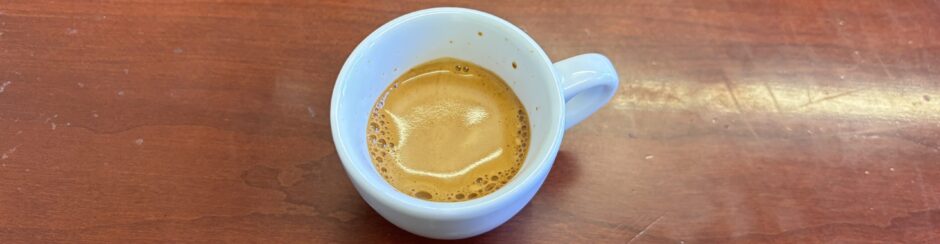
The 90th percentile quality coffee in Melbourne (random mall coffee) is at (approximately) the level of the 10th percentile coffee in Chicago. While there’s plenty of good coffee in Chicago, you don’t want into a random cafe and expect to get something drinkable. You also don’t expect any random place to have a top of the line Marzocco machines. But if you want a few recommendations in the neighbourhood of either Lygon street or near the state library, I can suggest Market Lane/Pool House/Seven Seeds/Vincent the Dog/The League of Honest Coffee/Vertue of the Coffee Drink to get you started. Expert tip at US hipster cafes: order a magic (3/4 flat white with double ristretto), then look unimpressed when they don’t know what you are talking about.

More Coffee!More Coffee!Even More Coffee!

While you’re near the state library, stop off in the reading room for some speed chess (victory is mine!)

Australia has a lot of long beaches, and I don’t mean long in the sense of fractal dimension greater than one. I mean in the sense of having several miles of pristine beach to yourself:

Beach

Fight terrorism with philosophy! (and concrete bollards):

Chicago Philosophy

I always assumed that A’Beckett St was named after the turbulent priest. Not So! Apparently it is named after the first chief justice of Victoria. Upon learning this, I checked out the origins of the other street names in Melbourne’s CBD. Four of the North-South (ish) streets in order include (at some point) King-William-Queen-Elizabeth, and it is “common knowledge” that these streets are so named in pairs. Also false! William is named for King William IV, and Queen for Queen Adelaide, but King is named for Philip Gidley King, the governor of NSW from 1800-1806, and Elizabeth was “possibly” named for the wife of another Governor of NSW, Richard Bourke. (I did of course know that Bourke St (named after the guv) was not named after Burke, the explorer who (with Wills) became famous for his ludicrous incompetence.

Posted in Coffee, Travel | Tagged , , , , , , , , , , , , , , | 1 Comment

Fan Mail

Edit: A previous version of this post has been edited upon request.

Somewhat less salaciously, I received a Christmas card from an academic couple of whom I am absolutely sure I have never met. (I just checked my mailbox at work for the first time this year, which is where this card was sent.) They work in a state I have never visited, and neither of them are mathematicians (though one appears to have a math PhD). They wished me the best “on my career.” Apparently (according to their website) one of them is an expert on “targeted killings.” I hope that “on my career” is not a euphemism.

As for mail more directly relevant to me and this blog, I did (three or so years ago?) receive an unsolicited package in the mail from a blog reader. The sender’s name (Leslie, I think?) was suitably unisex, so I naturally assumed that it was a swooning 20-something female who had fallen for my prose and occasional deliberate grammatical and spelling errors. But the reality was better: it was (as far as I could tell from a google search) a 60 year old male with a PhD in math, who send me a CD with some Schumann Lieder, in particular an Edith Mathis CD (with Christoph Eschenbach on the piano) entitled “Frauenliebe und Leben & other Lieder”. Absolutely wonderful! Through a quirk of fate this CD has ended up in my car, and has been in heavy rotation over the past year during my commute. Because I wouldn’t want you to miss out, I’ve given a youtube link to one of the songs below (Kennst du das Land — not from the titular cycle, but chosen in part because the accompaniment reminds me stylistically of Dichterliebe, partly because it sounds good, and partly because Robert wrote it for Clara and it is Valentine’s day). But it makes me wonder: what type of fan mail does Quomodocumque get? (or, for that matter, Terry Tao and Sir Timothy Gowers, FRS)

Posted in Uncategorized | Tagged , , , , , , , , , | 2 Comments

Alinea

Fresh off my dining experiences in Jerusalem, I returned home for some more local dining.

From smoked juniper bushes to edible stones, I arrived at Alinea fearing that I would be underwhelmed but left leaving very happy. Rather than try to describe my meal in any detail, let me instead just post a few teaser pictures. I came into the experience without any preconceived notions of what to expect, which I recommend. (I also wasn’t paying, which I also recommend.)

Stones

The trick is to guess how many of these are edible.

Juniper

The decorations and the food are intertwined. This was a feature of many dishes of this —and I am guessing most — meals at Alinea.

Berries

This had some Foie Gras, I believe.

Dessert Stones

This chocolate mousse hiding in one of these stones was delicious.

Balloon

I am not a number! I am a free man!

Rover

Many dishes omitted, of course. One notable course involved a pomegranate cocktail which had a slight bouquet of christmas pudding; possibly the best cocktail I have ever had. Indeed, that has inspired one of my upcoming culinary choices for next two weeks, which include: the Violet Hour, L’Etoile for the number theory seminar dinner at Madison (this one is more of a suggestion than a concrete plan, but JSE, can we make it happen?), and the Victoria Market.

Posted in Food, Travel | Tagged , , , , , , , | 1 Comment

This year in Jerusalem

I just returned from spending almost a week in Jerusalem (my first ever visit to Israel). The main reason for my visit was to talk with Alex Lubotzky (and Shai Evra) about mathematics, but there was plenty of time for other mathematical activities — I gave a four hour talk on cohomology to computer scientists, chatted with Kazhdan (and also Akshay), caught up with Alex Gamburd, Ehud de Shalit, and went to the presentation of the Ostrowski medal to Akshay Venkatesh (with a virtual laudation by Peter Sarnak).

But this post is less about the mathematics (hopefully more on that when the theorems are proved), but rather my other (mostly culinary) adventures.

My first night out, I was curious how Ethiopian food in Israel would compare to Chicago. However, my taxi driver had other ideas, and instead took me to a Kurdish restaurant (Ima) where I ended up with a pretty nice lamb dish. While walking home from dinner, I stumbled across the Chords Bridge (the “Bridge of Strings”). My particular approach presented me with a visual paradox: the bridge appeared to be straight with a central column with cables to either side. These cables appeared as lines sweeping out a ruled surface. Since the bridge was straight, these two surfaces should essentially have formed one surface, but they appear to meet at right angles at the column, which made no sense. Since my description also probably doesn’t make so much sense, I took a video:

(Admittedly my geometrical intuition is not so great, but I couldn’t work out what was going on until I saw it again from a different angle.)

Tuesday morning was my “time off” as a tourist. I think the old city would have been much better with a local guide, but I mostly just wandered around between ancient sites and an infinite number of tchotchke shops. Next stop was Machane Yehuda market, and lunch at the hippest restaurant in town. The shikshukit was delicious:

Lunch

Next stop was the fanciest coffee in Jerusalem (not that good)

Coffee

Akshay and I went back to the market for dinner and had the shamburak at Ishtabach along with some pretty good local beer.

On Wednesday, I was contemplating going straight back to the hotel and going to sleep after an undergraduate lecture by Akshay (full jetlag mode at this point, the talk itself was great). But then I ran into Alex Gamburd, who suggested going out to dinner and said he knew of a place which sold food from “biblical times.” At that point, my spirits were instantly lifted, and there was no choice about what I was going to do. So we jumped into a taxi and off we went to Eucalyptus, to have (amongst other things) chicken stuffed in figs (yes, I thought that was just a poor english translation for figs stuffed in chicken, but no, chicken stuffed in figs). The owner came out to chat with us, and claimed that this dish had won a special prize in Melbourne and had also appeared in Vogue (I couldn’t verify these claims, but they were tasty).

A few more things en passant:

A “reception” at Hebrew University apparently does not include Champagne, much for the worse for anyone who had to suffer though my subsequent basic notions seminar. (Hat tip to Michael Schein for telling me this in advance.)

Here’s Alex Gamburd and Andre Reznikov arguing over a point concerning Stalin:

Stalin

Near the old city:

Magnum

The campus appears to be overrun by cats. Well, overrun is an exaggeration, but then saying the campus is “run by cats” conveys a somewhat different image (which may or may not be accurate).

Cats

Posted in Travel | Tagged , , , , , , , , , , , , , , , , , , , , , , , , , | 4 Comments

The paramodular conjecture is false for trivial reasons

(This is part of a series of occasional posts discussing results and observations in my joint paper with Boxer, Gee, and Pilloni mentioned here.)

Brumer and Kramer made a conjecture positing a bijection between isogeny classes of abelian surfaces \(A/\mathbf{Q}\) over the rationals of conductor N with \(\mathrm{End}_{\mathbf{Q}}(A) = \mathbf{Z}\) and paramodular Siegel newforms of level N with rational eigenvalues (up to scalar) that are not Gritsenko lifts (Gritsenko lifts are those of Saito-Kurokawa type). This conjecture is closely related to more general conjectures of Langlands, Clozel, etc., but its formulation was made more specifically with a view towards computability and falsifiability (particularly in relation to the striking computations of Poor and Yuen).

The recognition that the “optimal level” of the corresponding automorphic forms is paramodular is one that has proved very useful both computationally and theoretically. Moreover, it is almost certain that something very close to this conjecture is true. However, as literally stated, it turns out that the conjecture is false (though easily modifiable). There are a few possible ways in which things could go wrong. The first is that there are a zoo of cuspidal Siegel forms for GSp(4); it so happens that the forms of Yoshida, Soudry, and Howe–Piatetski-Shapiro type never have paramodular eigenforms (as follows from a result of Schmidt), although this depends on the accident that the field \(\mathbf{Q}\) has odd degree and no unramified quadratic extensions (and so the conjecture would need to be modified for general totally real fields). Instead, something else goes wrong. The point is to understand the relationship between motives with \(\mathbf{Q}\)-coefficients and motives with \(\overline{\mathbf{Q}}\)-coefficients which are invariant under the Galois group (i.e. Brauer obstructions and the motivic Galois group.)

It might be worth recalling the (proven) Shimura-Taniyama conjecture which says there is a bijection between cuspidal eigenforms of weight two with rational eigenvalues and elliptic curves over the rationals. Why might one expect this to be true from general principles? Let us imagine we are in a world in which the Fontaine-Mazur conjecture, the Hodge conjecture, and the standard conjectures are all true. Now start with a modular eigenform with rational coefficients and level \(\Gamma_0(N).\) Certainly, one can attach to this a compatible family of Galois representations:

\(\displaystyle{\mathcal{R} = \{\rho_p\}, \qquad \rho_p: \mathrm{Gal}(\overline{\mathbf{Q}}/\mathbf{Q}) \rightarrow \mathrm{GL}_2(\overline{\mathbf{Q}}_p).}\)

with the property that the characteristic polynomials \(P_q(T) = T^2 – a_q T + q\) of Frobenius at any prime \( q\) not dividing \(Np\) have integer coefficients, and the representations are all de Rham with Hodge-Tate weights [0,1]. But what next? Using the available conjectures, one can show that there must exist a corresponding simple abelian variety \(E/\mathbf{Q}\) which gives rise to \(\mathcal{R}.\) The key to pinning down this abelian variety is to consider its endomorphism algebra over the rationals. Because it is simple, it follows that the endomorphism algebra is a central simple algebra \(D/F\) for some number field F. From the fact that the coefficients of the characteristic polynomial are rational, one can then show that the number field F must be the rationals. But the Albert classification puts some strong restrictions on endomorphism rings of abelian varieties, and the conclusion is the following:

Either:

  1. \(E/\mathbf{Q}\) is an elliptic curve.
  2. \(E/\mathbf{Q}\) is a fake elliptic curve; that is, an abelian surface with endomorphisms over \(\mathbf{Q}\) by a quaternion algebra \(D/\mathbf{Q}.\)

The point is now that the second case can never arise; the usual argument is to note that there will be an induced action of the quaternion algebra on the homology of the real points of A, which is impossible since the latter space has dimension two. (This is related to the non-existence of a general cohomology theory with rational coefficients.) In particular, we do expect that such modular forms will give elliptic curves, and the converse is also true by standard modularity conjectures (theorems in this case!). A similar argument also works for all totally real fields. On the other hand, this argument does not work over an imaginary quadratic field (more on this later). In the same way, starting with a Siegel modular form with rational eigenvalues whose transfer to GL(4) is cuspidal, one should obtain a compatible family of irreducible 4-dimensional symplectic representations \(\mathcal{R}\) with cyclotomic similitude character. And now one deduces (modulo the standard conjectures and Fontaine-Mazur conjecture and the Hodge conjecture) the existence of an abelian variety A such that:

Either:

  1. \(A/\mathbf{Q}\) is an abelian surface.
  2. \(A/\mathbf{Q}\) is a fake abelian surface; that is, an abelian fourfold with endomorphisms over \(\mathbf{Q}\) by a quaternion algebra \(D/\mathbf{Q}.\)

There is now no reason to suspect that fake abelian surfaces cannot exist. Taking D to be indefinite, the corresponding Shimura varieties have dimension three, and they have an abundance of points — at least over totally real fields. But it turns out there is a very easy construction: take a fake elliptic curve over an imaginary quadratic field, and then take the restriction of scalars!

You have to be slightly careful here: one natural source of fake elliptic curves comes from the restriction of certain abelian surfaces of GL(2)-type over \(\mathbf{Q},\) and one wants to end up with fourfolds which are simple over \(\mathbf{Q}.\) Hence one can do the following:

Example: Let \(B/\mathbf{Q}\) be an abelian surface of GL(2)-type which acquires quaternion multiplication over an imaginary quadratic field K, but is not potentially CM. For example, the quotient of \(J_0(243)\) with coefficient field \(\mathbf{Q}(\sqrt{6})\) with \(K = \mathbf{Q}(\sqrt{-3}).\) Take the restriction to K, twist by a sufficiently generic quadratic character \(\chi,\) and then induce back to \(\mathbf{Q}.\) Then the result will be a (provably) modular fake abelian surface whose corresponding Siegel modular form has rational eigenvalues. Hence the paramodular conjecture is false.

Cremona (in his papers) has discussed a related conjectural correspondence between Bianchi modular forms with rational eigenvalues and elliptic curves over K. His original formulation of the conjecture predicted the existence of a corresponding elliptic curve over K, but one also has to allow for fake elliptic curves as well (as I think was pointed out in this context by Gross). The original modification of Cremona’s conjecture was to only include (twists of) base changes of abelian surfaces of GL(2)-type from Q which became fake elliptic curves over K, but there is no reason to suppose that there do not exist fake elliptic curves which are autochthonous to K, that is, do not arise after twist by base change. Indeed, autochthonous fake elliptic curves do exist! We wrote down a family of such surfaces over \(\mathbf{Q}(\sqrt{-6}),\) for example. (We hear through Cremona that Ciaran Schembri, a student of Haluk Sengun, has also found such curves.) On the other hand, the examples coming from base change forms from Q have been known in relation to this circle of problems for 30+ years, and already give (by twisting and base change) immediate counter-examples to the paramodular conjecture, thus the title.

It would still be nice to find fake abelian surfaces over \(\mathbf{Q}\) (rather than totally real fields) which are geometrically simple. I’m guessing that (for D/Q ramified only at 2 and 3 and a nice choice of auxiliary structure) the corresponding 3-fold may be rational (one could plausibly prove this via an automorphic form computation), although that still leaves issues of fields of rationality versus fields of definition. But let me leave this problem as a challenge for computational number theorists! (The first place to look would be Jacobians of genus four curves [one might be lucky] even though the Torelli map is far from surjective in this case.)

Let me finish with one fake counter example. Take any elliptic curve (say of conductor 11). Let \(L/\mathbf{Q}\) be any Galois extension with Galois group \(Q,\) the quaternion group of order 8. The group \(Q\) has an irreducible representation \(V\) of dimension 4 over the rationals, which preserves a lattice \(\Lambda.\) If you take

\(A = E^4 = E \otimes_{\mathbf{Z}} \Lambda,\)

then \(A\) is a simple abelian fourfold with an action of an order in \(D,\) (now the definite Hamilton quaternions) and so gives rise to compatible families \(\mathcal{R}\) of 4-dimensional representations which are self-dual up to twisting by the cyclotomic character. However, the four dimensional representations are only symplectic with respect to a similitude character which is the product of the cyclotomic character and a non-trivial quadratic character of \(\mathrm{Gal}(L/\mathbf{Q}),\) and instead they are orthogonal with cyclotomic similitude character. So these do not give rise to counterexamples to the paramodular conjecture. A cursory analysis suggests that the quaternion algebra associated to a fake abelian surface which gives rise to a symplectic \(\mathcal{R}\) with cyclotomic similitude character should be indefinite.

Posted in Mathematics | Tagged , , , , , , , , , , , , | 7 Comments

Hiring Season

Lizard 1: Wait, explain again why we bury our young in the sand and thereby place them into mortal peril?

Lizard 2: So they develop character! If it was good enough for me, it’s good enough for them.

(Feel free to choose your own metaphors.)

Posted in Mathematics, Politics, Rant, Travel | Tagged , , , , , | 1 Comment

Abandonware

For a young mathematician, there is a lot of pressure to publish (or perish). The role of for-profit academic publishing is to publish large amounts of crappy mathematics papers, make a lot of money, but at least in return grant the authors a certain imprimatur, which can then be converted into reputation, and then into job offers, and finally into pure cash, and then coffee, and then back into research. One great advantage of being a tenured full professor (at an institution not run by bean counters) is that I don’t have to play that game, and I can very selective in what papers I choose to submit. In these times — where it is easy to make unpublished work available online, either on the ArXiv, a blog, or a webpage — there is no reason for me to do otherwise. Akshay and I are just putting the finishing touches on our manuscript on the torsion Jacquet–Langlands correspondence (a project begun in 2007!), and approximately 100 pages of the original version has been excised from the manuscript. It’s probably unlikely we will publish the rest, not because we don’t think its interesting, but because it can already be found online. (Although we might collect the remains into a supplemental “apocrypha” to make referencing easier.) Sarnak writes lots of great letters and simply posts them online. I wrote a paper a few years ago called “Semistable modularity lifting over imaginary quadratic fields.” It has (IMHO) a few interesting ideas, including one strategy for overcoming the non-vanishing of cohomology in multiple degrees in an \(l_0 = 1\) situation, a way of proving a non-minimal modularity lifting theorem in an (admittedly restricted) \(l_0 = 1\) situation without having to use Taylor’s Ihara Avoidance or base change (instead using the congruence subgroup property), and an argument explaining why the existence of Nilpotent ideals in Scholze’s Galois representation is no obstruction to the modularity lifting approach in my paper with David. But while I wrote up a detailed sketch of the argument, gave a seminar about it, and put the preprint on my webpage, I never actually submitted it. One reason was that David and I were (at the time, this was written in 2014-2015 or so) under the cosh by an extremely persnickety referee (to give you some idea, the paper was submitted in 2012 and was only just accepted), and I couldn’t stomach the idea of being raked over the coals a second time merely to include tedious details. (A tiny Bernard Woolley voice at the back of my head is now saying: excuse me minister, you can’t be raked over by a cosh, it doesn’t have any teeth. Well done if you have any idea what I am talking about.) But no matter, the paper is on my webpage where anyone can read it. As it happens, the 10 author paper has certainly made the results of this preprint pretty much entirely redundant, but there are still some ideas which might be useful in the future someday. But I don’t see any purpose whatsoever in subjecting an editor, a reviewer, and (especially) myself the extra work of publishing this paper.

So I am all in favor of avoiding publishing all but a select number of papers if you can help it, and blogging about math instead. So take a spoon, pass around the brandy butter and plum pudding, and, for the rest of this post, let us tuck in to something from the apocrypha.

Galois Extensions Unramified Away From One Place:

I learned about one version of this question in the tea room at Havard from Dick Gross. Namely, does there exist a non-solvable Galois extension K/Q unramified at all primes except p? Modular forms (even just restricting to the two eigenforms of level one and weights 12 and 16) provide a positive answer for p greater than 7. On the other hand, Serre’s conjecture shows that this won’t work for the last three remaining primes. Dick explained a natural approach for the remaining primes, namely to consider instead Hilbert modular forms over a totally real cyclotomic extension ramified at p (once you work out how to actually compute such beasts in practice). And indeed, this idea was successfully used to find such representations by Lassina Dembélé in this paper and also this paper (with Greenberg and Voight). But there is something a little unsatisfactory to me about this, namely, these extensions are all ramified at \(p\) and \(\infty.\) What if one instead asks Gross’ question for a single place?

Minkowski showed there are no such extensions when \(v = \{\infty\},\) but I don’t see any obstruction to there being a positive answer for a finite place. The first obvious remark, however, is that Galois representations coming from Hilbert modular forms are not going to be so useful in this case at least when the residual characteristic is odd, for parity reasons.

On the other hand, conjecturally, the Langlands program still has something to say about this question. One could ask, for example, for the smallest prime p for which there exists a Galois representation:

\(\displaystyle{\overline{\rho}: G_{\mathbf{Q}} \rightarrow \mathrm{GL}_2(\overline{\mathbf{F}}_p)}\)

whose image is big (say not only irreducible but also not projectively exceptional) and is unramified at all places away from p including infinity. (This is related to my first ever blog post.) Here is how one might go about finding such a representation, assuming the usual suite of conjectures. First, take an imaginary quadratic field F, and then look to see if there is any extra mod-p cohomology of \(\mathrm{GL}_2(\mathcal{O}_F)\) in some automorphic local system which is not coming from any of the “obvious” sources. If you find such a class, you could then try to do the (computationally difficult) job of computing Hecke eigenvalues, or alternatively you could do the same computation for a different such imaginary quadratic field E, and see if you find a weight for which there is an “interesting” class simultaneously for both number fields. If there are no such classes for any of the (finitely many) irreducible local systems modulo p, then there are (conjecturally) no Galois representations of the above form.

There are some heuristics (explained to me by Akshay) which predict that the number of Galois representations of the shape we are looking for (ignoring twists) is of the order of 1/p. On the other hand, no such extensions will exist for very small p by combining an argument of Tate together with the Odlyzko bounds. So the number of primes up to X for which there exist such a representation might be expected to be of the form

\(\log \log X – \log \log C\)

for some constant C to account for the lack of small primes (which won’t contribute by Tate + Odlyzko GRH discriminant bounds). This is unfortunately a function well-known to be constant, and in this case, with the irritating correction term, it looks pretty much like the zero constant. Even worse, the required computation becomes harder and harder for larger p, since one needs to compute the cohomology in the corresponding local system of weight \((k,k)\) for k up to (roughly) p. Alas, as it turns out, these things are quite slippery:

Lemma: Suppose \(\overline{\rho}\) is absolutely irreducible with Serre level 1 and Serre weight k and is even. Assume all conjectures. Then:

  1. The prime \(p\) is at least 79.
  2. The weight \(k\) is at least 33.
  3. If \(\overline{\rho}\) exists with \(k \le 53,\) then \(p > 1000.\)
  4. If \(\overline{\rho}\) exists with \(k = 55,\) then \(p > 200,\) or \(p =163,\) and \(\overline{\rho}\) is the unique representation with projective image \(A_4.\)

Of course the extension for \(p = 163\) (which is well-known) does not have big image in the sense described above.
The most annoying thing about this computation (which is described in the apocrypha) is that it can only be done once! Namely, someone who could actually program might be able to extend the computation to (say) \(p \le 200,\) but the number of extensions which one would expect to see is roughly \(\log \log 200 – \log \log 79,\) which is smaller than a fifth. So maybe an extension of this kind will never be found! (Apologies for ruining it by not getting it right the first time.)

Posted in Mathematics | Tagged , , , , , , , , , , , , , , , , , | 4 Comments

The ABC conjecture has (still) not been proved

The ABC conjecture has (still) not been proved.

Five years ago, Cathy O’Neil laid out a perfectly cogent case for why the (at that point recent) claims by Shinichi Mochizuki should not (yet) be regarded as constituting a proof of the ABC conjecture. I have nothing further to add on the sociological aspects of mathematics discussed in that post, but I just wanted to report on how the situation looks to professional number theorists today. The answer? It is a complete disaster.

This post is not about making epistemological claims about the truth or otherwise of Mochizuki’s arguments. To take an extreme example, if Mochizuki had carved his argument on slate in Linear A and then dropped it into the Mariana Trench, then there would be little doubt that asking about the veracity of the argument would be beside the point. The reality, however, is that this description is not so far from the truth.

Each time I hear of an analysis of Mochizuki’s papers by an expert (off the record) the report is disturbingly familiar: vast fields of trivialities followed by an enormous cliff of unjustified conclusions. The defense of Mochizuki usually rests on the following point: The mathematics coming out of the Grothendieck school followed a similar pattern, and that has proved to be a cornerstone of modern mathematics. There is the following anecdote that goes as follows:

The author hears the following two stories: Once Grothendieck said that there were two ways of cracking a nutshell. One way was to crack it in one breath by using a nutcracker. Another way was to soak it in a large amount of water, to soak, to soak, and to soak, then it cracked by itself. Grothendieck’s mathematics is the latter one.

While rhetorically expedient, the comparison between Mochizuki and Grothendieck is a poor one. Yes, the Grothendieck revolution upended mathematics during the 1960’s “from the ground up.” But the ideas coming out of IHES immediately spread around the world, to the seminars of Paris, Princeton, Moscow, Harvard/MIT, Bonn, the Netherlands, etc. Ultimately, the success of the Grothendieck school is not measured in the theorems coming out of IHES in the ’60s but in how the ideas completely changed how everyone in the subject (and surrounding subjects) thought about algebraic geometry.

This is not a complaint about idiosyncrasy or about failing to play by the rules of the “system.” Perelman more directly repudiated the conventions of academia by simply posting his papers to the arXiV and then walking away. (Edit: Perelman did go on an extensive lecture tour and made himself available to other experts, although he never submitted his papers.) But in the end, in mathematics, ideas always win. And people were able to read Perelman’s papers and find that the ideas were all there (and multiple groups of people released complete accounts of all the details which were also published within five years). Usually when there is a breakthrough in mathematics, there is an explosion of new activity when other mathematicians are able to exploit the new ideas to prove new theorems, usually in directions not anticipated by the original discoverer(s). This has manifestly not been the case for ABC, and this fact alone is one of the most compelling reasons why people are suspicious.

The fact that these papers have apparently now been accepted by the Publications of the RIMS (a journal where Mochizuki himself is the managing editor, not necessary itself a red flag but poor optics none the less) really doesn’t change the situation as far as giving anyone a reason to accept the proof. If anything, the value of the referee process is not merely in getting some reasonable confidence in the correctness of a paper (not absolute certainty; errors do occur in published papers, usually of a minor sort that can be either instantly fixed by any knowledgeable reader or sometimes with an erratum, and more rarely requiring a retraction). Namely, just as importantly, it forces the author(s) to bring the clarity of the writing up to a reasonable standard for professionals to read it (so they don’t need to take the same time duration that was required for the referees, amongst other things). This latter aspect has been a complete failure, calling into question both the quality of the referee work that was done and the judgement of the editorial board at PRIMS to permit papers in such an unacceptable and widely recognized state of opaqueness to be published. We do now have the ridiculous situation where ABC is a theorem in Kyoto but a conjecture everywhere else. (edit: a Japanese reader has clarified to me that the newspaper articles do not definitively say that the papers have been accepted, but rather the wording is something along the lines of “it is planned that PRIMS will accept the paper,” whatever that means. This makes no change to the substance of this post, except that, while there is still a chance the papers will not be accepted in their current form, I retract my criticism of the PRIMS editorial board.)

So why has this state persisted so long? I think I can identify three basic reasons. The first is that mathematicians are often very careful (cue the joke about a sheep at least one side of which is black). Mathematicians are very loath to claim that there is a problem with Mochizuki’s argument because they can’t point to any definitive error. So they tend to be very circumspect (reasonably enough) about making any claims to the contrary. We are usually trained as mathematicians to consider an inability to understand an argument as a failure on our part. Second, whenever extraordinary claims are made in mathematics, the initial reaction takes into account the past work of the author. In this case, Shinichi Mochizuki was someone who commanded significant respect and was considered by many who knew him to be very smart. It’s true (as in the recent case of Yitang Zhang) that an unknown person can claim to have proved an important result and be taken seriously, but if a similarly obscure mathematician had released 1000 pages of mathematics written in the style of Mochizuki’s papers, they would have been immediately dismissed. Finally, in contrast to the first two points, there are people willing to come out publicly and proclaim that all is well, and that the doubters just haven’t put in the necessary work to understand the foundations of inter-universal geometry. I’m not interested in speculating about the reasons they might be doing so. But the idea that several hundred hours at least would be required even to scratch the beginnings of the theory is either utter rubbish, or so far beyond the usual experience of how things work that it would be unique not only in mathematics, but in all of science itself.

So where to from here? There are a number of possibilities. One is that someone who examines the papers in depth is able to grasp a key idea, come up with a major simplification, and transform the subject by making it accessible. This was the dream scenario after the release of the paper, but it becomes less and less likely by the day (and year). But it is still possible that this could happen. The flip side of this is that someone could find a serious error, which would also resolve the situation in the opposite way. A third possibility is that we have (roughly) the status quo: no coup de grâce is found to kill off the approach, but at the same time the consensus remains that people can’t understand the key ideas. (I should say that whether the papers are accepted or not in a journal is pretty much irrelevant here; it’s not good enough for people to attest that they have read the argument and it is fine, someone has to be able to explain it.) In this case, the mathematical community moves on and then, whether it be a year, a decade, or a century, when someone ultimately does prove ABC, one can go back and compare to see if (in the end) the ideas were really there after all.

Posted in Mathematics, Politics, Rant | Tagged , , | 34 Comments