The class number 100 problem

Some time ago, Mark Watkins busted open the “class number n” problem for smallish n, finding all imaginary quadratic fields of class number at most 100 (the original paper is here) Although the paper describes the method in detail, it does not actually give the complete list of imaginary quadratic fields which occur (for fairly obvious reasons given the size of the list). I’ve occasionally wanted to consult the actual list, and most of the time I have just emailed Mark to find out the answer. But now it is available online! Here is the link. (Maybe someone could put this on the LMFDB?)

Consulting the table one immediately notices a number of beautiful facts, such as the fact that (Z/3Z)^3 does not occur as a class group. (Our knowledge of p-parts of class groups, following Gauss, Pierce, Helfgott, Venkatesh, and Ellenberg, is enough to show that (Z/2Z)^n and (Z/3Z)^n for varying n only occur finitely often [similarly these groups plus any fixed group A], but those results are not effective.) One also sees that D = – 5519 and D = -1842523 are the first and last IQF discriminants of class number 97. It’s the type of table that immediately bubbles up interesting questions which one can at least try to give heuristic guesstimates. For example, let mu(A) denote the number of imaginary quadratic fields with class group A. Can one give a plausible guess for the rough size of mu(A)? One roughly wants to combine the Cohen-Lenstra heuristics with the estimate \(h \sim \Delta^{1/2}.\) To do this, I guess one would roughly want to have an estimate for

\(\displaystyle{\sum_{x^{1/2 – \epsilon} < |A| \le x^{1/2 + \epsilon}} \frac{1}{|\mathrm{Aut}(A)|}}.\)

I wouldn't be surprised if someone has already carried out this analysis (thought I don't know any reference). As a specific example, what is the expected growth rate of mu(Z/qZ) over primes q? A related question: is there a finitely generated abelian group which provably does not occur as the first homology of a congruence arithmetic hyperbolic 3-manifold?

At any rate, this is a result that Gauss would have appreciated. Curiously enough, this paper was recently posted as an answer on to the (typically ridiculous as usual) MO question Which results from the last 30 years, in any area of mathematics, do you think are the most important ones? While I wouldn’t quite put it in that class, I do find it curious that it this answer (at the time of writing) has -4 votes on mathoverflow. Given the enormous crap that does receive positive votes, I suppose that such minus votes are not to be taken too seriously. I would, however, make the following claim: Watkins’ result is as least as interesting as any original number theory research that has appeared on MO (at least as far as anything I have seen).

Posted in Mathematics, Uncategorized | Tagged , , , , , , , , , , , , , | Leave a comment

Central Extensions, Updated

I previously mentioned a problem concerning polynomials, whose motivation came from thinking about weight one forms and the inverse Galois problem for finite subgroups of \(\mathrm{GL}_2(\mathbf{C}).\) I still like the polynomial problem, but I realized that I was confused about the intended application. Namely, given a weight one form with projective image \(A_5,\) there is certainly a unique minimal lift up to twist, but the images of the twists also automatically have image given by a central extension \(A_5.\) So, just by twisting, one can generate all such groups as Galois groups by starting with a minimal lift. More prosaically, every central extension of \(A_5\) by a cyclic group is either a quotient of \(A_5 \times \mathbf{Z}\) or of \(\widetilde{A}_5 \times \mathbf{Z}\) where \(\widetilde{A}_5\) is the Darstellungsgruppe of \(A_5\) (which is \(\mathrm{SL}_2(\mathbf{F}_5)).\) So, to solve the inverse Galois problem for central extensions of \(A_5\), it suffices to solve it for \(\mathrm{SL}_2(\mathbf{F}_5).\) That is not entirely trivial, but it is true.

I still think it’s an interesting problem to determine which extensions of \(A_5\) by cyclic groups occur as the Galois groups of minimally ramified up to twist extensions, but that is not the same as the inverse Galois problem.

Posted in Mathematics | Tagged , , , | Leave a comment

Correspondance Serre-Tate, Part I

Reading the correspondence between Serre and Tate has been as delightful as one could expect. What is very nice to see — although perhaps not so surprising — is the utter delight that both Serre and Tate find in discussing numerical examples. One of the beautiful aspects of number theory is that there is an abundance of examples, each of which exhibit both special cases of a vast general theory and yet each delighting with their own idiosyncracies: \(\mathbf{Q}(\sqrt{-23}),\) X_0(11), 691, 144169, etc. (It is precisely the absence of such examples, or at least any discussion of them, why geometric Langlands tends to leave me completely cold.) Take, for example, the following:

Letter from Tate to Serre, Dec 8, 1958:

Are you aware that the class number of the field of 97th  roots of 1 is divisible by 3457 and 118982593? And that 3457 = 36 * 96 + 1 and 118982593 = 1239402 * 96 + 1?

If reading that doesn’t give you just a little thrill, then you have no soul. Does it have any significance mathematically? The class number is large, of course, which relates to the fact (proved by Odlyzko) that there are only finitely many Galois CM fields with bounded class number. (The reason why one can access class numbers of CM fields F/F+ is that the unit group of F and F^+ are the same up to finite index, so the *ratio* of zeta values \(\zeta_{F}(1)/\zeta_{F^+}(1)\) is directly related to the minus part of the class group \(h^{-}\) uncoupled from any regulator term, so one can access this analytically.) Alternatively, one might be interested in the congruences of the primes q dividing the class number. In this case, we see a reflection of the conjectures of Cohen and Lenstra. Namely, we expect that there is a strong preference for the class group to be “more cyclic,” especially for larger primes. The class group also has an action of \((\mathbf{Z}/97\mathbf{Z})^*\) which is cyclic of order 96. Since one expects the plus part \(h^{+}\) to be very small (and indeed in this case it is trivial), this means that complex conjugation should act non-trivially, which means that the group of order 96 should (at least) act through a quotient of order at least 32. So if the class group is actually cyclic, this forces the prime divisors q of h_F to be 1 mod 32, and even 1 mod 96 if the class group of F doesn’t secretly come from the degree 32 subfield of F (which it doesn’t). (Not entirely irrelevant is Rene Schoof’s nice paper on computing class groups of real cyclotomic fields.)

Both Serre and Tate are unfailingly polite to each other. As a running joke, the expression “talking through one’s hat” occurs frequently, as for example the letter of Nov 14, 1961, where the subtle issue of the failure of \(B \otimes_A C \rightarrow B \widehat{\otimes}_A C\) is discussed. (Another amusing snippet from that letter “Even G. himself makes mistakes when he thinks causally.”) The correspondence is also fascinating from the perspective of mathematical history — one sees the progress of many ideas as they are created, including the Honda-Tate theorem and the Tate conjecture over finite fields. The first time the latter appears (as a very special case) it actually turns out to be an argument of Mumford, who shows Tate an argument (using Deuring) why when two elliptic curves have the same zeta function they are isogenous. This elicits the following reaction from Tate:

Letter from Tate to Serre, May 9, 1962:

“Damn! The result is certainly new to me, and it frankly makes me mad that I never noticed it”

We have all been there, although, to be fair, most of us have the excuse of not being Tate!

Posted in Mathematics | Tagged , , , , , , , , , , , , , , | Leave a comment

Indulgences

Today is Persiflage’s birthday, but let us not also forget to wish many happy returns to friends of the blog Ana and Vytas, who share the same birthday!

Here is how I plan to celebrate: I will spare you with the complete 12 hour 23 minute breakdown of my carefully curated iTunes play list, but suffice to say it is both suitably seasonal and indulgent. A few highlights: Spem in Alium, Lupu and Perahia playing Schubert’s Fantasia in F minor, Bach Cello Suites, A Musical Offering, and plenty of carols from King’s College Cambridge. There will be a trip to Intelligentsia (by Uber —  it is -17 C outside) and then a wander around the Chicago Art Institute. For lunch, smoked salmon and smoked eel (hat tip to Bao who pointed out the existence of a fine food store in duty free at Schiphol airport!) with Champagne, followed by left-over home made Coq au vin with orzo. For dinner, Foie Gras mi-cuit with a side of poached apples, together with Sauternes. And then maybe some vegetable and tofu stir fry to balance things out slightly, in order to justify finishing off the evening with some delicious moist fruit cake. The final indulgence: I plan to spend the afternoon at home drinking tea, reading the Serre-Tate correspondence, and looking out my window onto the lake (which right now has a beautiful cover of fog which my poor photography isn’t quite able to capture):

Fog on Lake

All of this, of course, with the best possible company imaginable for a quiet day of self-indulgence. Happy holidays!

Posted in Food | Tagged , , , , , , , , , , , , , , , , , , , | Leave a comment

Artin No-Go Lemma

The problem of constructing Galois representations associated to Maass forms with eigenvalue 1/4 is, by now, a fairly notorious problem. The only known strategy, first explained by Carayol, is to first transfer the representation to a unitary group over an imaginary quadrtic field, where one can realize the corresponding transfer in the coherent cohomology of a related “Griffiths-Schmid” variety X. Then one hopes to study the action of Hecke operators on this space and relate it to some (hopefully existing) rational structure on the cohomology. The wrinkle is that X is not algebraic but merely a complex manifold, so it’s not so easy to see how to impose any rational structure on the (higher) coherent cohomology. I have nothing intelligent to say about whether this approach will work. However, suppose one is as optimistic as possible, and thinks about what one might *hope* to be true — not only to construct Galois representations but also prove the converse (Artin). Then, following [CG], one might hope to find an *integral* structure on this cohomology (with interesting torsion) on which to study congruences and then glue together torsion classes using Taylor-Wiles to produce a patched complex of the right length. What is the invariant \(l_0\) in this case? One might (generally) hope in this context to study conjugate self-dual representations

\(\rho: G_E \rightarrow \mathrm{GL}_3(A)\)

for an imaginary quadratic field E (in which p splits) for local Artinian rings (A,m) with A/m of characteristic p which are unramified at p. The difference in dimension between the ordinary local deformation ring and the unramified deformation ring appears to be 3, and thus we expect \(l_0 = 3.\) Correspondingly, we expect cohomology to occur in a range of cohomological degrees \([q_0,q_0 + 3]\) for some \(q_0.\) Moreover, in the presence of cohomology in characteristic zero, we expect to see cohomologies in all such degrees. Yet this doesn’t happen for X; in fact, the cohomology only occurs (in characteristic zero) in degrees 1 and 2 (according to RLT). This suggests not only that we *won’t* be able to prove modularity using integral cohomology of X, but even that — in the most naive sense — we should not expect an integral structure at least with the usual properties. Namely, if we patch a complex of integral cohomology of length 1, then the corresponding patched modules in cohomology will be too big for any unramified deformation ring to act. So it appears that the best possible scenario is too good to be true.

On a different matter, there is another pressing issue I would like to bring to my readers. In the papers I have written with Matt and David (and some by myself), we have used the notation \(l_0\) — which has its origins in the book of Borel and Wallach. There is, however, a competing notation in some of Akshay’s papers, namely \(\delta.\) One argument for the latter is that \(l_0\) specifically comes from a particular calculation in \((\mathfrak{g},K)\)-cohomology, and is not compatible with other situations in which one might want to consider the problem of cohomology in various degrees. (For example, for weight one modular forms, the Galois \(l_0 = 1\) whereas GL(2)/Q has discrete series.) My argument is that there will never be any confusion when using \(l_0,\) and that it has the property of being unlikely to every conflict with any other notation. Moreover, the phenomenology in both coherent and Betti cohomology both depend on \(l_0\) in exactly the same way. Dear reader: what is your opinion?

Posted in Mathematics | Tagged , , , , , , , | Leave a comment

Z_p-extensions of Number Fields, Part II

This is continuation of the last post. We claimed there that we were going to deform a totally real number field of degree n into a field with signature (r,s) with r+2s = n, and pass information about Leopoldt’s conjecture from one field to the other.

How does one “deform” a number field? One natural way is to think of a finite etale map of varieties X->Y defined over Q, and then consider the fibres. More prosaically, write down some family of polynomials and then vary the coefficients. Most of the time, the unit group doesn’t behave so well in such families. For example, consider the equation:

\(x^2 – D = 0.\)

If one varies D, even with some local control at primes dividing infinity (that is, keeping D positive), then it is not at all clear how the fundamental unit varies. In fact, one knows that the height of the fundamental unit is very sensitive to the size of the class number, which changes somewhat irregularly with D. On the other hand, consider the equation:

\(x^2 – Dx = 1.\)

Here one is in much better shape: as D varies, the element x will always be a unit, and moreover always generates a finite index subgroup of the full unit group. How might one use this for arguments concerning Leopoldt’s conjecture? The idea is to consider (as above) a family of number fields in which some finite index subgroup of the full unit group is clearly visible, and is deforming “continuously” in terms of the parameters. Then, by Krasner’s Lemma, we see that Leopoldt’s conjecture for one number field (and a fixed prime p) will imply the same for all sufficiently close number fields. To start, however, one needs to have such nice families.

Ankely-Brauer-Chowla Fields: One nice family of number fields that deforms nicely is the class of so-called Ankeny-Brauer-Chowla fields (from their 1956 paper):

\(\prod (x – a_i) – 1 = 0\)

It is manifestly clear that in the field Q(x), the elements x – a_i are all units, and that (generically) there is only one multiplicative relation, namely that the product over all such units is trivial. In this way, we get a family of number fields (with generic Galois group) S_n and with a family of units generating a free abelian group of rank n-1. With a little tweak, we can also ensure that the prime p splits completely. Concretely, consider the equations

\(\prod (X – a_i) – \prod (X – b_i) = 1,\)

where X is a formal variable. The corresponding variety Y is connected of dimension n, and the projection to A^n given by mapping to {b_i} is a finite map, and so, generically, the values of b_i on Y are all distinct. In particular, for sufficiently large primes p, Y has points over F_p where all the b_i are distinct modulo p. Fix such a point {a_i,b_i} over F_p. Lift the a_i in F_p to arbitrary integers in Z. Then, by Hensel’s lemma, there exist p-adic integers v_i congruent to b_i mod p such that

\(\prod (x – a_i) – 1 = \prod (x – v_i),\)

and so p splits completely in our field as long as the a_i satisfy some suitable non-empty congruences mod p.

Deforming the signature: Suppose we assume that, for a fixed choice A = (a_1,..,a_n), the corresponding field F satisfies Leopoldt’s conjecture. Then we see that, in a sufficiently small neighbourhood of A, we obtain many other fields which are totally real with Galois group S_n that also satisfy Leopoldt’s conjecture. On the other hand, our goal is to study fields of signature (r,s) with r+2s=n. So we want to deform our fields to have non-trivial signature. I learnt this trick by reading a paper of Bilu: we deform the fields in a slightly different way, by making the replacement

\((x – a_i)(x – a_j) \Rightarrow (x – a_i)(x – a_j) + u,\)

where u has very small p-adic valuation, and yet is a large positive integer. The corresponding field no longer has n obvious units (whose product is one), but now only n-1 obvious units (whose product is one), where one of the units is now the quadratic polynomial above. On the other hand, one can also see that the signature of the number field is now (n-2,1). So we still have a nice finite index subgroup of the unit group. Moreover, p-adically, if our original units are written as {u_i}, then we get (p-adically) something very close (by Krasner), except now u_i and u_j have been replaced by u_i + u_j. By combining other pairs of units in the same way, we can reduce the signature to (r,s) with any r+2s = n and still have a nice p-adically continuous finite index family of global units.

Proposion Suppose that Leopoldt’s conjecture holds for the original field K at p. Then, by deforming suitably chosen pairs of roots, we obtain a (infinitely many) fields L with Galois group S_n and signature (r,s) with r+2s=n such that, for a choice of r+s-1 primes above p in L, the p-adic regulator of the units at those r+s-1 primes is non-zero.

As a consequence, for that choice of r+s-1 primes, the corresponding maximal Z_p-extension has rank zero. This proves that (L,p) is rigid for this choice of S. However, since S_n is n-transitive, the same result applies for any such choice of r+s-1 primes. It’s an elementary lemma to see that this also implies the result for sets S which are either larger or smaller than r+s-1.

The argument is exactly as you expect: Given the original field K, the assumption of Leopoldt’s conjecture for K implies that at least one of the corresponding (r+s-1) x (r+s-1) minors must be non-zero. We then deform the field globally so that the corresponding units in L of signature (r,s) are related to this minor, which (by Krasner) will still be non-zero. QED

Questions: The starting point of this construction was the assumption that K satisfied Leopoldt’s conjecture. Can one prove this directly? That is, can one find a choice of a_i such that the field

\(\prod (x – a_i) – 1 = 0.\)

satisfies Leopoldt at p? This seems quite plausible, after all, we have seen above that there are n nice units of finite index in the unit group whose regulator varies p-adically. So, it suffice to show that the regulator is not zero in the entire family. This certainly seems like an easier problem, because it’s easier to prove a function is non-zero rather than the special value of a function (for example, by looking at the derivative). Still, I confess that I don’t know how to prove this.

Posted in Mathematics | Tagged , , , , , , | Leave a comment

Z_p-extensions of Number Fields, Part I

In the next few posts, I want to discuss a problem that came up when I wrote a paper with Barry Mazur. We had a few observations and remarks that we discussed as part of a possible sequel but which we never wrote up(*); mostly because we never could quite prove what we wanted to prove. But some of those remarks might be worth sharing.

The basic problem is as follows. Let E/Q be a number field of signature (r,s). Let p be a prime that splits completely in E (this is not strictly necessary, but it makes things cleaner). Let S be a set of primes above p. If S includes all the primes above p, then the Leopoldt Conjecture for E and p is the statement that

\(r_S:=\mathrm{dim}_{\mathbf{Q}_p} \mathrm{Gal}(E^S/E)^{\mathrm{ab}} \otimes \mathbf{Q} = 1+s.\)

The question is then to predict what happens when S is a strict subset of the primes above p. This leads to the following minimalist definition:

Definition: The field E is rigid at p if

$latex r_S:=\mathrm{dim}_{\mathbf{Q}_p} \mathrm{Gal}(E^S/E)^{\mathrm{ab}} \otimes \mathbf{Q}
= \begin{cases} \#S – (r+s-1), & \#S \ge r + s – 1,
\\ 0, & \text{otherwise}. \end{cases}$

Note that, for any field E, the right hand side is always a lower bound. So rigid pairs (E,p) are those which have no “unexpected” Z_p-extensions. If E is totally real, the Leopoldt Conjecture at p is equivalent to E being rigid. However, one does not predict that all fields E are rigid. The following is elementary:

Proposition If E is a totally imaginary CM field, then complex conjugation acts naturally on the set S. There are inequalities \(r_S \ge [E^+:\mathbf{Q}] + 1\) if S consists of all primes above p, and

\(r_S \ge \frac{1}{2} \# (S \cap c S)\)

otherwise. If Leopoldt’s conjecture holds, then these inequalities are equalities.

It follows that if E is a CM field of degree at least 4, then E is not rigid for any prime p, because when S consists of two primes conjugate to each other under complex conjugation, then

\(r_S \ge 1 > 2 – (r+s-1) = 2 – s.\)

The “extra” extensions are coming from algebraic Hecke characters. Our expectation is that this is the only reason for a pair (E,p) to be rigid. For example:

Conjecture: Suppose that E does not contain a totally imaginary CM extension F of degree at least 4. Then (E,p) is rigid for any prime p that splits completely in E.

(When I say conjecture here, I really mean a guess; it could be false for trivial reasons.) Naturally these conjectures are hard to prove, since they imply Leopoldt’s Conjecture. Even if one assumes Leopoldt’s Conjecture, this conjecture still seems tricky. It makes sense, however, to see what can be proven under further “genericity” hypotheses on the image of the global units inside the local units. To this end, let me recall the Strong Leopoldt Conjecture which Barry and I formulated our original paper. Let F/Q be the splitting field of E/Q. Let G be the Galois group of F/Q. There is a G-equivariant map

\(\mathcal{O}^{\times}_F \otimes \mathbf{Q}_p \rightarrow \prod_{v|p} \mathcal{O}^{\times}_{F,v} \otimes \mathbf{Q}_p.\)

The right hand side is isomorphic as a G-module to \(\mathbf{Q}_p[G]\). However, more is true; for a fixed prime v|p, there is an isomophism

\(\mathbf{Q}_p[G] = \mathbf{Q}[G] \otimes \mathbf{Q}_p\)

which is well-defined up to a scalar in \(\mathbf{Q}_p\) coming from a choice of p-adic logarithm for the given place at p. It makes sense to talk about a rational subspace V of the right hand side, namely, a space of the form \(V = V_{\mathbf{Q}} \otimes \mathbf{Q}_p\) for some \(V_{\mathbf{Q}} \subset \mathbf{Q}[G].\) The strong Leopoldt conjecture asserts that the intersection of the global units wich such a rational subspace is as small as it can possibly be subject to the constraints of the G-action on both V and the units, together with Leopoldt’s conjecture that the map from the units tensor \(\mathbf{Q}_p\) is injective. Let H = \Gal(F/E). By inflation-restriction, there is an isomorphism

\(H^1_S(E,\mathbf{Q}_p) = H^1_T(F,\mathbf{Q}_p)^{H},\)

where the subscript denotes classes “unramified outside S,” and where T denotes the set of primes in F above S. By class field theory, this may be identified with the H-invariants of the cokernel of the map

\(\mathcal{O}^{\times}_F \otimes \mathbf{Q}_p \rightarrow \prod_{T} \mathcal{O}^{\times}_{F,v} \otimes \mathbf{Q}_p.\)

The cokernel is larger than expected if and only if the kernel is bigger than expected. In particular, \(r_S = \mathrm{dim} H^1_S(E,\mathbf{Q}_p)\) is bigger than expected only if

\(\left( \mathcal{O}^{\times}_F \otimes \mathbf{Q}_p \bigcap \prod_{\neg T} \mathcal{O}^{\times}_{F,v} \otimes \mathbf{Q}_p \right)^{H}\)

is bigger than expected. Note that the product over any subset T of primes in the right hand side is a rational subspace. Certainly the Strong Leopoldt Conjecture determines the dimension of the intersection \(U \cap V\) of the unit group with a rational subspace. What is slightly less clear is that the intersection \((U \cap V)^{H}\) for any subgroup \(H\) is also determined by the strong Leopoldt Conjecture, but this is true (and we prove it). As a consequence, one has:

Lemma: Assuming the Strong Leopoldt Conjecture, the dimension \(r_S\) depends only on G, H, and S.

This “reduces” the computation of r_S to an intersection problem in a certain Grassmannian. But this is a computation we were never really able to do!

This is the problem: One knows very well the structure of the unit group of F as a G-module. So to compute the relevant intersections, one only has to compute the intersection with a “generic” rational subspace. Paradoxically, it seems very difficult in general to give explicit examples of rational subspaces which are generic enough to obtain the correct minimal value. So while, for formal reasons, almost any rational subspace will do, none of the nice subspaces which allow us to compute the intersection tend to be good enough.

Instead, to compute these intersections, we somewhat perversely look at actual number fields and their unit groups. This seems like a bad idea, since even verifying Leopoldt for a particular K and p is not so easy to do. So instead, we start with a totally real number field K of a certain form. Then, under the assumption of Leopolodt’s conjecture we can (non-constructively) find subspaces of rational subspaces V which provably minimize various intersections \(\mathrm{dim}(W \cap V)\) for various unit-like submodules W. We then deform the field K to other fields L of different signature, and use this construction (as well as the Strong Leopoldt Conjecture) to make deductions about L. In the next post, we explain how this led Barry and me to a proof of the following:

Theorem: Let E/Q be a degree n field with whose Galois closure F has Galois group G = S_n. Assume the Strong Leopoldt Conjecture. Then (E,p) is rigid for any prime p which splits completely in p.

I will explain the details next time. But to unwind the serpentine argument slightly, we do not prove the result by finding rational subspaces in \(\mathbf{Q}_p[G]\) whose intersection with the units of F has the a dimension which we can compute to be the expected value, but only rational subspaces whose dimension we can compute contingent on Leopoldt’s conjecture for some auxiliary totally real number field. In other words, we would like to compute the generic dimension of some intersection inside some G-Grassmannian, a problem which has nothing to do with number theory, and we compute it using Leopoldt’s conjecture. More next time!

(* never wrote up = actually written up in a pdf file on my computer somewhere)

Posted in Mathematics | Tagged , , , | Leave a comment

Coffee Passport

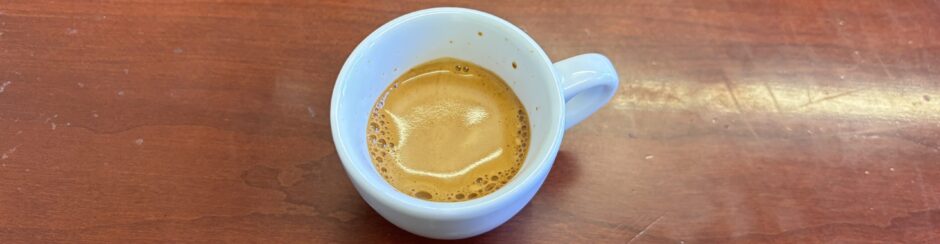
Having completed my visits to 22 Chicago coffee shops on the Chicago indie coffee passport tour, here are my notes together with a (rough) ranking in four categories from best to worst, taking into account a number of factors, including location.

In the rotation:

  • Cafe Integral:
    Artisan/scientific approach to coffee that interweaves the hipster with the pretentious. excellent 6 ounce cappuccino. A keeper.
  • Heritage Outpost:
    As good if not better than Heritage General. I have returned several times, although not since I moved downtown.
  • Heritage General:
    All the hipster accoutrements, including an in-the-store bike store. Croissant was absolutely rubbish, coffee was excellent. Will (and have) returned.
  • Metropolis:
    Excellent as expected; consistently good, have returned several times.

Good, but not in convenient (for me) location:

  • Buzz Killer Espresso:
    Nice atmosphere (modern decor (black, straight lines), pretentious vibe). Though it was my third drink of the day (on my Wicker Park Tour), it served a more than decent cortado.
  • Groundswell Coffee:
    I really liked this place; good coffee and decent food as well. Not really anywhere near where I go nowadays, but worth visiting.
  • Caffe Streets:
    The first stop on my day in Wicker Park.
    Nice latte. The internet somewhat bizarrely allowed LT6 websites to load, however, so I couldn’t stay so long. OTOH, the barista had a top tip for lunch (Antique Taco) which made up for that.

Might be worth a second chance:

  • Cup & Spoon:
    An acceptable latte; would give a second chance if it was in a more convenient location.
  • Bru Chicago:
    Had a 90’s brewed awaking vibe: decent espresso, but would probably to go Buzz Killer across the street. Next to an great second hand book store where I picked up a copy of B.F.Skinner’s autobiography. It was only later that I realized it was part 2 of 3, and now I’m left searching for the other two volumes in the same edition.
  • Ellipsis:
    Opposite my favorite Thai restaurant in Chicago (Thai Spice.) I ordered an almond croissant (I feel that I should make at least one genuine purchase) which was absolutely terrible. Coffee was quite decent, however.
  • Big Shoulders Cafe:
    This cafe falls into this category only because it’s “in the middle of nowhere.” I had a cortado, which showed promise.
  • Brew Brew :
    Opposite Kosciusko park (but probably not the same Kosciusko that Melbournians would think of.) Coffee decent, not ideal texture. Had a donut. Music was turned up and sucked (even headphones blaring Schumann were not sufficient).
  • Everybody’s Coffee:
    My timing was poor, they were closing early for some reason, so I only got a rushed coffee to go; I’ve heard decent things about this place, but I probably won’t be returning.
  • Sol Cafe:
    I’ve heard about this place for a while; it was less than 5 minutes drive from my old house in Evanston. Yet I never managed to make it there until my visit with coffee passport. I had a latte; the server told the barista that I was a “passport” customer, which may (or may not) have led to a coffee with one fewer shot; the result was a pleasant enough mild coffee, but nothing amazing. They had some interesting looking donuts. (Update, I have since tried buttermilk donuts; they are an abomination.)
  • HERO: Dearborn:
    Curiously better than the other HERO store below. 8 ounce latte. Mildy offensive popular music.

Don’t Bother:

  • Atomix Cafe:
    Friendly staff; happy to substitute a 12 ounce latte for an 8 ounce latte. So it was a little sad that, after the first sip, I had to toss it into the trash. The main culprit, as usual, was over-frothed milk.
  • HERO (Roscoe):
    Double Espresso to go, discretely emptied on the sidewalk after the first sip.
  • Wired:
    Like a 00’s London cafe, and not in a good way. (In other words, before the Australians came and upped the game.) Latte fail.
  • Nitecap Coffee Bar:
    When the servings offered on indie passport are the “special” flavoured lattes, you know you are in trouble. After some negotiation, they agreed to make a plain latte. It went down with some difficulty (I was in polite company and there was no convenient cuspidor); overly frothed milk.
  • Spoken Cafe:
    This is what passes for coffee in the suburbs, I guess. Not much memory of this place besides a terrible croissant and the note “better than starbucks.” Damned with faint praise.
  • Awake Cafe:
    I would have preferred to be asleep. No substitutions, forced to get
    a 12 ounce gingerbread latte. Went straight into the trash after the first sip. (wisely got it to go).
  • Bourgeious Pig:
    Is there any more to add than this? Undrinkable.
Posted in Coffee | Tagged , , , , , , , | Leave a comment

Serre 1: Calegari 0

I just spent a week or so trying to determine whether Serre’s conjecture about the congruence subgroup property was false for a very specific class of S-arithmetic groups. The punch line, perhaps not surprisingly, was that I had made an error. I should note that I was pretty skeptical during the entire endeavour, so the final resolution was not a surpise, but there were still a few interesting twists along the way. (Thanks to Matt for some informative chats along the way.)

Let’s start by recalling Ribet’s proof of (what is one of many statements known as) Ihara’s lemma. Let \(\Gamma\) be a congruence subgroup of \(\mathrm{SL}_2(\mathbf{Z})\) of level prime to q. There is a congruence subgroup \(\Gamma_0(q)\) defined in the usual way, where \(q|c.\) However, there is also a second copy \(\Gamma^0(q)\) of this group inside \(\Gamma\) with \(q|b.\) (Well, there are \(q+1\) copies of this group, but let’s just consider these two for the moment.) The two groups are conjugate inside \(\mathrm{GL}_2(\mathbf{Q}),\) but not inside \(\Gamma\). An argument of Serre now shows that the amalgam of \(\Gamma\) with itself along these groups (identified by conjugation by \([q,0;0,1])\) is the congruence subgroup \(\Gamma[1/q]\) of \(\mathrm{SL}_2(\mathbf{Z}[1/q]).\) That is, the congruence subgroup where the local conditions away from q are the same as \(\Gamma.\) The Lyndon long exact sequence associated to an amalgam of groups shows that there is an exact sequence:

\(H_1(\Gamma_0(q),A) \rightarrow H_1(\Gamma,A)^2 \rightarrow H_1(\Gamma[1/q],A) \rightarrow 0,\)

for any trivial coefficient system \(A.\) Now the group \(\Gamma[1/q]\) satisfies the congruence subgroup property, so the group on the right is easily seem to be finite and Eisenstein. By duality, there is also a map

\(H_1(\Gamma,A)^2 \rightarrow H_1(\Gamma_0(q),A),\)

and the composition of this map with the projection above is a matrix with determinant \(T^2_q – (1+q)^2.\) A bookkeeping argument now gives Ribet’s famous level raising theorem (taking coefficients \(A = \mathbf{F}_p.\))

Fred Diamond and Richard Taylor generalized this theorem by replacing the modular curve with both definite and indefinite quaternion algebras. The actual theorem itself at this point is probably quite easily to prove by the K-W method, but that’s not relevant here. Instead, let’s think a little about the proof. The more difficult and interesting case is when \(\Gamma\) comes from the norm one units in an indefinite quaternion algebra, which we consider from now on (the case of Shimura curves over \(\mathbf{Q}.)\) Morally, the proof should be exactly the same. The only wrikle is that the corresponding group \(\Gamma[1/q]\) is notoriously not known to satisfy the congruence subgroup property, although Serre conjectures that it does. Diamond and Taylor instead argued in the following way. (Let us specialize to the case of trivial weight, which is the only relevant case here.) Suppose that p is a prime greater than two and different from q. Then instead of working with Betti cohomology, one can instead, via a comparison theorem, use de Rham cohomology. The Hodge filtration consists of two pieces, one of which is \(H^0(X,\Omega^1),\) and the other is \(H^1(X,\mathcal{O}_X).\) They then investigate the kernel of the map:

\(H^1(X,\Omega^1)^2 \rightarrow H^1(X_0(q),\Omega^1)\)

where everything is now over \(\mathbf{F}_p.\) Here the two maps are the two pullbacks under the two projections \(X_0(q) \rightarrow X.\) They now show that element in the kernel gives rise to a differential \(\omega\) which vanishes at all the supersingular points or does not vanish at all. The first is impossible by a degree argument when \(p > 3,\) and the second is always impossible. They conclude that, returning to etale cohomology, any kernel of the map

\(H^1(X,\mathbf{F}_p)^2 \rightarrow H^1(X_0(q),\mathbf{F}_p)\)

must lie entirely in one filtered piece, from which they deduce it must be Eisenstein. But let’s look at this argument a little more closely. Even in Ribet’s case, the conclusion is really much stronger than level raising for non-Eisenstein primes; there is a very precise description of the kernel (or cokernel in homology) in terms of the homology of \(\Gamma\) coming from congruence quotients, which one can compute quite explicitly. So Ribet’s theorem also gives level raising for Eisenstein representations in some contexts. In particular, for a suitable choice of congruence subgroup (with \(p > 2)\) one can make the group \(H_1(\Gamma[1/q],\mathbf{F}_p)\) vanish identically. Let’s now return to the argument of Diamond and Taylor when \(p = 3.\) All the comparison theorems are still valid, so the only issue is that the map

\(H^1(X,\Omega^1)^2 \rightarrow H^1(X_0(q),\Omega^1)\)

does have a kernel, namely, if one takes the “Hasse Invariant” \(A\) which vanishes to degree one at all supersingular points, then the two pullbacks of \(A\) to \(X_0(q)\) coincide up to a scalar, and so the kernel is at least one dimensional. In fact, the argument of Diamond-Taylor shows that the kernel is at most one dimensional. But what does this mean in the proof of Ihara’s Lemma? It means that, assuming \(X\) has good reduction at the prime \(p = 3,\) the level raising map always has a kernel, and thus \(H_1(\Gamma[1/q],\mathbf{F}_3)\) is always non-trivial.

This now seems suspicious: all we need to do is find a quaternion algebra which doesn’t have any congruence homology of degree \(3.\) If the quaternion algebra \(D/\mathbf{Q}\) is ramified at a prime \(r,\) then the congruence homology coming from this prime (for \(p \ne 2 r)\) is a subgroup of the norm one elements of \(\mathbf{F}^{\times}_{r^2},\) which has order \(r + 1.\) So it makes sense to take a quaternion algebra ramified at \(7 \cdot 13,\) since these are the two smallest primes different from 3 which are congruent to 1.

Because this seemed to contradict Serre’s conjecture, I decided for fun to explicitly compute a presentation for the amalgam \(\Gamma[1/2]\) to help work out what was going on. To first start, one needs a presentation for \(\Gamma.\) John Voight (friend of the blog) has written a very nice magma package to do exactly this. (More precisely, it’s trivial to write down a presentation — \(\Gamma\) is torsion free, and hence a surface group \(\pi_1(\Sigma_g)\) for a genus \(g\) one can compute via other means to be \(g = 7;\) the point is that one also wants an explicit representation as well as an explicit identification with the norm one units of the correponding quaternion algebra.)

I then took an embarassingly long time to compute the subgroup \(\Gamma_0(2).\) The main issue was finding a suitable element in \(D\) to play the role of \(\eta = [2,0;0,1]\) in \(M_2(\mathbf{Q}).\) There certainly exists such a unit in \(D \otimes \mathbf{Q}_2,\) so in real life one just has to find an actual norm 2 unit which is sufficiently close 2-adically to this. However, I am absolute rubbish at mathematica and so repeatedly made the following error: when you define suitable quaternions \(i, j, k\) in \(D \otimes_{\mathbf{Q}} E\) for some quadratic splitting field \(E/\mathbf{Q},\) and then compute with the matrix \(a + b i + c j + d k,\) mathematica helpfully interprets “\(a\)” here as \([a,a;a,a]\) rather than a multiple of the identity, a programming decision which makes a lot of sense, said no one ever. I did this more times than I care to admit. Then, using John’s program, one can find the subgroup \(\Gamma_0(2),\) and then write down a presentation for the amalgam by conjugating this subgroup by \(\eta\) and identifying the correpsonding elements via a solution to the word problem as words in the original generators, and then substitute the names for these generators for the second copy of \(\Gamma.\) The result is a group with \(14 + 14\) generators and \(2 + 38\) relations (corresponding to the 2 surface relations and the fact that \(\Gamma_0(2)\) has \(3(14 – 2) + 2 = 38\) generators.) Finally, one takes this group, plugs it into magma, and finds:

\(\mathtt{AbelianQuotientInvariants(G);}\)
\(\mathtt{> [168]}\)

There are known congruence factors coming from \(7+1\) and \(13 + 1,\) but here one sees that the factor of three survives!

And then, shortly after this point, I realized that \(\mathrm{SL}_2(\mathbf{F}_3)\) has a quotient of order \(3,\) because it is \(A_4.\) So that degree three quotient is congruence after all… Oops! Still, it’s nice to see that mathematics is consistent.

However, at this point one might just ask why can’t one replace the quaternion algebra \(D/\mathbf{Q}\) by (say) a real quadratic field in which \(3\) is unramified and inert. Serre got away with it above because \(\mathrm{SL}_2(\mathbf{F}_3)\) is solvable, but \(\mathrm{SL}_2(\mathbf{F}_9)\) has the good manners not to have any such quotients. So why can’t one now run the same argument as above and disprove Serre’s conjecture? That’s a good question, and the entire argument works, up to the issue of defining the Hasse invariant. Quaternion algebras over fields other than \(\mathbf{Q}\) are a bit of a disaster, because they don’t have nice moduli theoretic descriptions. That doesn’t mean they don’t have Hasse invariants, however. But now what happens, which at this point in the game I suspected but was confirmed and explained to be by George Boxer (Keerthi also suggested a computation which would lead to the same conclusion): the Hasse invariant is no longer a section of \(\Omega^1 = \omega^{\otimes 2} = \omega^{p-1},\) but rather a section of \(\omega^{p^2 – 1},\) and this has too large a degree to contribute to the cohomology of \(\Omega^1.\) Since \(2^2 – 1 > 2,\) it still has too large a degree when \(p = 2,\) which is good, because otherwise working at this prime could have given rise to a counter-example to Serre’s conjecture because \(\mathrm{SL}_2(\mathbf{F}_4) = A_5\) is perfect. (One would have to be slightly more careful with p=2 about comparison theorems, but at least one is dealing with curves.) So the conclusion is that Serre’s conjecture still stands, but only because various Hasse invariants in low weight are exactly accounted for by the solvability of \(\mathrm{SL}_2(\mathbf{F})\) when \(|\mathbf{F}| = 2,3.\)

(Also, completely randomly and apropos of nothing, this link is now the top hit on the web to the search “Fred Diamond’s Beard.”)
Posted in Mathematics | Tagged , , , , , , , , , , , , | Leave a comment

Champagne Marxists

One wonders whether it is only the US in which highly educated white liberal college students from the upper reaches of the socio-economic strata support the extremely regressive Bernie Sanders-style policy of spending a trillion dollars on free education for all^* (* = all people like themselves), but I was pleased to note during my recent visit to King’s College London that even more extreme positions exist. Here is the following sign located on what appeared to be a graduate student working room in the school of social science & public policy at King’s College London. (I promise that, given the other political statements posted, that this is meant in all seriousness.)

img_3306

Posted in Politics | Tagged , , | Leave a comment