Exercise concerning quaternion algebras

Here’s a fun problem that came up in a talk by Jacob Tsimerman on Monday concerning some joint work with Andrew Snowden:

Problem: Let \(D/\mathbf{Q}(t)\) be a quaternion algebra such that the specialization \(D_t\) splits for almost all \(t\). Then show that \(D\) itself is split.

As a comparison, if you replace \(\mathbf{Q}\) by \(\overline{\mathbf{Q}}\), then although the condition that \(D_t\) splits becomes empty, the conclusion is still true, by Tsen’s theorem.

This definitely *feels* like the type of question which should have a slick solution; can you find one?

Posted in Mathematics | Tagged , , , , | Leave a comment

Catalan’s Constant and periods

There is a 60th birthday conference in honour of Frits Beukers in Utrech in July; I’m hoping to swing by there on the way to Oberwolfach. Thinking about matters Beukers made me reconsider an question that I’ve had for while.

There is a fairly well known explanation of why \(\zeta(3)\) should be irrational (and linearly independent of \(\pi^2\)) in terms of Motives. There is also a fairly good proof that \(\zeta(3) \ne 0\) in terms of the non-vanishinjg of Borel’s regulator map on \(K_5(\mathbf{Z})\). (I guess there are also more elementary proofs of this fact.) A problem I would love to solve, however, is to show that, for all primes \(p\), the Kubota-Leopoldt \(p\)-adic zeta function \(\zeta_p(3)\) is non-zero. Indeed, this is equivalent to the injectivity of Soule’s regulator map

\(K_5(\mathbf{Z}) \otimes \mathbf{Z}_p \rightarrow K_5(\mathbf{Z}_p).\)

(Both these groups have rank one, and the cokernel is (at least for \(p > 5\)) equal to \(\mathbf{Z}_p/\zeta_p(3) \mathbf{Z}_p\) by the main conjecture of Iwasawa theory.) It is somewhat of a scandal that we can’t prove that \(\zeta_p(3)\) is zero or not; it rather makes a mockery out of the idea that the “main conjecture” allows us to “compute” eigenspaces of class groups, since one can’t even determine if there exists an unramified non-split extension

\(0 \rightarrow \mathbf{Q}_p(3) \rightarrow V \rightarrow \mathbf{Q}_p \rightarrow 0\)

or not. Well, this post is about something related to this but a little different. Namely, it is about the vaguely formed following question:

What is the relationship between a real period and its \(p\)-adic analogue?

Since one number is (presumably) in \(\mathbf{R} \setminus \mathbf{Q}\) and the other in \(\mathbf{Q}_p \setminus \mathbf{Q}\), it’s not entirely clear what is meant by this. So let me give an example of what I would like to understand. One could probably do this example with \(\zeta(3)\), but I would prefer to consider the “simpler” example of Catalan’s constant. Here

\(G = \displaystyle{\frac{1}{1} – \frac{1}{3^2} + \frac{1}{5^2} – \frac{1}{7^2} \ldots } = L(\chi_4,2) \in \mathbf{R},\)

is the real Catalan’s constant, and

\(G_2 = L_2(\chi_4,2) \in \mathbf{Q}_2\)

is the \(2\)-adic analogue. (There actual definition of the Kubota-Leopoldt zeta function involves an unnatural twist so that one could conceivably say that \(L_2(\chi_4,2) = 0\) and that the non-zero number is \(\zeta_2(2)\), but this is morally wrong, as the examples below will hopefully demonstrate. Morally, of course, they both relate to the motive \(\mathbf{Q}(2)(\chi_4)\).)

So what do I mean is the “relation” between \(G\) and \(G_2\). Let me give two relations. The first is as follows. Consider the recurrence relation (think Apéry/Beukers):

\(n^2 u_n = (4 – 32 (n-1)^2) u_{n-1} – 256 (n-2)^2 u_{n-2}.\)

It has two linearly independent solutions with \(a_1 = 1\) and \(a_2 = -3\), and \(b_1 = -2\) and \(b_2 = 14\). One fact concerning these solutions is that \(b_n \in \mathbf{Z}\), and \(a_n \cdot \mathrm{gcd}(1,2,3,\ldots,n)^2 \in \mathbf{Z}.\) Moreover one has that:

\(\displaystyle{ \lim_{n \rightarrow \infty} \frac{a_n}{b_n}} = G_2 \in \mathbf{Q}_2.\)

The convergence is very fast, indeed fast enough to show that \(G_2 \notin \mathbf{Q}\). What about convergence in \(\mathbf{R}\), does it converge to the real Catalan constant? Well, a numerical test is not very promising; for example, when \(n = 40000\) one gets \(0.625269 \ldots\), which isn’t anything like \(G = 0.915966 \ldots\); for contrast, for this value of \(n\) one has \(a_n/b_n – G_2 = O(2^{319965})\), which is pretty small. There are, however, two linearly independent solutions over \(\mathbf{R}\) given analytically by

\( \displaystyle{\frac{(-16)^n}{n^{3/2}} \left( 1 + \frac{5}{256} \frac{1}{n^2} – \frac{903}{262144} \frac{1}{n^4}
+ \frac{136565}{67108864} \frac{1}{n^6} – \frac{665221271}{274877906944} \frac{1}{n^8} + \ldots \right)},\)

\( \begin{aligned}
\frac{(-16)^n \cdot \log n}{n^{3/2}} \left( 1 + \frac{5}{256} \frac{1}{n^2} – \frac{32261}{7864320} \frac{1}{n^4}
+ \frac{136565}{67108864} \frac{1}{n^6} – \frac{665221271}{274877906944} \frac{1}{n^8} + \ldots \right)\\
+\frac{(-16)^n}{n^{3/2}} \left( -\frac{1}{768} \frac{1}{n^2} + \frac{32261}{7864320} \frac{1}{n^4}
– \frac{30056525}{8455716864} \frac{1}{n^6} + \frac{1778169492137}{346346162749440} \frac{1}{n^8} + \ldots \right) \end{aligned},\)

from which one can see that \(a_n/b_n\) must converge very slowly, and indeed, one has (caveat: I have some idea on how to prove this but I’m not sure if it works or not):

\(\displaystyle{\frac{a_n}{b_n} = G – \frac{1}{(0.2580122754655 \ldots) \cdot \log n + 0.7059470639 \ldots}}\)

So one has a naturally occurring sequence which converges to \(G\) in \(\mathbf{R}\) and \(G_2\) in \(\mathbf{Q}_2\). So that is some sort of “relationship” alluded to in the original question. Here’s another connection. Wadim Zudilin pointed out to me the following equality of Ramanujan:

\( \displaystyle{G = \frac{1}{2} \sum_{k=0}^{\infty} \frac{4^k}{(2k + 1)^2 \displaystyle{\binom{2k}{k}}}} \in \mathbf{R}.\)

This sum also converges \(2\)-adically. So, one can naturally ask whether

\( \displaystyle{G_2 =^{?} \frac{1}{2} \sum_{k=0}^{\infty} \frac{4^k}{(2k + 1)^2 \displaystyle{\binom{2k}{k}}}} \in \mathbf{Q}_2.\)

(It seems to be so to very high precision.) These are not random sums at all. Indeed, they are equal to

\( \displaystyle{ \frac{1}{2} \cdot F \left( \begin{array}{c} 1,1,1/2 \\ 3/2,3/2 \end{array} ; z \right)}\)

at \(z = 1\). Presumably, both of these connections between \(G\) and \(G_2\) must be the same, and must be related to the Picard-Fuchs equation/Gauss-Manin connection for \(X_0(4)\). This reminds me of another result of Beukers in which one compares values of hypergeometric functions related to Gauss-Manin connections and elliptic curves, and finds that they converge in \(\mathbf{R}\) and \(\mathbf{Q}_p\) for various \(p\) to algebraic (although sometimes different!) values. Of course, things are a little different here, since the values are (presumably) both transcendental. Yet it would be nice to understand this better, and see to what extent there is a geometric interpretation of (say) the non-vanishing of \(L_p(\chi,2)\) for some odd quadratic character \(\chi\). Of course, one always has to be careful not to accidentally prove Leopoldt’s conjecture in these circumstances.

Posted in Mathematics | Tagged , , , , , , , | Leave a comment

Exposition is not underrated

It seems to be the conventional wisdom (for example, some of the comments here) that exposition is undervalued in our profession. I disagree. To cast things in economic terms, let’s take “valued” to mean one of two things: increased salary (cash) or increased recognition by peers (ego). First, I think it is unquestionably the case that a reputation as a good expositor is more likely to lead to invitations to conferences, to give colloquiua, and to give invited addresses, all of which also affect one’s career in a positive way. Second, a well written paper is more likely to be accepted by a higher ranked journal, and is also more likely to be cited by others – factors which also have a direct impact on one’s career (the effect here may be marginal, but is, I think, non-trivial.) Third, I think that certain forms of expository writing — such as graduate texts (think “the Arithmetic of Elliptic Curves”) — are widely known and (deservedly) widely praised. So what is the complaint?

I think the key point here is to distinguish between several flavours of expository writing. The first concerns articles which might once have appeared as short articles in the Monthly. Here a highlight of the form is something like Elkies on Pythagorean triples and Hilbert’s Theorem 90. This is the amuse-bouche of the exposition world.
Second is the account of a known result whose proof is not readily available in the literature, perhaps something like A proof that Euler missed. Third is an attempt to come to terms with some body of work by either filling in details, giving plenty of examples, or offering a slightly different perspective; let’s say Vakil’s algebraic geometry notes. Finally, there is the survey/overview style paper which seeks to convey a vision of the field and its connections to mathematics, pehaps something like Mazur’s paper “The theme of p-adic Variation” (a title that is both poetic and yet almost a pun).

The majority of expository writing falls in the third class. It usually takes the form of notes for a graduate class that someone posts on their webpage. The “level” of mathematics is usually that of a graduate class, or an advanced undergraduate class. Let me freely admit that it is wonderful to have such sources freely available, and that they can be useful. They play an important educational role. But how much of a contribution do they make to the advancement of mathematics? I think the level is relevant here. An exposition of Dirichlet’s theorem on arithmetic progression is essentially worthless — it is a topic covered well in an endless numbers of textbooks. And let me pass on without mentioning (apophasis alert) any article concerning the discrete geometry of Chicken McNuggets. Then, as the difficulty of the subject matter becomes higher, and the number of available resources become scarcer, the utility of such notes are increased. However, there’s a catch. The most inspiring, fundamental, insightful, and useful expository pieces can only possibly be written by a very few people. This is due to two obvious restrictions: few people can write well, and few people have interesting and deep things to say. Take, for example, the topic of recent progress in the Langlands programme. It’s perfectly possible for many people to give an anodyne talk to a broad audience on the latest developments. With some effort, a smaller number of people can also present some intuition for some of the core ideas. But anyone qualified to give a detailed exposition of the latest modularity lifting theorems is more interested in proving new theorems themselves.

By all means encourage good exposition, by all means cherish it when the masters commit their intuition to paper, by all means enjoy the wealth of expository notes available on the web, by all means encourage (through the reviewing process) authors to write clearer papers and describe their intuition, by all means use NSF money to fund instructional workshops. But don’t, as Cathy O’Neil suggested (update: I heard this suggestion from Cathy in person, but it was pointed out to me that she says something similar here), pay good mathematicians to spend six months learning topic X in order to produce a purely expository treatment of some important piece of mathematics; either they won’t be up for the task, they will have better things to do, or they would have done it naturally out of their own accord and inclination.

Posted in Mathematics, Waffle | Tagged , , , | Leave a comment

Galois Representations for non-self dual forms, Part III

Here are some complements to the previous remarks, considered in Part I and Part II.

First, in order to deal with non-zero weights, one has to replace the Shimura varieties \(Y\), \(X\), \(W\) by Kuga-Satake varieties over these spaces. This “only” adds technical difficulties.

Second, in order to work over the most general bases \(F\), one seems to require good minimal models and compactifications \(X_U\), \(W_U\) in characteristic \(p\), for a prime \(p\) which may be very ramified in \(F\). This is a genuine problem. The way to avoid this problem is amusing. It turns out that one only needs a good model of \(X^{\mathrm{ord}}\) and \(W^{\mathrm{ord}}\). In other words, one only has to understand integral models and toroidal compactifications at the ordinary cusps. However, the ordinariness is exactly what allows one to give appropriate models at these cusps, without having to deal with the more complicated cusps except in some fairly superficial way (say by taking normalizations over an integral model of a universal moduli space of abelian varieties). This seems quite clever.

Third, I was going to talk in more detail about \(n=2\), but having written down the argument it seems a little pointless now, since it is not going to simplify things very much. The only thing that is (perhaps) easier is to understand why the higher direct images of the pushforward of the subcanonical bundle to the minimal compactification vanishes; yet the example of \(\mathcal{A}_2\) in the previous post gives the idea, I think. I was also going to talk about the combinatorics of the boundary and their relationship to the cohomology of \(\mathrm{GL}(n)\), but on second thoughts I’m not.

Fourth, how close is \(H^*_{c,\partial}(\overline{X}^{\mathrm{ord}})\) to \(H^*_{c,\mathrm{Betti}}(X)\), the compactly supported Betti cohomology of the Shimura variety? It’s not so clear.

Fifth, the argument really only uses the ordinary locus in a fairly loose way, namely, it is (in the minimal compactification) affinoid, and it is compatible with Hecke correspondences. On the other hand, at finite level, this is pretty much the only possible such choice. However, perhaps at infinite level there may be other possible choices (in a perfect[-oid] world, as it were…).

Posted in Mathematics | Tagged | Leave a comment

Inverse Galois Problem

My favourite group as far as the inverse Galois problem goes is \(G = \mathrm{SL}_2(\mathbf{F}_p)\). This is not known to be a Galois group over \(\mathbf{Q}\) for any \(p > 13\), the difficulty of course being that is must correspond to an even Galois representation. A more tractable case is \(G = \mathrm{PSL}_2(\mathbf{F}_p)\), and this was recently answered by David Zywina here. Here is a more elementary version of that construction. Suppose that \(\pi\) is a classical modular form of weight three with coefficients in \(\mathbf{Z}[\sqrt{-1}]\) and quadratic Nebentypus character \(\chi\). Note that there is an isomorphism \(\pi^c:= \overline{\pi} \simeq \pi^{\vee} \otimes \| \cdot \|^2 \chi\). For all primes \(v\) in \(\mathbf{Q}(i)\), one obtains a representation:

\(\varrho = \rho \otimes \epsilon^{-1}: \mathrm{Gal}(\overline{\mathbf{Q}}/\mathbf{Q}) \rightarrow \mathrm{GL}_2(\mathbf{F}_v).\)

with determinant \(\chi\). There are two cases, depending on whether \(v|p\) is split or not. If \(p \equiv 1 \mod 4\) splits, then, assuming \(\pi\) is not CM, the image of \(\varrho\) restricted to the kernel of \(\chi\) is \(\mathrm{SL}_2(\mathbf{F}_p)\) for sufficiently large \(p\) which can be explicitly determined in any specific case. Thus the image of \(\varrho\) is \(\mathrm{SL}_2(\mathbf{F}_p)\) plus the image of complex conjugation:

\(\left( \begin{matrix} 1 & 0 \\ 0 & -1 \end{matrix} \right).\)

Since \(p \equiv 1 \mod 4\), there exists an element \(\alpha \in \mathbf{F}_p\) of square \(-1\), and hence an element in \(\mathrm{SL}_2(\mathbf{F}_p)\) equal to

\(\left( \begin{matrix} \alpha & 0 \\ 0 & – \alpha \end{matrix} \right).\)

Hence the image of \(\varrho\) contains a scalar element of determinant \(-1\), and thus it has projective image \(\mathrm{PSL}_2(\mathbf{F}_p)\).

If \(p \equiv -1 \mod 4\), then, from the isomorphism \(\pi^c \simeq \pi^{\vee} \otimes \| \cdot \|^2 \chi\), there is an isomorphism \(\varrho^c \simeq \varrho \otimes \chi,\) where \(\varrho^c\) is the Galois conjugate induced by complex conjugation. It follows that the *projective* image of \(\varrho\) lands in \(\mathrm{PGL}_2(\mathbf{F}_p)\). The image of \(\varrho\) is thus, for sufficiently large \(p\), a subgroup of \(\mathbf{F}^{\times}_{p^2} \mathrm{GL}_2(\mathbf{F}_p)\) with projective image containing \(\mathrm{PSL}_2(\mathbf{F}_p)\). We first observe that this implies that \(\varrho\) contains \(\mathrm{SL}_2(\mathbf{F}_p\)). It suffices to show that it contains all the transvections; yet the lift of any transvection in \(\mathrm{PSL}_2(\mathbf{F}_p)\) is a transvection of order \(p\) times a scalar of order prime to \(p\), which one can remove by taking an appropriate power. Since the determinant of \(\varrho\) is \(\chi\), this leaves only the following three possibilities for the image of \(\varrho\):

1. The subgroup of \(\mathrm{GL}_2(\mathbf{F}_p)\) of matrices with determinant \(\pm 1\).
2. The previous subgroup together with the the scalar element \(I\) with \(I^2 = -1\).
3. The group \(\mathrm{SL}_2(\mathbf{F}_p)\) together with \(I\).

The third group does not have a non-scalar element of order \(2\) correponding to complex conjugation, and the first has traces which do not generate \(\mathbf{F}_{p^2}\). Hence the image must be the second, which has projective image \(\mathrm{PSL}_2(\mathbf{F}_p)\).

To conclude the argument, it suffices to show that there exists such a \(\pi\). Consulting William Stein’s tables, one may take

\(f = q + 4i \cdot q^3 + 2 \cdot q^5 – 8i \cdot q^7 + \ldots \in S_3(\Gamma_1(32),\chi),\)

for a quadratic \(\chi\) where \(i^2 = -1\). Since \(a_3, a_5, a_7 \ne 0\), this form does not have CM by \(\mathbf{Q}(\sqrt{-1})\) or \(\mathbf{Q}(\sqrt{-2})\), so \(\mathrm{PSL}_2(\mathbf{F}_p)\) is a Galois group for sufficiently large \(p\), which one could compute exactly if one wanted. My impression from the notation in William Stein’s tables is that the fixed field of the kernel of \(\chi\) is \(\mathbf{Q}(\sqrt{-1})\), so this is presumably the same family of examples that arises in Zywina. Other examples (in the range of William’s tables) are as follows:

\(g = q + 2 i \cdot q^2 – 4 \cdot q^4 + (3 – 4 i) \cdot q^5 + \ldots \in S_3(\Gamma_1(20)),\)
\(h = q + 3 i \cdot q^2 – 5 \cdot q^4 – 3 i \cdot q^5 + \ldots \in S_3(\Gamma_1(27))\)

Note that this argument requires slightly more than pure thought; it was key that there existed a non-CM form with coefficient field \(\mathbf{Q}(\sqrt{-1})\), and there is no *a priori* reason why there should exist any such form. For example, suppose one wanted to generalize this argument to to \(\mathrm{PSp}_4(\mathbf{F}_p)\). Then one would want to look for a non-endoscopic Siegel cusp form of weight \((a,b)\) where (edit) \(2a+b\) is odd with Hecke eigenvalues in \(\mathbf{Q}(\sqrt{-1})\) and quadratic Nebentypus character. Possibly such things exist but perhaps they don’t!

Posted in Mathematics | Tagged , , , , | Leave a comment

Galois Representations for non self-dual forms, Part II

(Now with updates!)

Let’s recap from part I. We have a Shimura variety \(Y\), a minimal projective compactification \(X\), and a (family of) smooth toroidal compactifications \(W\). We also have Galois representations of the correct shape associated to eigenclasses in

\(H^0(X^{\mathrm{ord}},\xi_{\rho}).\)

So at this point (well, not only at this point) there is some confusion. In the construction above, I am imagining that we are working with the rigid analytic space corresponding to the ordinary locus. But now there are some remarks in my notes about dagger spaces. Here is what I am imagining is going on. For any sufficiently small radius, we may consider the rigid analytic space \(Y[\nu]\) which corresponds (on the moduli level) to the appropriate abelian varieties \(A\) (with polarization and level structure and enomorphisms, blah blah) together with a canonical subgroup which (under some measure) is close to being ordinary. Then there is a “dagger space” \(Y^{\dagger}\) which is the limit of all such spaces. The issue (for me) is that I don’t really know anything about dagger spaces, but since this is probably not the main point, I will (again) elide the issue here. Of course, the goal is to realize the eigenvalues of the Eisenstein series \(\Pi\) inside this cohomology. Let’s assume that \(\Pi\) actually has good reduction at \(p\). Then it is probably going to be true that \(\Pi\) actually has finite slope, and so it lives inside the cohomology of some overconvergent neighbourhood of \(X^{\mathrm{ord}}\). So there’s some flexibility with exactly what spaces one is working with. Perhaps working with finite slope eigenforms might help to get local-global compatibility at \(p\).

(update: it’s most natural to work with the dagger spaces (whose cohomology is as described above) since that most naturally corresponds to the rigid cohomology groups occurring below.)

OK, so, we may take the direct limit over all compact subgroups \(U\) of the cohomology above, and we want to realize the Eisenstein series \(\Pi\) as a p-adic cusp form inside this space.

To this end, one introduces the following cohomology groups:

\( H^*_{c,\partial}(\overline{X}^{\mathrm{ord}}) := \mathbb{H}^{*}(W^{\mathrm{ord}}, \Omega^{\bullet}_{W^{\mathrm{ord}}}(\log \infty) \otimes
\mathcal{L})\)

OK. So this is just a definition, it isn’t supposed to obviously be functorial: we are taking the special fibre, lifting to characteristic zero, taking a toroidal compactification, then looking at the hypercohomology of the de Rham complex with log poles at the boundary. Well I guess one can do whatever one wants, I suppose.

So what is this? The hycohomology of the de Rham complex of a smooth variety \(M\) with log poles along some divisor \(D\) with normal crossings should just be the Betti cohomology of the complement of \(D\) in \(M\). The factor \(\mathcal{L}\) is the difference between the sub-canonical and canonical extensions, not entirely sure why it is there, presumably for some fundamentally important reason. So morally, I think the RHS should be computing something like the Betti cohomology of \(Y^{\mathrm{ord}}\), with the proviso that these are dagger spaces, not smooth complex varieties. So one should think of the LHS is some type of algebraic Betti cohomology of the ordinary locus.

(update: the remark about the Betti cohomology of the complement of \(D\) is correct, but the presence of the boundary divisor \(\mathcal{L}\) is exactly what, in the classical sense, changes the answer from the cohomology of the open variety to the interior cohomology. So the cohomology is somehow compactly supported towards the boundary of \(W\), but not the “other” part of the boundary (that is, the difference between \(W\) and \(W^{\mathrm{ord}}\).)

Let’s write down a spectral sequence:

\( H^i(W^{\mathrm{ord}}, \Omega^{\bullet}_{W^{\mathrm{ord}}}(\log \infty) \otimes
\mathcal{L}) \Rightarrow H^{i+j}_{c,\partial}(\overline{X}^{\mathrm{ord}}),\)

The existence of this spectral sequence must be a formal consequence of the definition and properties of hypercohomology. Note that the \(\Omega^j_{W^{\mathrm{ord}}}(\log \infty)\) are canonical automorphic sheaves of the standard type, so with the boundary piece \(\mathcal{L}\) the LHS consists of terms of the form \(H^i(W^{\mathrm{ord}},\xi^{\mathrm{sub}})\). To compute these terms, one can push foward via the map \(\pi: W \rightarrow X\) from the toroidal compactification to the minimal one. Then one notes that:

1. The higher direct images \(R^i \pi_* \xi^{\mathrm{sub}}\) vanish.
2. Since \(X^{\mathrm{ord}}\) is affinoid, its higher cohomology also vanishes.

The second point seems reasonable, I have no idea why the first is true. It is probably a really key point, which I might talk about in part III (note: RLT said nothing about this and there is no pre-print, so I have no idea how to prove this at the moment). Apparently it is important that one uses the subcanonical extension here. This implies that every class which occurs in the RHS in this new cohomology actually occurs in an \(H^0\) term on the LHS. Now one has Galois representations of terms of the form \(H^0(W^{\mathrm{ord}},\xi^{\mathrm{sub}})\), by the first construction – here it must be OK to pass between \(W\) and \(X\) using the Kocher principle. So we are reduced to showing that \(\Pi\) contributes to this new cohomology \(H^{\bullet}_{c,\partial}(X^{\mathrm{ord}})\).

(update: here is some more about higher direct images. Let’s say a little bit about what the toroidal compactifications look like. Let’s even imagine we are working with \(\mathcal{A}_2\) and are looking at a cusp where one has purely toric reduction. For the purposes of computing the higher direct images all that matters is the formal completion of \(W\), which at the boundary looks something like \(Z/\Gamma\) for some toric variety \(Z\) which is not of finite type. One shows that \(H^i(Z,\mathcal{O}_Z) = 0\) using Cech cohomology for \(i > 0\), which allows one to think of \(Z\) as contractible. Then one would like to say that \(H^i(Z/\Gamma,\mathcal{O}_Z)\) is also zero, which comes down to understanding the action of \(\Gamma\) on \(H^0(Z,\mathcal{O}_Z)\). Roughly one would like to say that \(\Gamma\) acts with no fixed points and and use Shapiro’s Lemma. Back to the specific example, one finds that \(H^0(Z,\mathcal{O}_Z)\) corresponds to positive semi-definite \(2 \times 2\) matrices, and \(\Gamma\) a finite index subgroup of \(\mathrm{GL}_2(\mathbf{Z})\). Here one should be reminded of the \(q\)-expansions of Siegel modular forms at the cusp — recall that \(q\)-expansions are given in terms of such matrices whose coefficients are invariant under \(M \mapsto X M X^{T}\). This action is free as long as \(\det(X) \ne 0\); at the level of \(q\)-expansions this corresponds exactly to working with cusp forms; this is why working with the sub-canonical extension allows one to restrict the positive definite forms on which the action is indeed free. In the degenerate case when \(n = 1\), then \(\Gamma\) is trivial, and so it even acts freely on the non-cusp form \(1\), which is why it doesn’t matter in that case.)

Note: the spectral sequences above is, like the Hodge-de Rham spectral sequence, a 1-st page spectral sequence. Thus the vanishing above does *not* imply that it degenerates. Moreover, it certainly won’t degenerate, since the RHS will turn out to consist of finite dimensional vector spaces, whereas the terms on the LHS are certainly not (as they are spaces of p-adic or overconvergent forms). (Note to self: compare to work of Coleman.)

The next point is the following. Suppose one now simply replaces \(X^{\mathrm{ord}}\) by \(X\). Then the cohomology theory \(H^{\bullet}_{c,\partial}\) is probably *literally* computing the Betti cohomology of \(Y\). The Betti cohomology of \(Y\) does indeed see the classes coming from the boundary that we would like to find.

Recall that \(W \setminus Y\) is a normal crossings divisor. Let \(\partial_0\) denote the variety, \(\partial_1\) the (disjoint) union of the irreducible components of the boundary divisor, \(\partial_2\) the union of the intersection of these components, and so on. One now writes down another 1st page spectral sequence as follows:

\(\mathbb{H}^j(\partial_i, \Omega^{\bullet}_{W^{\mathrm{ord}}}(\log \infty)) \Rightarrow H^{i+j}_{c,\partial}(X^{\mathrm{ord}}).\)

This is supposed to be an example of the following: in a nice geometric situation (normal crossings divisor) one may compute cohomology with compact supports in terms of the cohomology of the boundary strata. (I’m still a little confused why \(H^*_{c,\partial}\) is cohomology with compact supports rather than the cohomology of the interior, but anyway…(update: this is explained above: the presence of \(\mathcal{L}\) means it has compact supports in the direction of \(W\setminus Y\), but not \(W \setminus W^{\mathrm{ord}}\))). Moreover, a key point is that the LHS can be interpreted as the rigid cohomology of \(\partial_i\). This allows one to use results of Berthelot and Chiarellotto to deduce that the terms of the LHS are given in terms of the rigid cohomology of (open) varieties. In particular:

1. They admit a theory of weights,
2. \(H^j\) is mixed of weight at least \(j\).
3. They are finite dimensional.

We deduce that RHS is also mixed of weight at least \(i+j\) and finite dimensional.

We want our \(\Pi\) to occur in the RHS, so it certainly suffices to show it actually occurs in \(H^0\). But then by weights it suffices to show that it is coming from the \(H^0\)-terms in the LHS. These are simply given by component groups, and so the computation reduces to a problem concerning the combinatorics of the boundary, on which we shall say more in part III.
Posted in Mathematics | Tagged , , , , | Leave a comment

Cambridge Days

Dinner at the Helmand: Zagat rating 27 (Food) and 20 (Service). After I was seated, it was fifteen minutes until I was brought a menu. Sixty seconds later, the waitress asked what I wanted to order, and then pouted when I said I needed a little extra time. References to the owner being a brother of Hamid Karzai were far less conspicuous then on my last visit. The bread is great!

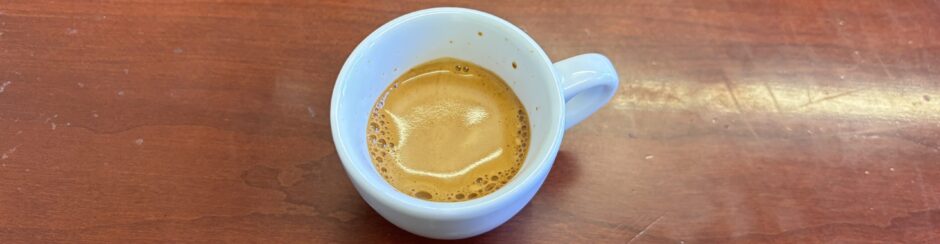
Voltage coffee and art with Sug Woo Shin: pretentious in a hipster kind of way, elegant design, a payment system that involves an ipad, and a serious attitude towards coffee; in otherwords, my kind of place. I ordered a cortado, which was everything one could ask it to be. Who would have thought even five years ago that Kendall square would have a place like this!

Poonen can give a beautiful exposition of Coleman-Chabauty in 10 minutes. And he knows how to wield it too; see the recent beautiful result of Poonen-Stoll.

Seminars by Calegari & Calegari at MIT and Harvard. This off-broadway show will come to Chicago soon, book your tickets now!

Suppose that \(X\) is a PEL Shimura variety. Can one classify all \(X\) for which the image in \(A_g\) lands in the Torelli locus? In Rachel Pries’ talk at MIT, a result of Moonen was mentioned which classified the \(A/X\) which satisfied certain exceptional isomorphisms with families of Jacobians of curves which are cyclic covers of the projective line, but I wasn’t sure whether this was supposed to give the complete answer to this question.

Sitting next to me in Rachel’s talk: David Treumann, who has a nice paper with Venkatesh on the way (I’ll update the link when it becomes available.)

Unconfirmed Rumor: Mark Kisin’s student Thanos Papaïoannou will be the next president of Cyprus.

Posted in Waffle | Tagged , , , , , | Leave a comment

Galois Representations for non self-dual forms, Part I

This is the first of a series of posts discussing the recent work of Harris, Lan, Taylor, and Thorne on constructing Galois representations associated to regular algebraic automorphic forms for \(\mathrm{GL}(n)\) over a CM field \(F/F^{+}\). I will dispense with any niceties about why one should care, and try simply to decipher the scribbles I made during a talk RLT gave at the Drinfeld seminar. I should warn the reader of two difficulties: this paper does not exist as a public manuscript, and it also involves technical details which I generally prefer not to avoid thinking about. So caveat emptor.

First, some simplifying assumptions. Let’s assume that:

  • \(\pi_{\infty}\) has trivial infinitesimal character.
  • \( \pi_p\) is unramified.
  • \(F\) is an imaginary quadratic field in which \(p\) splits.

    For examples, I will generally consider the case \(n = 1\) and \(n = 2\).
    The goal will be to construct a Galois representation

    \(R_p(\pi) = r_p(\pi) \oplus \epsilon^{1-2n} r_p(\pi^{c,\vee})\)

    If one can do this for \(\pi\) and for \(\pi \otimes \chi\) for enough characters \(\chi\), then one can recover \(r_p(\pi)\). Naturally enough, \(R_p(\pi)\) will be associated to an automorphic form \(\Pi\) for a bigger group. Now \(\pi \boxplus \epsilon^{1-2n} \pi^{c,\vee}\) is automorphic for \(\mathrm{GL}(2n)/F\); it is, moreover, an essentially conjugate self-dual (RAESD) although no longer cuspidal. It does, however, come from a smaller group, namely, the unitary similitude group \(G\) which is ubiquitous in the papers of of Harris and Taylor. Over the complex numbers, \(G\) looks like \(\mathrm{GL}(2n) \times \mathrm{GL}(1)\), but over the real numbers I think it must look like \(\mathrm{GU}(n,n)\). Although it’s true that the natural — i.e. occurring in cohomology of \(X(G\)) — Galois representations associated to RAESDC forms \(\varpi\) for \(G\) will actually be nth exterior powers, I don’t think that matters so much, since once one has congruences between \(\varpi\) and \(\Pi\) one gets Galois representations of the right degree for \(\Pi\).

    OK. Now associated to \(G\) and an open compact \(U\) of \(G(\mathbf{A}^f)\) one has three natural objects: a smooth quasi-projective Shimura variety \(Y = Y_U\), a (typically non-smooth) normal minimal compactification \(X = X_U\), and a (family of) smooth toroidal compactifications \(W = W_U\). The complement of \(Y\) in \(W\) is SNCD (smooth normal crossing divisor). I’m using somewhat non-standard terminology as far as the letters go because I don’t want too many subscripts. If \(n = 1\), then \(Y\) is an open modular curve, \(X = W\) is a smooth compactification, and the complement of \(Y\) in \(W\) is a finite number of points (cusps). If \(n = 2\), then \(Y\) has complex dimension \(4\). More on that example later.

    As usual, one has the Hodge bundle \(\mathbb{E} = \pi_* \Omega^{1}_{A/Y}\), from which one may build automorphic bundles \(\xi_{\rho}\) in the usual way for suitable algebraic representations \(\rho\) of what I guess amounts to the levi of \(G(\mathbf{C})\). In my notes I have written:

    \(\xi_{st} = \mathrm{st}_{\tau} \oplus \mathrm{st’}_{\tau’}\)

    Here \(\mathrm{st}\) means the standard \(n\)-dimensional representation of \(\mathrm{GL}_n\), and \(\mathrm{st’}\) denotes the complex conjugate representation. One must have has \(\mathbb{E} = \xi_{st}\), where the decomposition into a direct sum of two rank \(n\)-modules comes from the action of the auxiliary ring on the tangent space to the universal abelian variety (built into the definition of \(G\) which I have omitted). I also have written:

    \( \mathrm{KS} = \mathrm{st}_{\tau} \otimes \mathrm{st’}_{\tau’}\)

    This presumably relates to the Kodaira–Spencer isomorphism. It’s certainly consistent with a surjection:

    \(\bigwedge^2 \pi_* \Omega^{1}_{A/Y} \rightarrow \Omega^1_{Y/k}\)

    Now it turns out that \(\xi_{\rho}\) extends to \( W\) in two natural ways, there is the canonical extension \(\xi^{\mathrm{can}}_{\rho}\) and the sub-canonical extension \(\xi^{\mathrm{sub}}_{\rho}\); they differ by the divisor corresponding to the boundary. Just as in the case \(n = 1\), the bundle \(\xi^{\mathrm{can}}\) should be though of as having log-poles at the boundary. Last but not least, for the one dimensional representation \(\wedge^{2n}(\mathrm{st}_{\tau} \oplus \mathrm{st’}_{\tau’})\), one has the line bundle \(\omega\) on \(Y\). Denote the canonical extension of \(\omega\) to \(W\) by \(\omega\). Then it turns out that \(\omega\) is the pull-back of an ample line bundle \(\omega\) on \(X\). Of course, if \(n =1\), then \(\omega\) is what you think it is — well, almost, since we are using \(GU(1,1)\) Shimura varieties rather than \(\mathrm{GL}(2)\). However, for general \(n\), things are a little trickier. For example, \(\omega\) is ample on \(X\), but not (in general) on \(W\).

    If \(U\) is maximal at \(p\), then the previous constructions also work over a finite field \(k\) of characteristic \(p\) and the appropriate smoothness claims are still true. One has the Hasse invariant \(H\), which is a section of \(\omega^{p-1}\) over \(X/k\). Since \(\omega\) is ample on \(X\), the complement of the zero divisor of \(H\) is affine, it is of course the ordinary locus. In particular, one has Galois representations of the correct flavor associated to forms in the infinite dimensional space

    \(H^0(X^{\mathrm{ord}}, \xi_{\rho})\)

    This follows in the “usual” way; RLT sketched an argument, it goes as expected, although I think the Kocher principle must have slipped in at some point.

    So far, I haven’t really said anything related to the actual argument, but I think I will stop here for now. The next step is to connect \(\Pi\) in any way to classes in the p-adic modular forms arising in the cohomology group above.

  • Posted in Mathematics | Tagged , , , | Leave a comment

    Office Toys

    I think I need one of these for my office, possibly to point at undergraduates when they ask for a higher grade: quantum computer.

    For the full story, see here.

    Posted in Waffle | Tagged , | Leave a comment

    Straight from the top to the bottom

    Possibly the worst programme on radio is NPR’s “from the top.” Ostensibly the show is about showcasing young performers in classical music. Yet, in reality, it is all about the incredibly annoying host, Christopher O’Riley, for whom condescension has become an art form in itself. Whilst I wouldn’t call a 15 year old an adult, I can’t imagine why you would talk to a 15 year old you didn’t know as if you were asking a 5 year old what their favourite colour was. My impression – both now and when I was younger – is that talking to kids you have just met as if they are adults is almost always the right thing do to.

    Posted in Music, Uncategorized | Tagged , , , | Leave a comment