More or less OPAQUE

I recently talked with Lynnelle Ye (a soon to be graduating student of Mark Kisin) for a few hours about her thesis and related mathematics. In her thesis, she generalizes (in part) the work Liu-Wan-Xiao on the boundary (halo) of the eigencurve to unitary groups. One of her main results gives a precise asymptotic growth rate of the Newton Polygon of U_p as one moves towards the boundary.

Turning this around, this leads to estimates for the function \(N_{\lambda}(X)\) which counts the number of eigenvalues \(\lambda\) of U_p (with multiplicity) of valuation at most \(X.\)

I have always had a soft spot for counting slopes, although I haven’t really done anything in this business for many years. It is already interesting to estimate this growth function for classical overconvergent modular forms in the centre of weight space. Precise estimates were first obtained by Wan in his work on the Gouvea-Mazur conjectures.

Suppose we fix a tame level \Gamma, and let X = X(\Gamma) denote the relevant modular curve. Then it turns out that, conjecturally at least, that:

\(\displaystyle{N_{\lambda}(X) \sim^{?} \frac{\mathrm{Vol}(X_0(p))}{4 \pi} X.}\)

But this is precisely the growth estimate in Weyl’s law for the Laplacian on X_0(p)! This suggests an analogy between the spectrum of the compact operator U_p in the p-adic case and the spectrum of the Laplacian operator in the complex case which was first suggested to me by Don Blasius and which I always hoped but never quite managed to extract anything from (see section 5 of these notes, which also contain more precise details about Wan’s results and related results towards the conjecture above, as well as many further speculations on Overconvergent P-Adic Quantum Unique Ergodicity, if you were wondering about the title).

What growth rate should one expect for the Unitary group U(n)? Lynnelle exploits the fact (as do Liu-Wan-Xiao) that one can work on a compact form of the group which is zero dimensional. However, the eigenvariety is (or should be) essentially the same as the eigenvariety for other forms of the group. Following the analogy above, we can consider the growth rate of Weyl’s law for U(n-1,1), which, since the Shimura variety for U(n-1,1) has complex dimension n-1, grows like \(X^{n-1}.\) However, the exponent in Lynnelle’s work turns out to be

\(X^{n(n-1)/2}.\)

If I understood correctly, this one can even predict (if not prove) by simply counting the dimension of certain classical spaces of regular algebraic automorphic forms as one ranges over local systems of appropriate weights (proving it requires more work, of course). However, this seems to spoil the very precise (up to the level of constants) analogy for the complex dimension n = 1 case above. Is there something one can do to massage these results so they look more similar or was the n = 1 case simply misleading?

Posted in Mathematics | Tagged , , , , , , , , , | 3 Comments

Mazur’s Program B on Abelian Surfaces

In the book “More mathematical people,” there is an interview with Robin Wilson with the following quote:

At the meal I found myself sitting next to Alistair Cooke who was very charming, and absolutely fascinating to listen to. The very next Sunday when I was back in England I turned on his “Letter from America” on the radio — he started off by saying, “I went to a very boring dinner at the White House. There was no one interesting to talk to.” That amused me a lot.

So let me start off by saying that even though this post is about one or two things I learnt at Oberwolfach, it is deliberately not about anything I learnt in the talks, lest my choosing some talks over others leading to false inferences on what I thought interesting. For example, the title of this post alludes to David Zureick-Brown’s talk, which I will not mention again.

Let g be a non-negative integer and p a prime. Suppose one starts with a representation

\(\displaystyle{\rho: G_{\mathbf{Q}} \rightarrow \mathrm{GSp}_{2g}(\mathbf{F}_p)}\)

with (say) cyclotomic similitude character. To avoid later circumlocutions, let me (most of the time) assume it is absolutely irreducible. One can ask whether this representation arises infinitely often from the p-torsion on an abelian variety — perhaps additionally assuming that it does arise from at least one such variety, or perhaps not.

This problem is very well-studied in the case g = 1, where we know that the answer is positive exactly for the primes p = 2, 3, and 5, where the corresponding moduli space X(p) has genus zero, and the associated twists X(rho) are Brauer-Severi varieties that also turn out to be rational over Q under the given hypothesis on the similitude character. When p > 5, the curves X(p) have genus at least 3, and so their twists always have at most finitely many points over any field, by Faltings. So there is certainly a satisfactory answer in this case. (Of course, there are many more subtle versions of this question — for example, replacing “infinitely” by “at least twice” — and those variations are open in general.)

If we move to genus g = 2, then the case of p = 2 is also straightforward — the 2-torsion of the Jacobian of y^2 = f(x) for a degree 6 polynomial with Galois group G just comes from the isomorphism \(G \hookrightarrow S_6 \simeq \mathrm{GSp}_4(\mathbf{F}_2).\) (One needs to be a little bit careful here because the outer automorphism of S_6 means there are two non-conjugate such maps and one has to choose the right one.) Given that one can write down families of sextics where the etale Q-algebra Q[x]/f(x) is constant, it’s easy to see that the answer is positive in this case without any restrictions. For example, given an \(S_6\) extension, there’s a six dimensional family of polynomials one can write down whose splitting field generically gives this extension, and so after accounting for the action of \(\mathrm{PGL}_2\) on the roots, this still gives a three-dimensional rational family of genus two curves whose two torsion comes from this extension.

In my paper with Boxer, Gee, and Pilloni (coming soon!), will also give a similarly conclusive answer for p = 3, although there are some unexpected surprises, as well as some complementary results recently proved by my student Shiva Chidambaram. But more on this in a post coming up soon!

When p > 3, then the corresponding 3-folds obtained by taking full level p-structure of the corresponding Siegel 3-fold \(\mathcal{A}_2\) are of general type. (Note that it is essentially known when \(\mathcal{A}_g(n)\) is either geometrically rational of general type, see for example Theorem II.2.1 and the surrounding comments in this paper.) Of course, unlike the case of curves, varieties of dimension greater than one of general type can have many rational points. For example, it’s obvious that there are many abelian surfaces over Q whose 5-torsion has the form \((\mathbf{Z}/5 \mathbf{Z} \oplus \mu_5)^2,\) because one can take A to be E + E where E is an elliptic curve whose 5-torsion has the form \((\mathbf{Z}/5 \mathbf{Z} \oplus \mu_5),\) and there are infinitely many such E because the classical modular curve of full level 5 is rational over Q. To put it a different way, the 3-fold A_2(5) corresponding to abelian surfaces with fixed 5-torsion will contain a number of rational Shimura subvarieties coming both from Hilbert modular surfaces and from modular curves, even though it itself is of general type. This can happen even if the mod-p representation rho is irreducible. For example, given an elliptic curve over a quadratic field K/Q, there will once more be a rational curve of elliptic curves with the same mod-5 representation, and so the restriction of scalars will give a rational curve on some twist A_2(rho) of A_2(5). On the other hand, one might at least start off by making the following naive minimal guess.

Question Suppose that \(\rho\) is surjective for g = 2 and p >= 5. Then are there only finitely many points on \(\mathcal{A}_2(\rho)?\)

An even more extreme version of this question would be to ask if there is at most one such point. This seems a little unlikely even by comparison with the case of g=1. I learnt the following nice example talking to John Cremona during the hike through the Black Forest: for g=1 and p=7 and varying E, the twist X(E[7]) has genus 3 (it is a twist of the Klein quartic). This twist is still geometrically a plane quartic. By considering the tangent to the point of X(E[7]) corresponding to E, the line has two further intersections with the curve, and one obtains two further points over X(E[7]) which now (in general) lie over a quadratic extension. But one can parametrize the E for which these points are actually *rational* and this turns out to be the rational cover of the \(j\)-line corresponding to asking that the invariant c_4 is a square. So there are infinitely many elliptic curves A (even with A[7] surjective) for which there exist at least a pair of non-isogenous elliptic curves A,B with A[7]=B[7] as symplectic Galois representations. So a better question is the following:

Question Can one find examples of non-isogenous abelian surfaces A and B with A[5]=B[5] and such that the corresponding representation has a surjective Galois representation?

This is the type of question where it is useful to have Andrew Sutherland nearby with a laptop. Within an hour or two, he sent me the following examples:

$latex \displaystyle{\begin{aligned} C_1: y^2 = & \ -120x^6-264x^5+186x^4+276x^3-201x^2+24x \\
C_2: y^2 = & \ 16x^5 – 33x^4 + 60x^3 – 42x^2 + 36x – 9 \end{aligned}}$

both of conductor \(2^{10} \cdot 3^7\) with surjective and isomorphic mod-5 Galois representations which are not isogenous. Nice!

Naturally, the question turned to the existence of a pair with A[7] = B[7]. That proved a tougher challenge, but not an insurmountable one, and here is such a pair (again found by Andrew the same day):

$latex \displaystyle{\begin{aligned} C_1: y^2 + (x^3 + x) y = & \ -x^6+2x^4+2x^3+16x^2+4x+16 \\
C_2: y^2 + (x^2) y = & \ 14x^5-44x^4+46x^3-23x^2+12x-3 \end{aligned}}$

this time of conductor \(2^7 \cdot 3^2 \cdot 7^4.\)

Any guesses as to whether there are any such pairs for \(p = 11?\) I’m not sure I have any idea.

Other news from Oberwolfach:

I do appreciate being invited to the Oberwolfach conference on computational number theory — it pushes me outside my usual range of interests. It’s also the conference I have attended most often, now 8 times since 2003, although even that is far fewer than some of the regular participants. The conference is also chance to see a bunch of people I pretty much never get to see anywhere else. Even better, they are all nice enough to still invite me after this post. On the other hand, every time I give a talk I think that this is the time that I finally have something interesting to say to this audience, and it never quite seems to work out that way. I was certainly convinced that this was going to be the year, but then during my talk I managed to catch three people asleep in the front row. To be fair, it was the third last talk of the conference. On the other hand, Mike Bennett talked directly after me and completely failed to rise to my level of soporificness, despite his best efforts and his own predictions he would do otherwise.

There was a lunar eclipse on the final night of our stay. Most of us took to the roof to observe it, but the tall mountains of the Schwarzwald obscured our view until the final moment. Mike Bennett took the following photo, which he describes as the “best of a bad bunch”
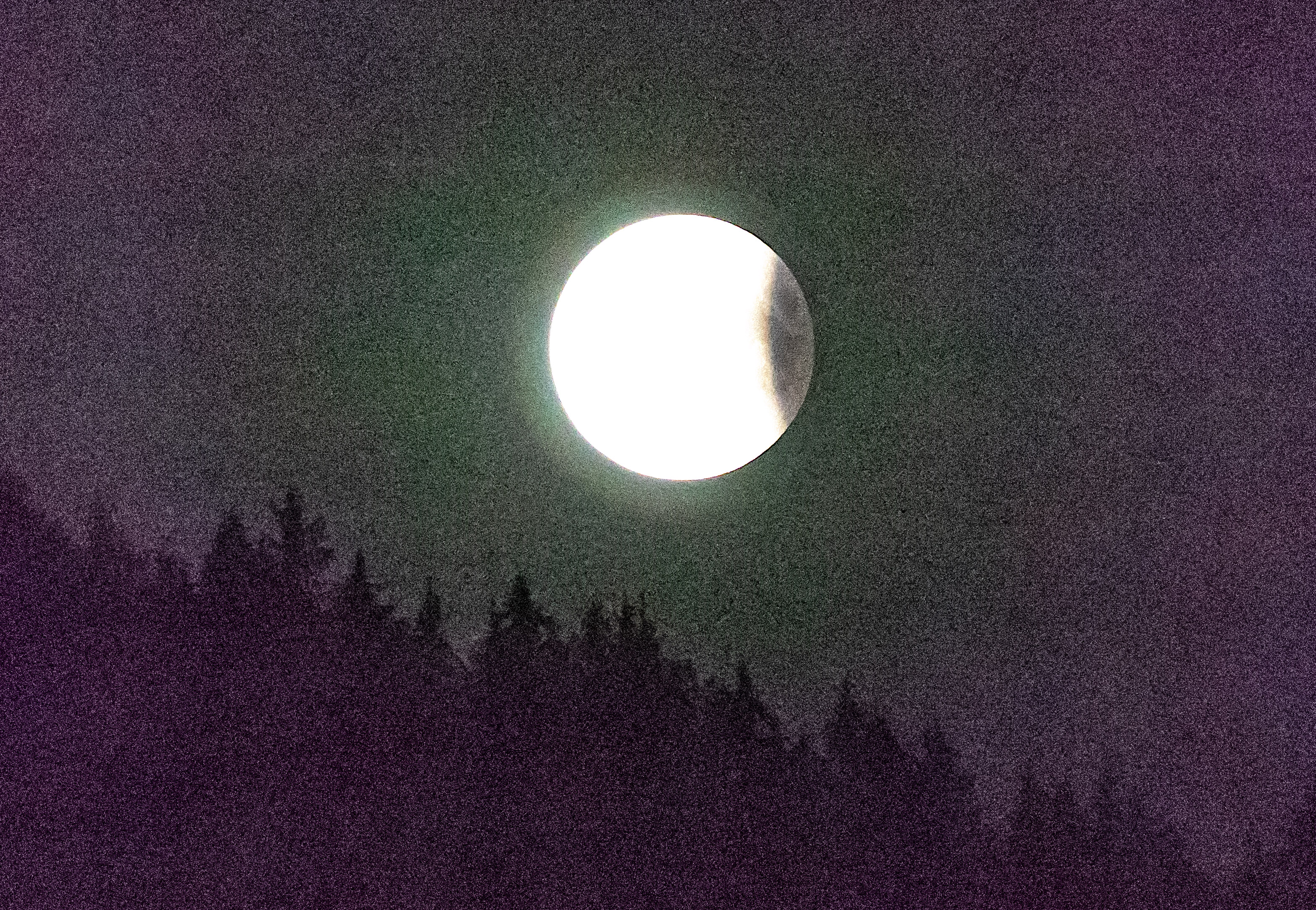
The Moon

For comparison, here is my best photo of the same scene:
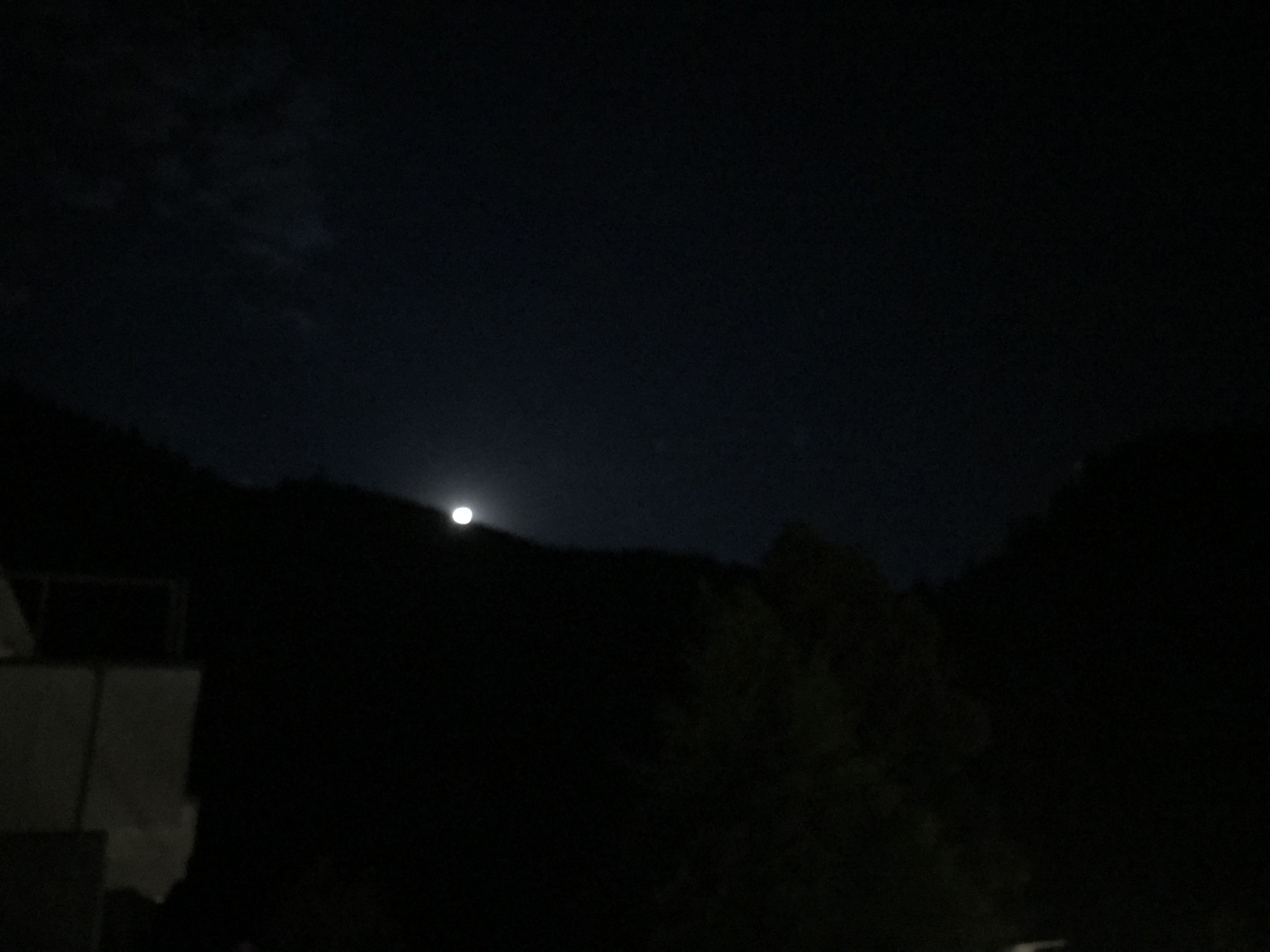
Also The Moon

Finally, if you are travelling to Oberwolfach during the summer, you mind will naturally turn to the question of whether you can enjoy the warm evenings by sipping on an Aperol spritz or two. Certainly they have lots of sparkling water, and so if Champagne (or equivalent) is available, you will easily be able to set yourself up simply by bringing along a bottle of Aperol. You might then consider trying to determine in advance whether they actually have any sparkling wine. Let me inform you, gentle reader, that the answer to that question is a definite yes, although you may have to look at the alcohol supply near the lecture theatre rather than near the dining room:
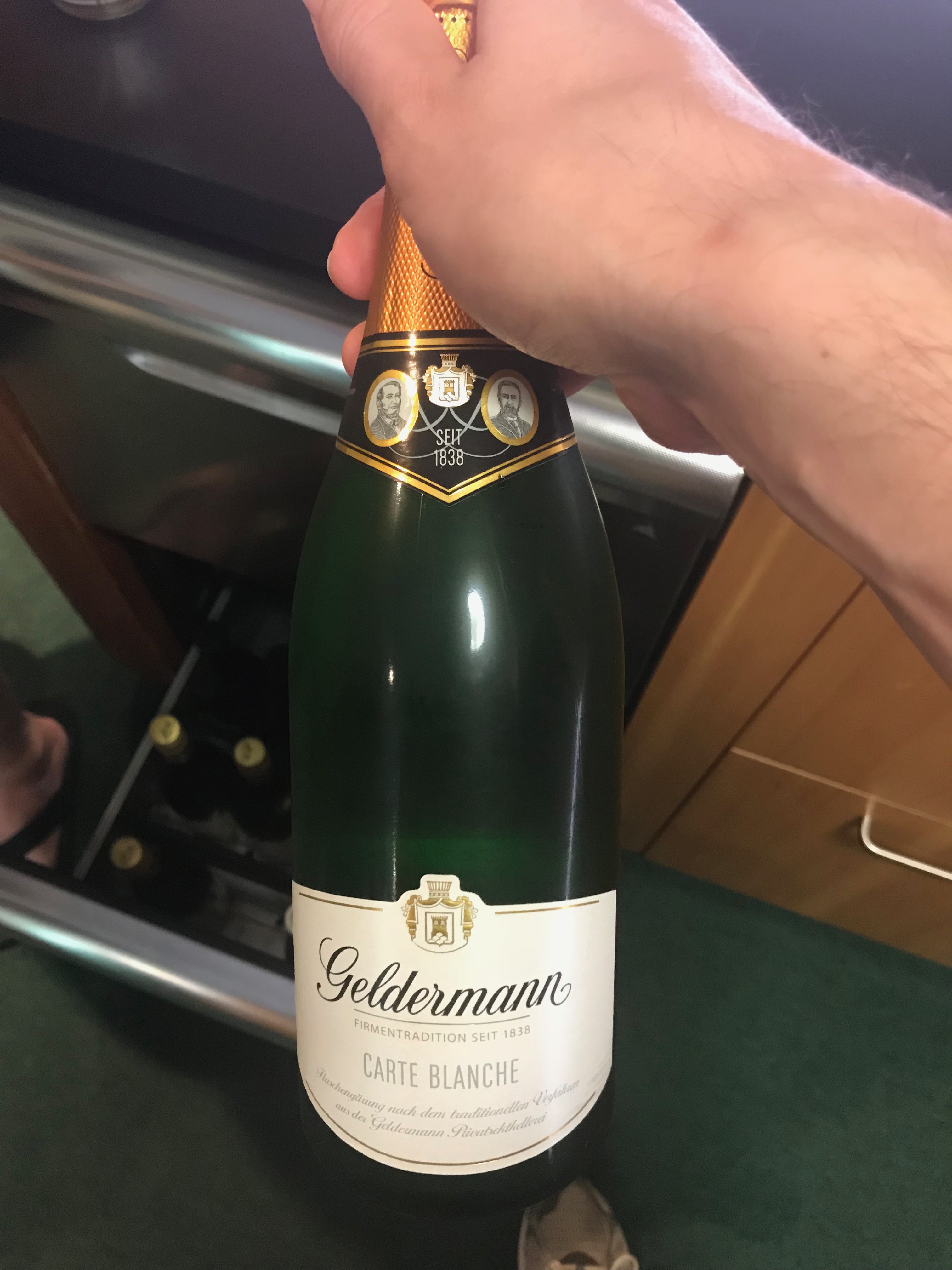
Champagne(ish)

Alas, my own intelligence was not up to snuff, as my informant on Facebook who was visiting the previous week was unable to locate this bottle.

There can be only one way to end this post (mostly only relevant to those brought up in Australia in the early 80s or perhaps in England a decade or so earlier:

Now for a walk in the Black Forest:

(10:40, 11:00, 18:52, 22:06 for relevant times if the timestamp link doesn’t work for you…)
Posted in Mathematics, Travel | Tagged , , , , , , , , , , , , , , , , , , , , , | 2 Comments

Bristol 2005

(This is really just a supplement to this post.)

The AIM model of conferences encourages real time collaboration, which is unusual as far as mathematical conferences go. But the ne plus ultra of such a conference (among those I have attended) was not at AIM at all, but rather organized by the University Bristol (Although to be fair, I believe it was organized specifically by Brian Conrey). The mission was to take a group of mathematicians and have them work on a very specific problem (which we were not told about in advance). The result: we failed to solve it (c’est la vie). On the other hand, I met a bunch of interesting mathematicians for the first time. My records are spotty, but I did manage to dig out some (poorly executed) photographic evidence from the time, which I present to you below.

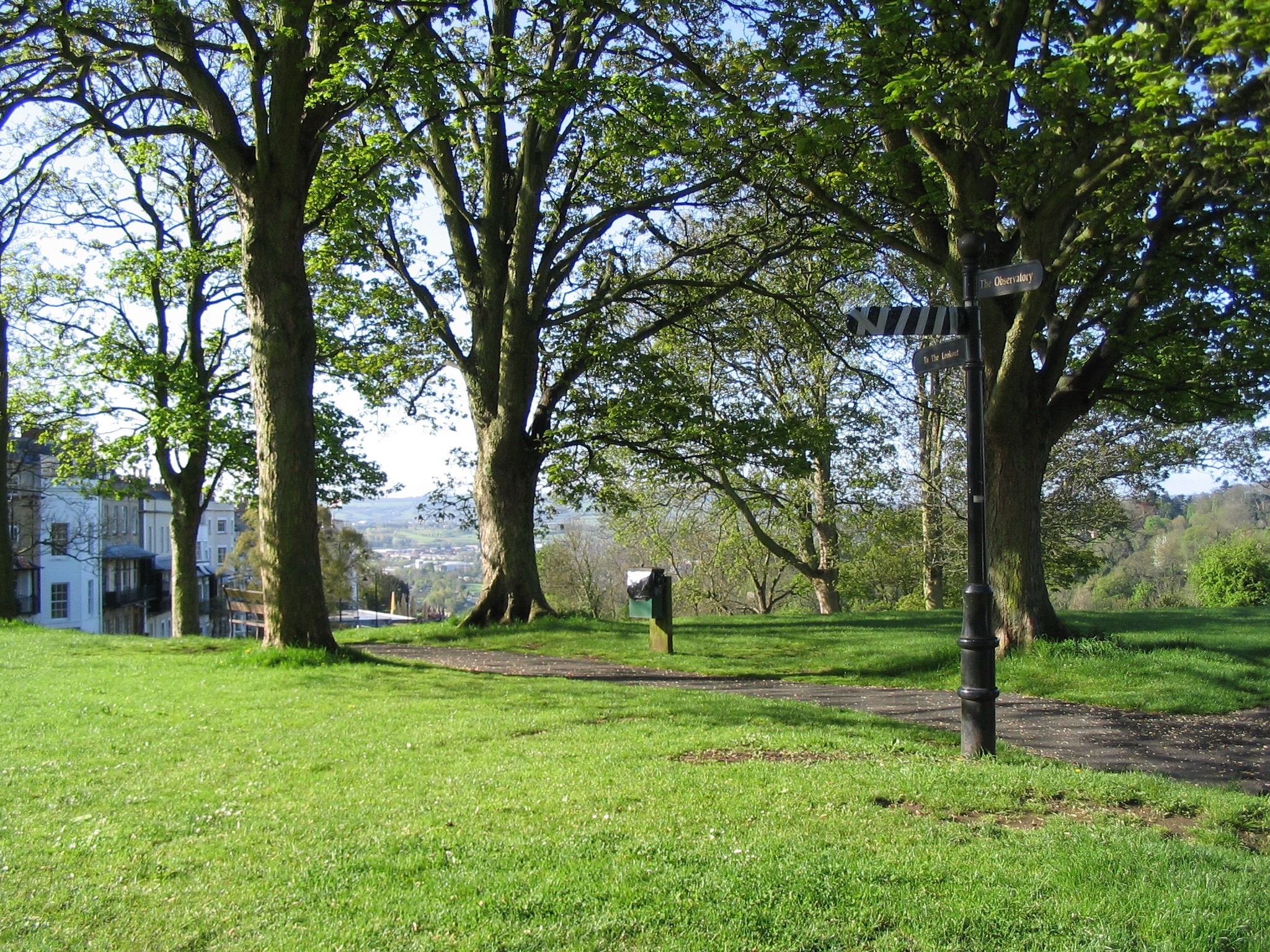
Clifton

The conference was actually located in Clifton rather than Bristol. It didn’t look much like its namesake Clifton Hill (in Melbourne) to me.

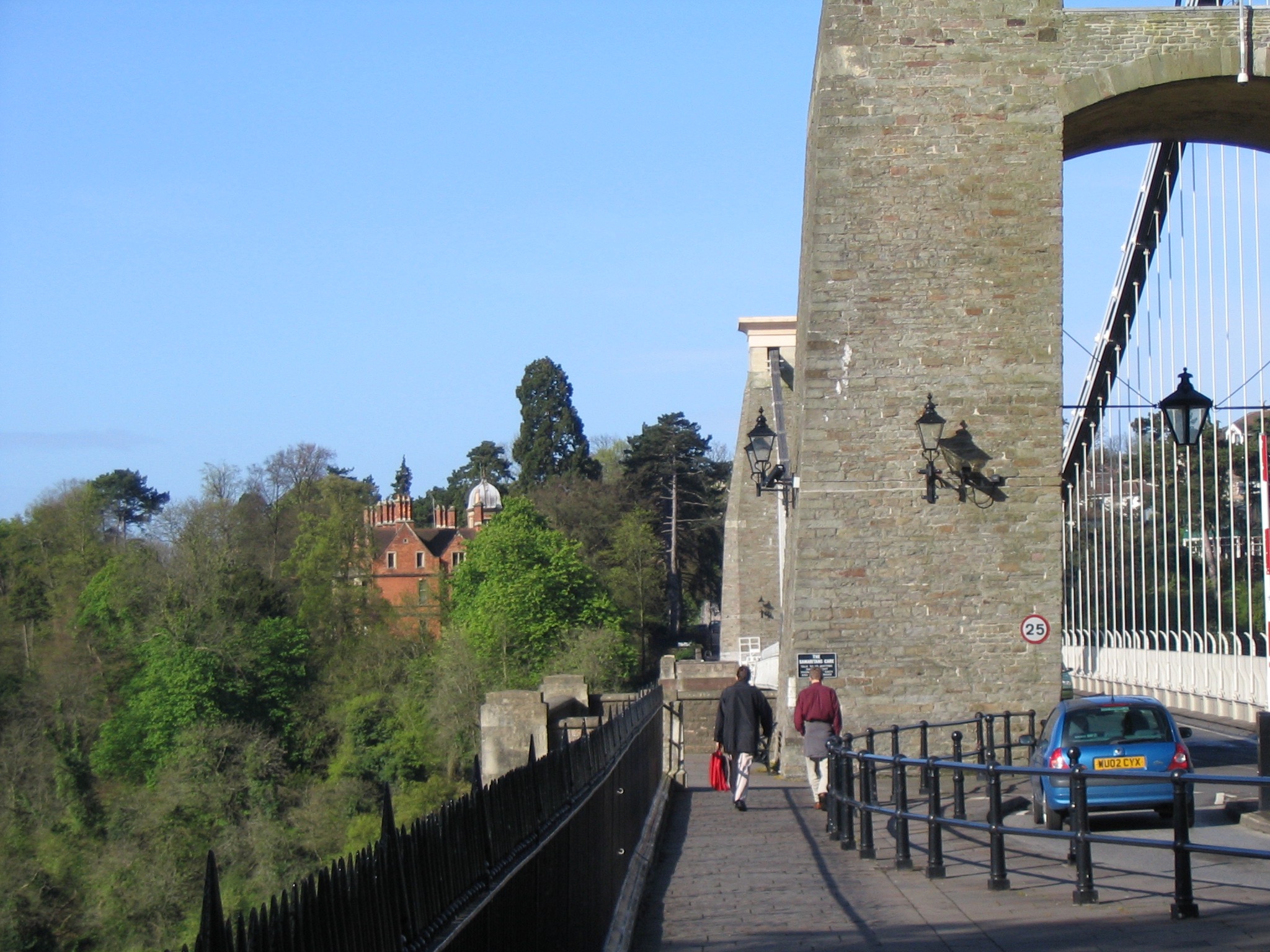
Bridge

Emmanuel Kowalski and Mark Watkins heading towards the Clifton Suspension Bridge. (Check out the snazzy red suitcase!) The conference centre was located in an old manor (Burwalls house, now apparently sold by the University of Bristol to a developer) which is visible in the photo as the orange brick building to the left.

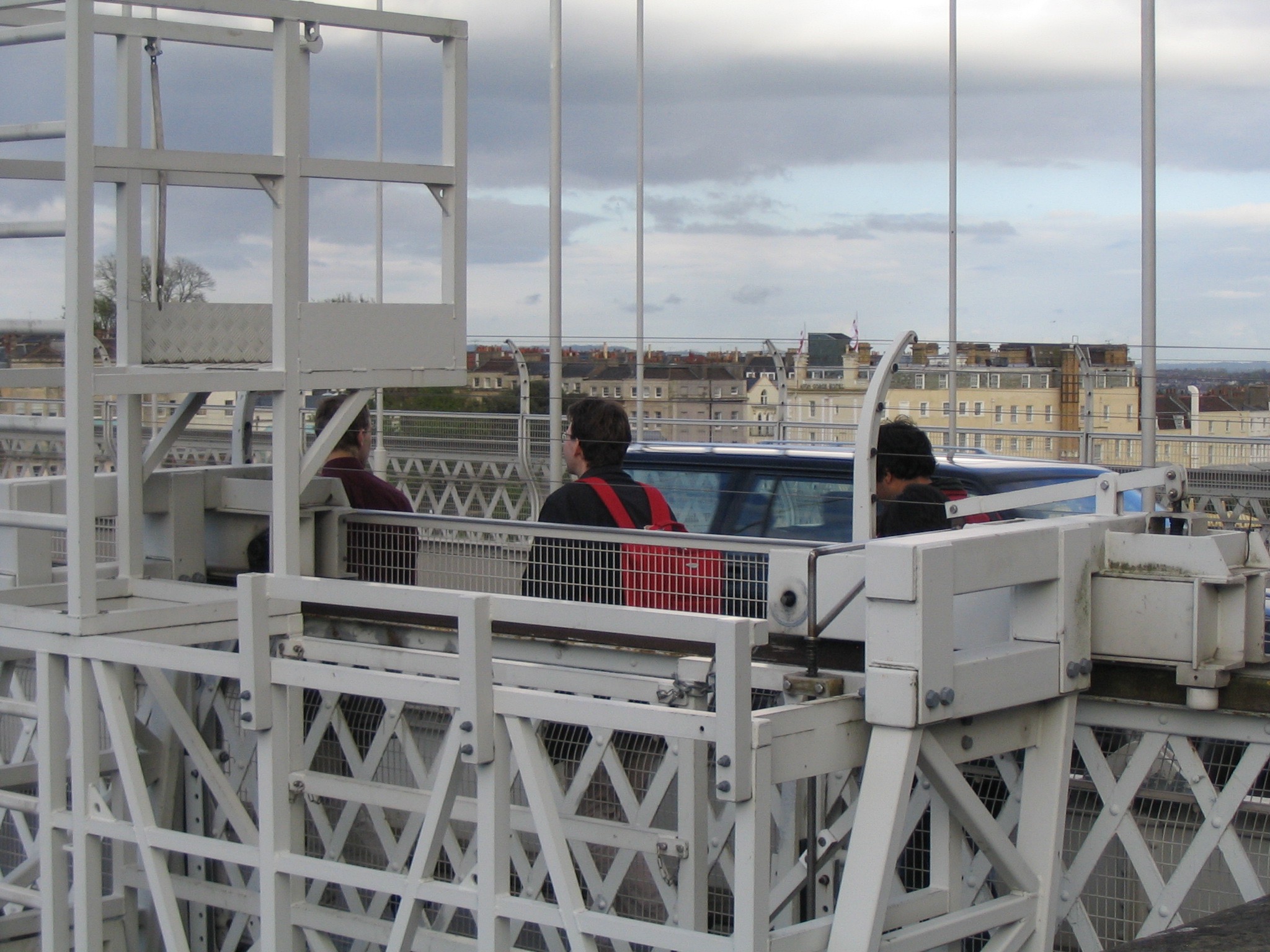
Red

I can’t quite tell if the red suitacase has now transformed into a red backpack or if this is a different day and my fellow blogger has a predilection for vermillion satchels.

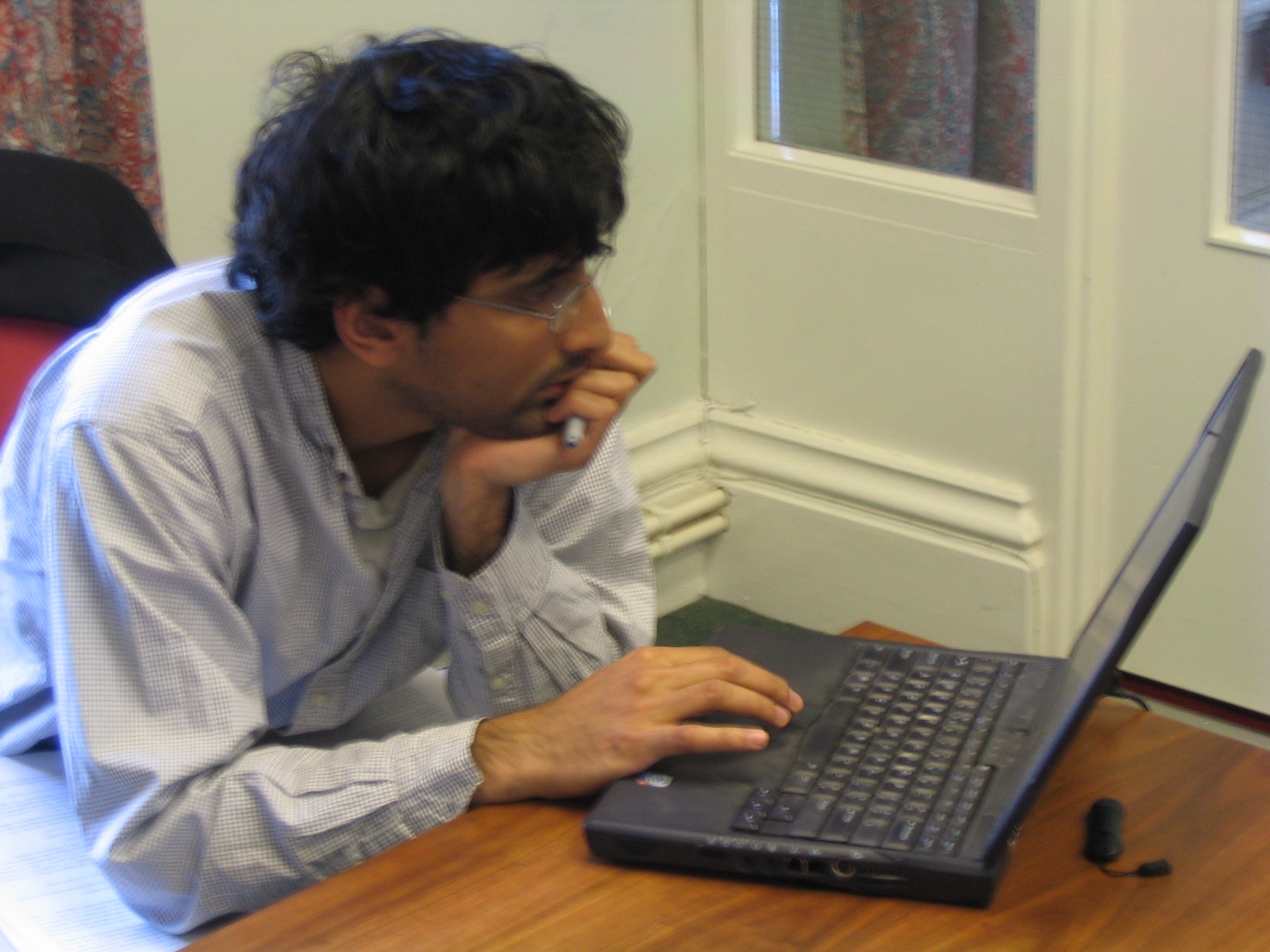
Akshay

Akshay Venkatesh (I’m not going to comment on the hair colour.)

Sound

Soundararajan (see comment above)

ElonErez

Elon Lindenstrauss and Erez Lapid

GreenKeating

Ben Green and Jon Keating

ConreyFarmer

Brian Conrey and David Farmer.

This collection of photos is definitely incomplete: attending but missing from the photos includes William Stein (who I’m pretty sure was there) and Andy Booker and Sally Koutsoliotas (who were both definitely there) [also Mike Rubinstein]. I think there were a few more local Bristol people as well.

Other things I learnt at this conference: the naive Ramanujan conjecture is false for GSp(4), pork pies are pretty much best avoided, and Collins’s 628.

Posted in Mathematics, Travel | Tagged , , , , , , , , , , , , , , , , , , , | 5 Comments

The spoils of Rio

Congratulations to Akshay and Peter — don’t spend all those loonies at once! (Actually, I’m not sure that’s a grammatically correct usage of the word loonies unless they pay the winners in the form of 15000 coins; possibly the Hawk can correct me.)

One could (perhaps) equally offer commiserations — at this point, such a prize has little to no effect on your professional advancement, but may well seriously increase low-level harassment both from the press and from certain types of graduate student who will now follow you around in a ring at conferences at a respectful distance of two to six feet. (Perhaps they already do.)

Of course, echoing Emmanuel’s sentiments, in addition to not forgetting the collaborators of this year’s Fields medalists, let us especially not forget those people (currently estimated as a set of size one cough cough) who have collaborated with at least two of this year’s winners — you have clearly inspired [edit: adeptly ridden the coattails of] the next generation of mathematicians.

Posted in Mathematics, Politics, Waffle | Tagged , , , , , , | 6 Comments

Update on Sato-Tate for abelian surfaces

Various people have asked me for an update on the status of the Sato-Tate conjecture for abelian surfaces in light of recent advances in modularity lifting theorems. My student Noah Taylor has exactly been undertaking this task, and this post is a summary of his results.

First, let me recall the previous status of this conjecture. An explicit form of this conjecture (detailing all the 52 possible different Sato-Tate groups which could occur for abelian surfaces over number fields — 34 of which occur over Q) was given in a paper of Fité, Kedlaya, Rotger, and Sutherland (I recommend either reading these slides or especially watching this video for the background and some fun animations). Christian Johansson gave proofs of this conjecture over totally real fields in many of the possible cases in which the abelian surface had various specific types of extra endomorphisms over the complex numbers by exploiting modularity results that had been used in the proof of the Sato-Tate conjecture for elliptic curves. Over totally real fields, this left essentially four remaining cases:

  1. The case when the Galois representations associated to A decomposes over a quadratic extension L/F into two representations which are Galois twists of each other, and L/F is not totally real.
  2. The case when the Galois representations associated to A decomposes over a quadratic
    extension L/F into two representations which are not Galois twists of each other, and L/F is CM.
  3. The case when the Galois representations associated to A decomposes over a quadratic
    extension L/F into two representations which are not Galois twists of each other, and L/F is neither totally real nor CM.
  4. The case when the geometric endomorphism ring of A is \(\mathbf{Z}.\)

Noah has something to say about each of these cases.

Case 1: Noah completed the proof of Sato-Tate in this case using only the methods from BLGGT, by exploiting the fact that the corresponding two-dimensional representations — while possibly only defined over a field L which need not be totally real or CM — in fact give rise to projective representations which extend to F. By a theorem of Tate, each of these representations can be extended to F after twisting by a character, and so the original 4-dimensional representation looks like the tensor product of a 2-dimensional representation over F (which is potentially modular) and an Artin representation. At this point one is in good shape.

Case 2: The Sato-Tate conjecture is proved in this case. This case required the least amount work, because it is pretty much an immediate consequence of the modularity results proved in the 10-author paper.

If the totally real field is Q, this implies the Sato-Tate conjecture for all abelian surfaces except those of type (4).

Cases 3 & 4: In these cases, one can apply the potentially modularity results proved in my (very close to being finished) paper with Boxer, Gee, and Pilloni. It is too much to expect a full proof of Sato-Tate at this point. However, knowing potential modularity allows one to obtain partial results, similar to those of Serre and Kim-Shahidi for the case of elliptic curves (after Wiles but before Clozel-Harris-Taylor). Here is a sample result:

Theorem (Noah Taylor). Let C be a genus two curve over a totally real field F. Then, for any \(\epsilon > 0,\) there exists a positive density of primes \(\mathfrak{p}\) (with \(N(\mathfrak{p}) = p),\) one has

\(\displaystyle{\# C(\mathcal{O}/\mathfrak{p}) – p – 1 > \left(\frac{2}{3} – \epsilon \right) \sqrt{p}}.\)

Compare this to the Hasse bounds, which imply that the quantity on the LHS has absolute value at most \(4 \sqrt{p}.\)

Of course this theorem is much weaker than the Sato-Tate conjecture. But even the weaker version of this theorem which says that \(\#C(\mathbf{F}_p) > p + 1\) for infinitely many primes was completely open before such curves were known to be potentially modular. Similarly, I don’t think one can prove the corresponding result for elliptic curves without either using something very close to modularity (in the non-CM case) or the equidistribution theorems of Hecke in the CM case. I think the following example is instructive: take the elliptic curve \(y^2 = x^3 – x\) which admits CM by the Gaussian integers. One has a formula for the difference \(a_p= 1+p-\#E(\mathbf{F}_p)\) as follows: for a prime which is 1 mod 4, one may write p = a^2 + b^2 uniquely in integers by imposing the additional congruence

\((a + b i) \equiv 1 \mod (1 + i)^3.\)

Then one has the formula \(a_p = 2a.\)

The problem then becomes: do there exist infinitely many primes p = 1 mod 4 such that one has \(a > 0?\) This seems suspiciously like something that can be proven using Cebotarev, but it is not. The problem is that the infinite places of \(F = \mathbf{Q}(\sqrt{-1})\) are all complex, so there is no choice of “conductor” which differentiates between complex numbers with positive or negative real part at the infinite places in \(\mathbf{A}^{\times}_F.\)

Noah’s proof of the theorem above exploits the following idea. Potential modularity not only gives meromorphy of the L-function, but more importantly (in this case) holomorphy and non-vanishing in the (analytically normalized) halfplane Re(s) >= 1. Moreover, again using functorialities, potential automorphy, and results of Shahidi, one obtains similar results not only for the degree 4 L-function, but also the degree 5 L-function, and also crucially the Rankin-Selberg L-functions of degrees 16, 20, and 25. From this one can obtain various “prime number theorem” estimates for quantities involving the Frobenius eigenvalues, and then one has to massage these into an inequality. A simple version of this argument is as follows: given some infinite set of real numbers \(a_n \in [-2,2]\) such that

\(\displaystyle{\frac{1}{n} \sum_{i=1}^n a_i \rightarrow 0, \qquad \frac{1}{n} \sum_{i=1}^n a^2_i \rightarrow 1,}\)

One can draw the conclusion that \(a_n > 1/2 – \epsilon\) infinitely often, by (for example) considering the average of the quantity \((2a_n – 1)(a_n + 2).\) Moreover, this is the best possible bound given these constraints.

Note that since the Sato-Tate conjecture is known in all other cases, one only has to consider cases (3) and (4), which behave slightly differently in this argument. In fact, in case (3), one can do much better:

Theorem (Noah Taylor). Let C be a curve over a totally real field F such that \(A = \mathrm{Jac}(C)\) is of type (3). Then there exists a positive density of primes \(\mathfrak{p}\) (with \(N(\mathfrak{p}) = p),\) such that

\(\displaystyle{\# C(\mathcal{O}/\mathfrak{p}) – p – 1 > 2.47 \sqrt{p}}.\)

(Note that once this result is known in case (3) it is known for all curves whose Jacobian is not of type (4), that is, those whose Jacobians admit a non-trivial endomorphism over \(\mathbf{C}.)\) The point is that, in this case, one knows not just the potential automorphy of A, but also the potential automorphy of the corresponding two-dimensional representations over the quadratic extension L, and so one can also exploit the automorphy of symmetric powers of the corresponding GL(2)-automorphic representations (and further analyticity results for higher symmetric powers) as well as a zoo of Rankin-Selberg L-functions coming from pairs of low symmetric powers. (As for the constants involved in both of these theorems, they are essentially optimal given the automorphic input.)

These results tie in to problems raised in various talks of Nick Katz (see for example this talk). Noah’s result above implies that, given an curve C over a totally real field, one can tell that it doesn’t have genus one from the distribution of the traces of Frobenius except possibly in the case when its Jacobian has no non-trivial geometric endomorphism (the “typical” case, of course). It’s a little sad that the modularity results are not sufficient to handle that last case as well — showing that the support of the normalized trace of Frobenius extends beyond \([-2,2]\) would require knowing something close to functoriality of the map \(\mathrm{Sym}^2: \mathrm{GL}(4) \rightarrow \mathrm{GL}(10),\) and this is currently out of reach, unfortunately. Oh well, that’s a shame: wow I dearly would have loved to give a talk entitled Simple things that Nick Katz doesn’t know (but I do).

Posted in Mathematics, Students | Tagged , , , , , , , , , , , , , , , , , , , , , , , , , | 3 Comments

Cookies for everyone!

Chicago University has recently moved to two-factor authentication. While this is not itself objectionable, it is pretty annoying to have to have access my cell phone for push notifications just to be able to use MathSciNet. Fortunately, there is (at least) an option to “remember” a login for 30 days without having to use two-factor authentication. That is, it would be fortunate if this feature actually worked. Having just converted to Firefox from the interminably slow Safari, the uchicago website prevents me from remembering my log in for 30 days because “I don’t have cookies enabled.” Except I do have cookies enabled, just not from third parties. What does the crack security team at Chicago ITS suggest? Enable all third parties cookies from everyone! Firefox does have an option from allowing (third party) cookies from an approved list of websites, but, at this time, they couldn’t work out all the different websites that wanted force a cookie upon me when logging in.

 added: The final word from Chicago ITS:

Hello,

We have looked into other reasons as to why this functionality is the way it is and it seems to be a part of DUO authentication that cannot be changed. The best suggestion we [have is] using VPN when accessing university resources if you want it to remember you for 30 days. Otherwise, 3rd party cookies will have to be enabled to have this work without using VPN. Using the University VPN does have advantages if you are working in a public network.

Regards,

ITS Service Desk

====================

Posted in Rant | Tagged , , , | 14 Comments

Hear my prayer

Music post!

Current obsession:

This plaintive choral work, possibly an incomplete fragment of an unfinished anthem, is essentially one long phrase building to a final resolution with just the right amount of dissonance. There are a number of fine recordings on youtube, but this performance is my current favourite. (It appears to be tuned in something close to a baroque pitch with A = 415, but I’m neither sure how accurate that estimate is nor how deliberate that specific choice was — those of you who know how to take Fourier transforms in practice can tell me how close I am.)

Edit: OK, thanks to an old answer here by user Lenoil (I love it how the Stack Exchange websites are stocked with competent experts able to answer so many questions; a pity there is no equivalent in mathematics), I could at least clip out the very first note in the file and let Mathematica compute the corresponding Fourier transform. There’s still a little vibrato which makes for inaccuracies, but here was the result from the opening “hear”:

Frequency Graph

Assuming (very generously to myself) that the second peak is the result of vibrato, I think this suggests an opening note very close to 245Hz. The piece itself is in C (minor) and opens on a middle C. Assuming (equal temperament) an A = 415 tuning, the resulting middle C should in fact be approximately

\(415 \cdot 2^{-9/12} \sim 246.7\)

Make of that what you will (probably not so much, I imagine).

Posted in Music | Tagged , , , , , , , | 2 Comments

Mazur 80

Last week I was in Cambridge for Barry’s 80th birthday conference. If you are wondering why it took so long for Barry to get a birthday conference, that’s probably because you didn’t know that there was *also* a 60th birthday conference (in 1998, which is not entirely obvious given Barry’s actual birthday). It dates me somewhat to remark that I arrived at Berkeley as a graduate student just in time to miss this conference. (Come July 1, or thereabouts, I will have spent 20 years living in the US.) My first memory of Barry dates from when I was a graduate student in Berkeley. Ken introduced us; we chatted in the tea room (1015), and, as I remember, Barry listened and talked to me with much more generosity and patience than anything I had to say particularly warranted. My next interactions came about through my work with Kevin Buzzard on various conjectures relating to the Eigencurve. Once again, the level of enthusiasm he expressed for our ideas was the type of positive feedback that (to put it mildly) comes somewhat infrequently in academia. He agreed to be my NSF sponsor at Harvard, and later we became co-authors and friends. Needless to say, I was psyched about coming to this conference, and the conference was great! I will not rehash the talks here, beyond a few small observations.

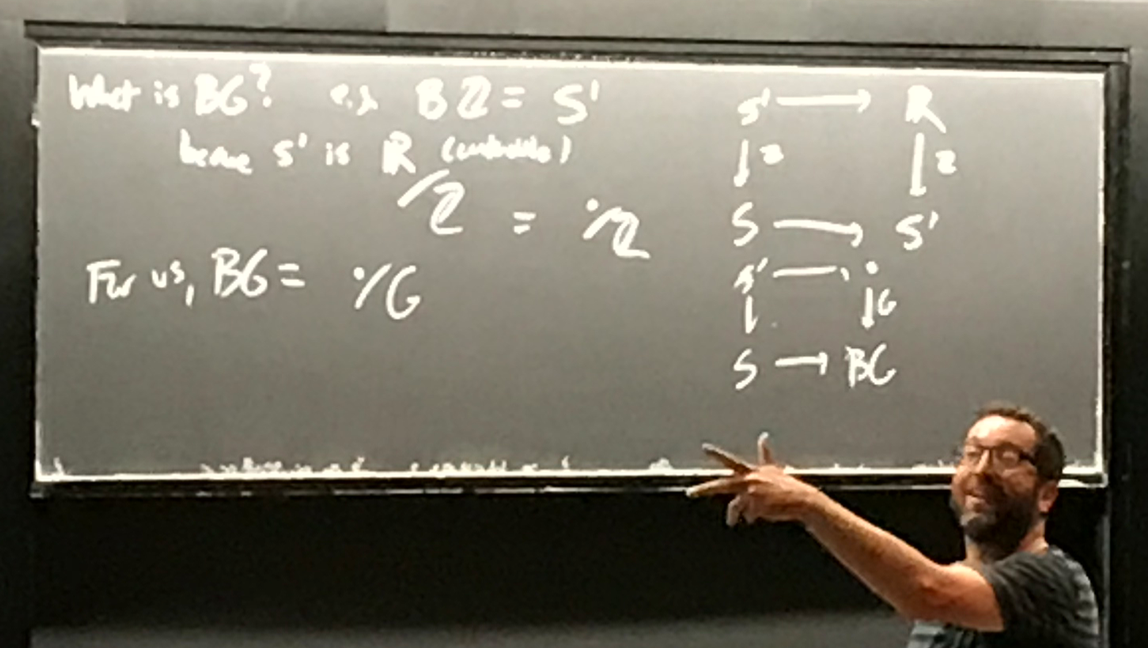
Jordan was very careful about notation in his talk. He had previously used \(X\) as a symbol to denote an integer, so he carefully used \(S\) to denote an object which admits a map to \(B\mathbf{Z}\):

Jordan

Answered here: What is BG? Not answered here: why do two corners of this pullback square look suspiciously like the same symbol?

As for my own talk, having previously tried to give some technical talks on math related to the CG-method which went horribly wrong, this time I gave a slide talk on my work with Boxer, Gee, and Pilloni which was all candy and no vegetables. (Summary of talk: first Riemann, then Wiles, and now us). Kai-Wen legitimately expressed disappointment at the lack of details (fair enough, you can’t fault that guy for skipping details). Otherwise, it elicited the reminder from Dick Gross that — although I could get by and make a living doing this sort of thing — it was time for number theorists to escape the “ghetto of holomorphic forms” (a phrase I think he attributed to someone else, I should say). Hey, Dick, don’t I at least get points from escaping the even worse “swamplands of discrete series”?

For those playing Barry Mazur bingo (sample squares: Gorenstein, “but…that’s beautiful”, \(X_0(11))\) there were plenty of opportunities to see the influence of Barry’s mathematics. There was, however, a novel aspect of the conference which was an interdisciplinary day consisting of three conversation sessions of Literature/Poetry, History of Science, and Philosophy/Law/Physics respectively. By all accounts this was a wildly successful enterprise (hat-tip to the organizers). I did have one question I would have liked to ask one of the historians of mathematics, but the theme of the conversation meandered elsewhere. Instead I shall ask it here into the void (I’m not accusing you, dear reader, of being a void, merely that there are probably not any actual historians reading this blog):

A working mathematician usually has a very interpretative (and somewhat anachronistic) view of the history of mathematics: Galois “knew” which groups \(\mathrm{PSL}_2(\mathbf{F}_p)\) acted on p points, Gauss “knew” XYZ about class groups, etc. Mathematicians feel confident in these interpretations even if they are not explicitly written in this form in the original texts. What are the dangers in this (Whiggish?) view of the history of mathematics?

Cambridge Culinary Roundup:

With conference banquets (with some touching and amusing speeches by those who knew Barry well) and receptions going on, there was only a limited time for dining, not to mention the problem of trying to book restaurants at the last moment. Still, there was some opportunity to revisit some familiar and some new places:

Burger versus Burger: When it comes to Cambridge burgers, there is only one possible choice…or is there? My general impression was that the only way you could like Mr Bartley’s was if you were first exposed to it before your culinary tastes had a chance to develop (i.e. as a drunk undergraduate). On the other hand, a Cragie on Main burger (circa 2012) was as close in my mind to burger perfection as you could get. But did either of these opinions hold up today? Thus was the origin of the burger versus burger challenge. The participants for round one (Tuesday lunch) included myself, Quomodocumque,
The Hawk, Akshay, Joel, and Bisi. (Although Bisi was participating in a slightly different show, namely the latest episode of “mathematicians trick Bisi into going to a grungy restaurant.”) Round two was Tuesday dinner. Bisi and Joel dropped out on the reasonable basis that they had already consumed enough saturated fat for one week, but the rest of us continued on.

The conclusion? Cragie on Main clearly serves the superior burger (as noted by the Hawk, the fact that the request for a “medium rare” burger came out medium rare at Cragie on Main versus medium well at Bartley’s meant there could be no other conclusion). But perhaps inevitably, my opinions were forced to be somewhat softened in both directions. Bartley’s really did a decent job as far as the overall taste was concerned, and Cragie on Main’s burger — while better — stopped well short of being transformative. I suspect that they’ve been coasting for too long and haven’t maintained the level of excellence they started with (maybe that’s true of Bartley’s too, although I didn’t get a chance to eat there in 1960). In fact, there’s a generally sound principle to be a little wary about restaurants which have been around for too long. (Having said that, I would still find it hard to skip going to Rivoli restaurant on my next trip to Berkeley.)

Chess: Au Bon Pain has disappeared! The entire Holyoke center building is under some sort of reconstruction. The chess players are still around, however, having moved to (literally) the triangle that is Harvard square. I played a few games, and was prettily solidly crushed by a 2300 player in some lightning games. I also declined to play a $10 lightning game against an IM with generous odds, not because I thought I didn’t have a 50% chance of winning, but because I didn’t think I had a 90% chance of winning, and losing would have been at least 10 times more annoying than winning would have been pleasant.

Coffee: 5 (or so) years ago, Crema was a revolution in Harvard Square (i.e. drinkable coffee, reasonable hipster attitude). While their coffee was never at the level of something like Voltage Coffee (near MIT, and sadly now gone), it made staying at the car park known as the Harvard Square Hotel a more palatable option than at the “quaint” Irving street B&B. Times have changed! Crema is a victim of its own success — in a busy place which requires a frequent changeover of staff, the emphasis on coffee no longer seems to be paramount, and the quality control has dropped precipitously. The result was high inconsistency. Out of four coffees I got there, two were OK, one was pretty bad, and one was send directly into the bin. (I would like to have said “tossed in an elegant arc directly into the rubbish bin,” but if I had really attempted that, it would have been more like “unceremoniously spilt all over my shirt.”) As of today, there are definitely better options even in Harvard Square (further afield, one trip was made to Broadsheet which showed promise, even though my own flat white there was merely acceptable). Namely: Tatte Bakery & Cafe, which I really quite liked as far as the pastries and the sandwiches went, and the coffee itself rose to acceptable if not excellent standards.

Darwin’s is still Darwin’s (I prefer Tatte), Night Market (inspired by asian street food) was pretty interesting (some tasty eggplant) if a little idiosyncratic, and Parsnip did a perfectly good job of replacing “Upstairs at the Square,” a restaurant at which I had many a dinner when I used to live in Cambridge. (I had my eye on a few other restaurants, but none of them could take at short notice a reservation for 4 on a Thursday, so Parsnip was especially good given the constraint of not being so popular.

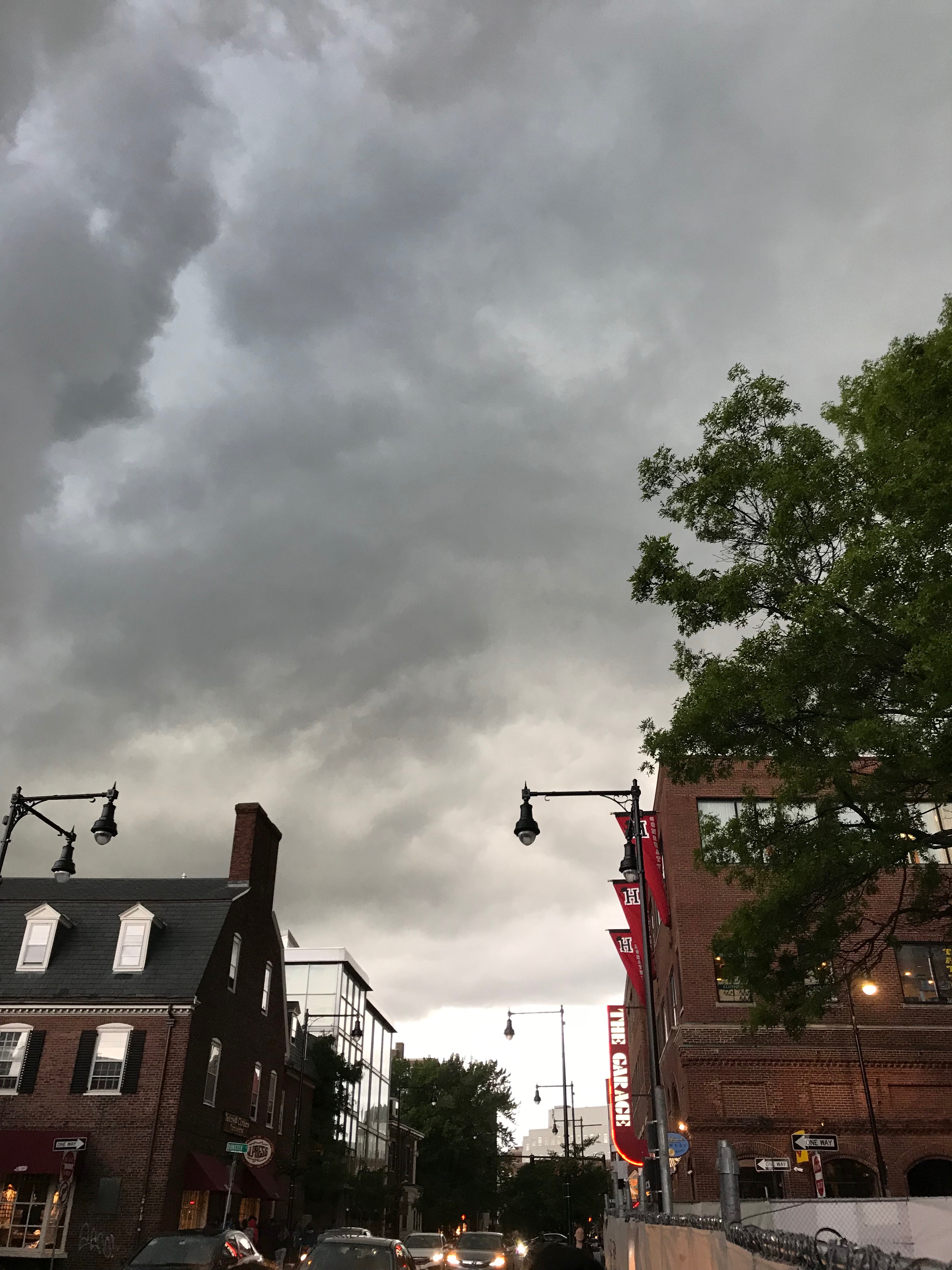
If you have suggestions of better coffee that I may have missed, please make suggestions since I will be returning in November. I also hope the Cambridge weather in November is more like June weather, given that the weather this week was more like November weather:

Cambridge Clouds

Posted in Mathematics | Tagged , , , , , , , , , , , , , , , , , , , , , , , , , , , , , , , , , | 17 Comments

Upcoming Attractions

There’s a packed schedule for graduate classes at Chicago next Fall: Ngô Bảo Châu on automorphic forms (TueTh 11:00-12:30), Akhil Mathew on perfectoid spaces (MWF 12:30-1:30), and George Boxer and me on (higher) Hida theory (MW 1:30-3:00). Strap yourself in!

Slightly more into the future and for a slightly different audience, it has now bene confirmed that there will be a special semester on “The arithmetic of the Langlands program” at the Hausdorff Institute in Bonn during May 4 — August 21 in 2020 (organized by Ana Caraiani, Laurent Fargues, Peter Scholze, and me).

Posted in Mathematics | Tagged , , , , , , , , , | 1 Comment

Nobody Cares About Your Paper

I handle quite a few papers (though far fewer than other editors I know) as an associate editor at Mathematische Zeitschrift. Since the acceptance rate at Math Zeit is something in the neighbourhood of 20%, there are certainly good papers which I have to reject. What papers “make the cut” through the first round depends, to some extent, on how “interesting” the paper is. Naturally, this is a somewhat subjective judgement. I make the determination (in part) on quick opinions I solicit from experts. But there is also a second possible mechanism available. Suppose I decide to send the paper out for a thorough review, but then I can’t find anyone to review it. If I email 10 people in the immediate field (not at the same time of course; usually requests to review come with a request for alternative suggestions for reviewers) and they all say no, does that indicate that nobody cares about your paper and it should be rejected? What if it’s twenty people? I haven’t (yet) ever rejected a paper on these grounds. But I have started to form opinions on certain specific subfields of number theory which seem to generate many pages of material but very few people willing to review anything. If they don’t care enough about their own subject to bother reviewing each other’s papers, why should anyone else?

Posted in Mathematics, Politics, Rant | Tagged , | 6 Comments