Job Dedication

Earlier last quarter, I had suffered a fairly poor night from some sort of stomach bug. Unfortunately, I made the ill-advised decision not to cancel my classes and went to work, which involves driving from Evanston to Hyde Park. Things did not go well; I was feeling so grim during honours group theory that for a 20-minute period I had to sit down with my head slumped on the table, occasionally able to utter a few sentences explaining the Orbit-Stabilizer theorem (I think I did a pretty good job in the circumstances). I somehow managed to survive through the full 50 minutes, by which time I had realized that I had to immediately cancel my graduate class and go straight home. Now one of the pleasant aspects of my drive is that there is a large uninterrupted stretch on LSD in which one does not have to stop. On the flip side, it also turns out that there is a large uninterrupted stretch on LSD in which one is not able to stop. That fact was more pertinent in the current situation. And so, ladies and gentlemen, for approximately 3-4 minutes while traveling approximately 40 miles an hour, I recreated almost in full one of cinema’s (and Terry Jones, RIP) most iconic scenes, with the seats, windows, and steering wheel of my newly purchased second-hand car playing the role of the bucket. With that anecdote out of the way, let me post that clip here now:
Posted in Travel, Waffle | Tagged , , , , | 1 Comment

Inter-universal Teichmüller theory explained

Normally a message such as the one below would go immediately to the rubbish bin. Fortunately for me, I happened to open it accidentally and thereupon discovered the most cogent explanation to date of IUT. I hereby share with you (in its entirety) the following email which was sent to me by a gentleman going by the name Samarium Beesix.

PRIVATE AND CONFIDENTIAL:

16.01.20

DEAR SIR,

PLEASE FORGIVE THIS INTRODUCTION. THIS MORNING I WAS LOOKING AT IMAGES FOR INTER UNIVERSAL TEICHMULLER THEORY.

I DISCOVERED ONE PARTICULAR IMAGE, A SKETCH FROM SOMEONE AT MSRI, WHICH CONTAINS A FAMILIAR LOOKING GEOMETRY.

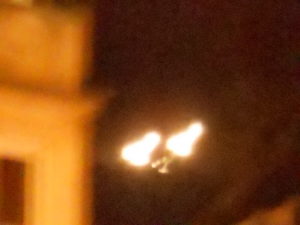
IN DECEMBER OF 2014 I WAS SENT A PHOTOGRAPH OF A STRANGE OBJECT WHICH APPEARED IN THE SKY OVER BEECHEN CLIFF IN BATH.

THE PERSON WHO TOOK THE PHOTOGRAPH WAS STANDING AT THE ABBEY CHURCHYARD IN BATH – IN BETWEEN THE RECENTLY ERECTED WOODEN HUTS FOR THE BATH CHRISTMAS MARKET.

THERE WAS ALSO A MALE AND FEMALE WITNESS TO THE EVENT WHO WERE WALKING PAST, THEY WERE COMPLETELY NONCHALANT AND UNPHASED BY THE INCIDENT.

THE MALE ACTUALLY AFFIRMED WHAT THEY HAD SEEN AND SAID:

‘SO WHAT?’

THE EYE WITNESS SAID THAT THE LIGHTS IN THE PHOTOGRAPH WERE ATTACHED TO A VERY LARGE AND NON-SYMMETRICAL MUSTARD COLOURED FRAME. AND NO, THEY WERE NOT CHRISTMAS LIGHTS.

THE SURFACE OF THE GIGANTIC FRAME WAS PITTED WITH WHAT LOOKED LIKE DARK IRREGULAR POOLS OF WATER, RATHER LIKE THE WATER THAT RESTS ON A SURFACE AFTER RAINFALL.

THE EYE WITNESS ALSO SAID THAT THE LATTICE FRAME HAD SOME FORM OF HEAT HAZE AROUND IT.

THE CAMERA USED TO TAKE THE PHOTOGRAPH WAS NOT OF THE BEST QUALITY. THE SLIGHT DISTORTION OF THE IMAGE WAS CAUSED BY CAMERA SHAKE, AS WELL AS THE LENS BEING FULLY EXTENDED TO CAPACITY.

PLEASE EXERCISE PROFESSIONAL DISCRETION. THANK YOU.

Posted in Rant | Tagged , , , , | 1 Comment

The last seven words of Kedlaya-Medvedovsky

New paper by my student Noah Taylor! It addresses some conjectures raised by Kedlaya and Medvedovsky in this paper. Let \(\mathbf{T}\) denote the Hecke algebra acting on modular forms of weight two and prime level \(N\) generated by Hecke operators \(T_p\) for \(p\) prime to \(N\) and \(2\) (the so-called “anemic” Hecke algebra). If \(\mathfrak{m}\) is a maximal ideal of \(\mathbf{T}\) of residue characteristic two, and \(\mathbf{T}/\mathfrak{m} = k\), there exists a corresponding Galois representation:

\( \overline{\rho}: G_{\mathbf{Q}} \rightarrow \mathrm{GL}_2(\mathbf{T}/\mathfrak{m}) = \mathrm{GL}_2(k).\)

If \(S\) denotes the space of modular forms modulo \(2\), then certainly \(\mathrm{dim}_{k}(S[\mathfrak{m}]) \ge 1\). Since there can exist congruences between modular forms, it is certainly possible that the generalized \(\mathfrak{m}\)-eigenspace of \(S\) has dimension greater than one. Kedlaya and Medvedovsky observe that if one assumes that \(\overline{\rho}\) has (projectively) dihedral image, then one can systematically predict lower bounds for this generalized eigenspace contingent on various properties of \(\overline{\rho}\). They prove a number of such results, but they finish the paper with what amounts to six more conjectures. Actually, one of the conjectures splits into two completely different cases, and so I like to think of it as seven conjectures.

Before stating the conjectures, first note that \(\overline{\rho}\) (when projectively dihedral) is necessarily induced from the field \(\mathbf{Q}(\sqrt{\pm N})\). The corresponding representation may or may not be ordinary at the prime 2. Also, let \(h(N)\) denote the even part of the class number of \(\mathbf{Q}(\sqrt{N})\). Now we can state the conjectures, which are now all proved by Noah:

  1. Suppose that \(N \equiv 1 \pmod 8\). If \(\mathfrak{m}\) is \(\mathbf{Q}(\sqrt{N})\)-dihedral, then the generalized \(\mathfrak{m}\)-eigenspace has dimension at least 4.
  2. Suppose that \(N \equiv 1 \pmod 8\). If \(\mathfrak{m}\) is \(\mathbf{Q}(\sqrt{-N})\)-dihedral, then the generalized \(\mathfrak{m}\)-eigenspace has dimension at least \(h(-N)\).
  3. Suppose that \(\mathfrak{m}\) is Eisenstein. Then the generalized \(\mathfrak{m}\)-eigenspace has dimension at least \((h(-N) – 2)/2\).
  4. Suppose that \(N \equiv 5 \pmod 8\). If \(\mathfrak{m}\) is ordinary-\(\mathbf{Q}(\sqrt{N})\)-dihedral, then the generalized \(\mathfrak{m}\)-eigenspace has dimension at least 4.
  5. Suppose that \(N \equiv 5 \pmod 8\). If \(\mathfrak{m}\) is \(\mathbf{Q}(\sqrt{-N})\)-dihedral, then the generalized \(\mathfrak{m}\)-eigenspace has dimension at least 2.
  6. Suppose that \(N \equiv 3 \pmod 4\). If \(\mathfrak{m}\) is \(\mathbf{Q}(\sqrt{N})\)-dihedral, then the generalized \(\mathfrak{m}\)-eigenspace has dimension at least 2.
  7. Suppose that \(N \equiv 3 \pmod 4\). If \(\mathfrak{m}\) is ordinary-\(\mathbf{Q}(\sqrt{-N})\)-dihedral, then the generalized \(\mathfrak{m}\)-eigenspace has dimension at least 2.

Noah uses quite a number of different arguments to prove this theorem. One basic idea is that the extra dimensions are related to deformations of \(\overline{\rho}\), but only in some of the proofs is this connection transparent. More directly, Noah exploits the following:

  1. The existence of weight one dihedral representations. When \(\overline{\rho}\) is unramified at 2 it is natural to look to such forms. However, even when \(\overline{\rho}\) is ramified at two, the weight one forms, after giving rise via congruences to weight two forms, can often be level-lowered to level \(N\) using an argument similar to that employed by me and Matt in our paper on the modular degree of elliptic curves.
  2. Known properties of the real points of the Jacobian \(J_0(N)\), in particular the connectedness of \(J_0(N)(\mathbf{R})\) for prime \(N\) as proved by Merel. This can be used to give a lower bound of \(2\) when \(\overline{\rho}\) is totally real. In order to get a better bound in the even case (if necessary) one has to combine this with other arguments.
  3. The difference between the Hecke algebra \(\mathbf{T}\) and the Hecke algebra where the operator \(T_2\) is also included. If this Hecke algebra is strictly larger than \(\mathbf{T}\) after localization at \(\mathfrak{m}\), then one can show that the \(\mathfrak{m}\)-torsion of \(S\) has to be at least two, and moreover one can make this argument work nicely with some of the other methods for producing non-trivial lower bounds.

Concerning the third point: the difference between the Hecke algebra \(\mathbf{T}\) and the full Hecke algebra is the addition of the operators \(T_2\) and \(T_N\). Noah’s arguments crucially use this in the case of \(T_2\) but not of \(T_N\). But this is also explained in the paper: once you add the Hecke operator \(T_2\), it turns out that you have the full Hecke algebra! The fact that the Hecke algebra is integrally generated by \(T_p\) for \(p\) prime to the level is not true for general levels \(N\) but just happens to be true for \(N\) prime. It suffices to prove the result after localizing at any maximal ideal \(\mathfrak{m}\). Mazur proved it in the Eisenstein case by a somewhat subtle argument (it’s false in general for Eisenstein primes at non-prime level). Second, in the non-Eisenstein case, the argument uses the result that all irreducible representations modulo \(2\) are ramified at \(N\). If there were such a representation, it would be an absolutely irreducible and unramified away from \(2\), and Tate prove that no such representations exist!

Of course, apropos of the title, this post must finish with the following:

Posted in Mathematics, Music, Students | Tagged , , , , , , , , , , , , , , | 3 Comments

New Results in modularity, Christmas Update II

Just like last year, once again saint Nick has brought us a bounty of treasures related to Galois representations and automorphic forms in the final week of the year.

First there was this paper by Newton and Thorne, proving, among other things, the modularity of symmetric powers for a large range of holomorphic modular forms, including \(\Delta\) and any newform associated to a semistable elliptic curve. There is a lot to enjoy about this paper, not least of which is the nice application of an old computation of Buzzard and Kilford. But there are also some very nice new results on Selmer groups and reducible modularity lifting proved in the substantial related papers by Newton-Thorne and Allen-Newton-Thorne respectively. (Added: It was remiss of me not to also mention this paper by Thorne and Christos Anastassiades as well!) It’s often hard for the non-specialist to appreciate “technical” improvements on previous theorems, but in this case, they are all wrapped up neatly with a bow by such a clean application: \(\mathrm{Sym}^n(\Delta)\) is modular!

Moving on, we have this paper (monograph?) by Liu, Tian, Xiao, Zhang, and Zhu on the Bloch-Kato conjecture for a very general class of motives associated to Rankin-Selberg convolutions of forms on \(\mathrm{GL}_n\) and \(\mathrm{GL}_{n-1}\). I remember a few years ago talking to Yifeng during his interview at Northwestern (reader, we hired him) about this beautiful paper, giving a totally new argument to study questions of Selmer groups using cycles and level raising congruences. The current paper seems to be not only a version of that on steroids but also with a nice hot cup of tea with 3 lumps of potassium. It’s an amazing achievement which pulls together a lot of wonderful ideas, including Xiao-Zhu’s work on the Tate conjecture, not to mention all the previous work on the Gan-Gross-Prasad conjecture.

Well done to both groups of authors!

(In different times I would have given more details as to what these papers actually do, but as my free time nowadays consists of brief moments like this at 5:00AM in the morning you will have to forgive me, and anyway, these papers all seem to be very well written with nice introductions. That said, there will be some more technical mathematics posts coming up, not least of which relates to work of my own students. Stay tuned, Persiflage intends to keep posting!)

Posted in Mathematics | Tagged , , , , , , , , , , , , , , , , , , , | 6 Comments

Background for the Hausdorff Summer School

For those attending the Haussdorf Summer School previously mentioned here, I followed up with the speakers to ask them a little about what background was optimal for getting the most out of their lectures. In particular, I asked them to send me a sentence along the following lines: it would be useful for participants in this course to know X and to have some familiarity with Y, but no knowledge of Z is assumed for various (set) values of X,Y, and Z. Here are the responses, which I hope will be useful for some of you. (Some light editing has taken place which may have introduced typos, as I’m pretty prone to those.)

  • Arthur-Cesar le Bras and Gabriel Dospinescu on p-adic geometry.

    It would be useful for participants in this course to know the basic formalism of adic spaces (most importantly the notion of continuous valuation, adic spectrum, rational domain and being aware of some of the perversities related to the structure presheaf not being a sheaf in general) and to have some familiarity with Fontaine rings (and what they are useful for; we recommend Berger’s paper An introduction to the theory of p-adic Galois representations, sections I-II for a brief overview) and p-divisible groups (the latter being most likely a prerequisite for other courses as well)

  • George Boxer and Vincent Pilloni on Higher Hida theory.

    A basic familiarity with modular forms, modular curves, Hecke operators, etc. together with basic familiarity with rigid analytic geometry would be enough to follow a significant part of the course.

  • Patrick Allen and James Newton on Automorphy lifting.

    It would be useful for participants in this course to know the basics of Galois cohomology and modular forms and to have some familiarity with automorphic representations and deformation theory of Galois representations (although we will give a quick summary of the deformation theory needed).

  • Eva Viehmann and Cong Xue on Shtukas.
  • We will assume algebraic geometry and some familiarity with linear algebraic groups.

  • Sophie Morel and Timo Richarz on Geometric Satake.

    It would be useful to know about schemes, etale cohomology, the six functors, algebraic groups, root systems, highest weight theory, classical Satake isomorphism — for the last four topics, knowing the theory in the case of \(\mathrm{GL}_n\) or \(\mathrm{SL}_n\) is already pretty good. It would be helpful to have some familiarity with the Tannakian formalism, perverse sheaves, and G-bundles. No knowledge is assumed of loop groups or affine Grassmannians.

Posted in Mathematics, Uncategorized | Tagged , | Leave a comment

Mathjobs Application Tips Update

Previously I wrote about what I considered a “bug” in mathjobs: when letter writers submit their letter, the default time those letters are available is 18 months. But this leads to the following chain of events:

  1. An applicant applies for a job. Perhaps because of the vagaries of the market (or because they only apply to a limited number of places) they do not get an offer.
  2. The same applicant applies (perhaps more broadly) the next year.
  3. Because the letters have 18 month expiry dates, the applications all list THE OLD LETTERS as well as the new letters.
  4. Because letter writers are often busy and/or lazy, they typically do not update a letter very much from one year to the next. Hence the letter they submit is almost identical.

The result is that it becomes completely clear to the letter reader that the candidate is applying for the second straight year. This has the chance of conveying the message that not only did they fail to get a job last year, but they haven’t done very much in the subsequent year either since the letters are pretty much the same. This is why I encouraged reference letter writers to be particularly careful when either choosing the default expiry date or when writing for someone for a second consecutive year.

Two job seasons later, this still seems to happen pretty frequently (I noticed it quite a few times on the [11] applications that I looked at so far). I was thus motivated to write to the AMS about this issue. Their main response was to gently point out to me that mathjobs is not exclusively a system for applicants to apply to R1 research institutions and that the needs of applicants might vary “possibly more than you realize.” In particular, they pointed out the opposite problem of hearing from “frantic job applicants whose letters have expired at a time when they need/want them right away.” After a little more discussion, however, they did point out to me the useful tip that the applicants themselves have a way of avoiding this from happening:

You can exclude existing letters from being used in any applications by clicking on the green checkmarks after the letters on your coversheet form to turn them into red x’s.

I was assured that you could do this explicitly in the context in which there were multiple letters from the same person over two years. (That is, as an applicant, one can “red x” Professor X’s letter from 2018 and “green check” Professor X’s letter.) So my recommendation is to do this! Even better, if you are an applicant applying for a second year and you do this, please let me know in the comments (anonymous names are OK!) that it worked.

Posted in Mathematics | Tagged , | 3 Comments

En Passant VI

I just learnt (from a comment on this blog) that Pierre Colmez hosts a wonderful page on Fontaine and Wintenberger here. I particularly recommend reading both the personal recollections of their friends and collaborators (sample quote from Mark: These \(p\)-adic Hodge theorists seemed to me like an order of monks, who were able to reveal the hidden design of a tapestry by examining it one thread at a time), as well as this article by Colmez which gives a beautiful introduction to Fontaine’s work (rather than my own somewhat superficial summary).

One can’t mention the early work of Fontaine in \(p\)-adic Hodge theory without also mentioning the recent passing of John Tate (my mathematical grandfather). Tate’s enormous contributions to mathematics are very well-known by readers of this blog, many of whom certainly knew him personally much better than me. I first met him at the 2000 Arizona Winter School, where there was an impromptu celebration for his 75th birthday. We crossed paths a few times since then, chatting about a number of things from \(p\)-adic modular forms to smoked trout (his wife made a particularly tasty version of the latter for some Harvard holiday party). I last saw him at the banquet for Barry’s 80th birthday when he called out my name in a friendly way to say hello, and I felt the flutter of satisfaction that comes when one of your idols remembers who you are. Instead of trying to write a summary of his work, however, let me instead recommend (again) that you purchase for yourself a copy of the Serre-Tate correspondence, also discussed previously on this blog.

Posted in Mathematics | Tagged , , , , , , | Leave a comment

Appropriate Citations

Once I wrote a paper (two, in fact) on even Galois representations. The second paper in particular proved what I thought was a fairly definitive result ruling out the existence of a wide class of even de Rham representations with distinct Hodge-Tate weights. It turns out that almost nobody seems to cite these results, probably because they aren’t particularly useful — at least in any obvious sense. On the other hand, almost everyone who does cite the paper seems to cite it for a specific proposition (3.2) which is an easy consequence of the results of Moret-Bailly. The proposition, more or less, is a potential inverse Galois problem with (any finite collection) of local conditions. The main application of such a proposition (both in my paper and in papers which cite it) is that, given a local mod-\(p\) representation which looks like it could come (say) from the localization of a global representation associated to an automorphic form, the proposition often allows one to produce such a form at the cost of making a finite totally real extension in which \(p\) splits completely. This suffices for many purposes.

It turns out, however, that the lemma (pretty much in an equivalent form by an equivalent argument) was already proved by Moret-Bailly himself in this paper. This means that if you cite my paper for this particular lemma, you should definitely cite the paper of Moret-Bailly. Of course, if you are also applying it in a context similar to my paper (say in order to construct automorphic forms with certain local properties), you should certainly feel free to continue to cite my paper as well.

Posted in Mathematics | Tagged , , | Leave a comment

A homework exercise for Oaxaca

Here’s a homework problem for those coming to Oaxaca who have a facility for working with Breuil-Kisin modules and finite flat group schemes. Let \(\mathbf{F}\) be a finite field of characteristic \(p\), and consider a Galois representation:

\(\rho: G_{\mathbf{Q}_p} \rightarrow \mathbf{GL}_2(\mathbf{F}).\)

which (one should imagine) is the local restriction of a global representation coming from a modular form. By a standard global argument, one can find a congruent form in weight \(2\), and thus a lift to a representation which is de Rham with Hodge-Tate weights \([0,1]\). For almost all such representations one can ensure that lift is potentially crystalline and hence comes from a representation which is potentially Barsotti-Tate. An immediate consequence is that the representation \(\rho\) itself is — after restriction to some finite extension \(K\) — the generic fibre of a finite flat group scheme. Without any other conditions this is obvious, since one can take \(K\) to be the splitting field of \(\rho\). However, the global argument gives a further restriction that one can take \(K/\mathbf{Q}_p\) Galois with the property that, for some \(2\)-dimensional representation \(V_K\) lifting the restriction of \(\rho\) to \(G_K\), there is a representation:

\( \varrho: \Gamma:=\mathrm{Gal}(K/\mathbf{Q}_p) \rightarrow \mathrm{GL}(D_{\mathrm{cris}}(V_K)) \rightarrow \mathrm{GL}_2(\overline{\mathbf{Q}}_p) \)

which is faithful on the inertia subgroup. In particular, this forces \(\Gamma\) and \(K\) to be “small” in some sense. One can prove this result directly without recourse to any global arguments. For example, consider the case when \(\rho\) is reducible, and, if the ratio of characters is cyclotomic, then additionally assume the extension is not très ramifée. In this case, I claim that one can take \(K\) to be the (unramified extension) of \(\mathbf{Q}_p(\zeta_p)\) which contains the fixed field of the characters on the diagonal. The restriction of \(\rho\) to \(K\) is then the extension of the generic fibre of the trivial group scheme by the multiplicative group scheme. But our assumptions imply that the Kummer extension that arises will come from the pth power of a unit and hence come from a finite flat group scheme over \(K\). The (abelian) group \(\mathrm{Gal}(K/\mathbf{Q}_p)\) has no problem admitting a representation of small dimension which is faithful on inertia.

When \(n = 3\), the automorphic picture would suggest that one can find de Rham lifts with Hodge-Tate weights \([0,1,2]\), and this is the type of thing that I guess one knows now in full generality by Emerton-Gee (but probably earlier in this case). But suppose we are still interested in whether there exist lifts of \(\rho\) which are potentially Barsotti-Tate. We can ask the weaker question: does \(\rho\) come (after restriction to \(K\)) from the generic fibre of a finite flat group scheme for a Galois extension \(K/\mathbf{Q}_p\) which admits a representation:

\( \varrho: \Gamma:=\mathrm{Gal}(K/\mathbf{Q}_p) \rightarrow \mathrm{GL}_3(\overline{\mathbf{Q}}_p) \)

which is faithful on inertia? This seems like a question which one should be able to answer. In particular, suppose that \(\rho\) is some representation with upper-triangular image. It seems possible that if \(K/\mathbf{Q}_p\) is any extension such that \(\rho\) is the generic fibre of a finite flat group scheme over \(K\) then \(K\) might be “too big” to admit such a \(\varrho\). If that were true, this would give a direct proof that \(\rho\) does not admit lift which are potentially crystalline with Hodge-Tate weights \([0,0,1]\), which would (essentially) answer the final question in this post. (I say “essentially” because one should also consider potentially semistable lifts as well. Certainly one should be able to address this by similar methods, but for now, perhaps just assume that the ratio of any two consecutive characters occurring in \(\rho\) is not cyclotomic.)

This seems to be an eminently answerable question to someone who knows what they are doing, and there are certainly some experts in this sort of computation who will be in Oaxaca in a few weeks time. So maybe one of you can work out the answer (calling the Hawk!).

Posted in Mathematics | Tagged , , , , , , | 3 Comments

Read my NSF proposal

Since this is NSF season, I took the opportunity to go back and look at some of my old proposals. I am definitely too shy to put my *most recent* proposal online, but I thought it might be interesting to share the very first proposal I ever submitted back in 2006. You can find it here. Honestly, it’s not as bad as I might have imagined. Here are some first impressions:

  • The first thing that strikes me is that there is no “results from prior support section.” In particular, there is a pretty limited discussion of my previous work. It looks like I don’t even try to name drop my paper with Matt in Inventiones which I had been recently accepted before writing this grant; how virtuous.
  • I attribute a theorem to “Taylor” which is really a theorem of Taylor and Harris-Soudry-Tayor. Sorry Michael! (I do reference [HST] later on in the proposal.)
  • What is claimed in Theorem 3 is not entirely accurate — this was later fixed by my student Vlad Serban in this paper.
  • It’s less than the full 15 pages — Possibly this is an incomplete draft?
  • Already in 2006, I had started thinking about the modularity of elliptic curves over imaginary quadratic fields. Many ideas are missing. There is at least one reasonable idea here, however, namely, that if one can prove that the “half” Hida families (taking limits for one prime above \(p = \pi \pi’\) but not the other) are flat over \(\mathbf{Z}_p)\), then one is effectively in an \(\ell_0 = 0\) situation. Of course, even today, nobody has any idea how to prove this flatness. The problem is that one can sometimes show that it is pure of co-dimension one over the Iwasawa ring, but then one has to deal with a \(\mu\)-invariant type question proving that the support over \(\Lambda\) does not contain \((p)\). GB and I occasionally discussed whether it was reasonable even to conjecture this. I think I am more bullish that it should always be flat, but the question remains open.
  • Using poles of (as yet unconstructed) \(p\)-adic L-functions to prove lifting criteria from smaller groups is a great idea! I’m sure I discussed this with Matt. If you don’t want to find it in the PDF, here is the basic idea. Given an autormophic form \(\pi\), Langlands explains how (morally) to determine whether it arises via functoriality from a smaller group by considering \(L(\pi,\rho,s)\) for every representation \(\rho\) and determining the order of vanishing (or the order of poles) of this L-function at \(s=1\). This is the automorphic analog of the group theoretic fact that one can determine a representation \(V\) of a group \(G\) by knowing not only the dimension of the invariant subspace of \(V\) but also of \(S(V)\) for every Schur functor applied to \(V\). Actually, it’s more than just an analogy, since both are just consequences of the Tannakian formalism (which only conjecturally applies to automorphic forms). For example, a completely concrete example of this is that a cuspidal \(\pi\) for \(\mathrm{GSp}(4)\) should arise as an induction from \(\mathrm{GL}(2)/F\) for a quadratic extension \(F\) if and only if \(L(\pi \otimes \chi,\rho,s)\) has a pole at \(s=1\) where \(\rho\) is the standard 5-dimensional representation and \(\chi\) is the quadratic character of \(F\). I believe this is even a theorem in this case. The point made in the proposal is that this formalism should apply equally to ordinary Siegel modular forms of non-classical weight, where the consequence of course is the weaker claim that \(\pi\) comes via induction from a non-classical ordinary form \(\varpi\) for \(\mathrm{GL}(2)\). Here is a nice example which suggests that this picture is consistent. Start with a classical ordinary \(\varpi\) for \(\mathrm{GL}(2)\) over an imaginary quadratic field (with some Galois invariance condition on the central character). After inducing, we obtain an ordinary Siegel modular form \(\pi\) such that \(L(\pi \otimes \chi,\rho,s)\) has a pole. This should also be true more or less for the \(p\)-adic L-function, defined correctly. But now as we vary \(\pi\) over the ordinary family, the locus where the \(p\)-adic L-function has a pole should have codimension one. Thus the philosophy predicts a one-dimensional family of ordinary deformations of \(\varpi\). And this is indeed something that Hida proved. But everything we know strongly suggests that this will be a non-classical family in general, so this lifting criterion is something that is really completely different from the classical analog. It also suggests and even partially implies corresponding results for lifting torsion classes as well. I think that this project is definitely something worth pursuing, but I’ve never learnt enough about \(p\)-adic L-functions to do so. Whenever I have talked to someone who has constructed such functions, they are always working in some context where normalizations have been made to ensure that the L-functions are Iwasawa functions and certainly don’t have poles. Anyway, I think this remains the most attractive open problem in this proposal.
  • Question 2 has been answered (and much more) by Ian Agol. Agol (et. al.) pretty much put an end to the cottage industry of using number theory to answer various special cases of these Thurston conjectures. Interesting problems still remain, of course.
  • I haven’t had anything really interesting to say about the geometry of the Eigencurve since writing this proposal. But Hansheng Diao and Ruochuan Liu did end up proving that the Eigencurve is indeed proper in this paper.
  • I redacted some stuff! There’s an idea in this proposal that I might want to give to a graduate student — so I blacked it out (no peeking using secret technologies)
  • The broader impact section suffers from the fact that this was my first year as a tenure track assistant professor. But the panel understands that there is only so much you can do at this point. The more senior you are, the more you should be doing.

In the end, I think this was not a bad proposal from a young researcher. There are some good ideas and some good problems. Probably the part on the geometry of the eigencurve is the weakest bit, and that is not unrelated to the fact that I stopped thinking about these types of questions. I think I accomplished less of what I set out to do than for some of my more recent proposals. This is not entirely surprising from looking at the proposal — a (forgivable) weakness is that it’s somewhat speculative and optimistic. What did I end up doing instead? Probably my most interesting result in the next cycle was my result with Matt on bounds for spaces of tempered automorphic forms using completed cohomology. This proposal was (in the end) funded — I think I certainly must have benefited from the fact that panels look generously on proposals from people within 5 years (or is it six?) from their PhD (“early career researchers”).

Posted in Mathematics | Tagged , , , , , , , , , , , , , , | 3 Comments